
Home » Javizen Blog » Beyond the ETF: How Corporate Digital Asset Treasuries are Changing Bitcoin’s Liquidity

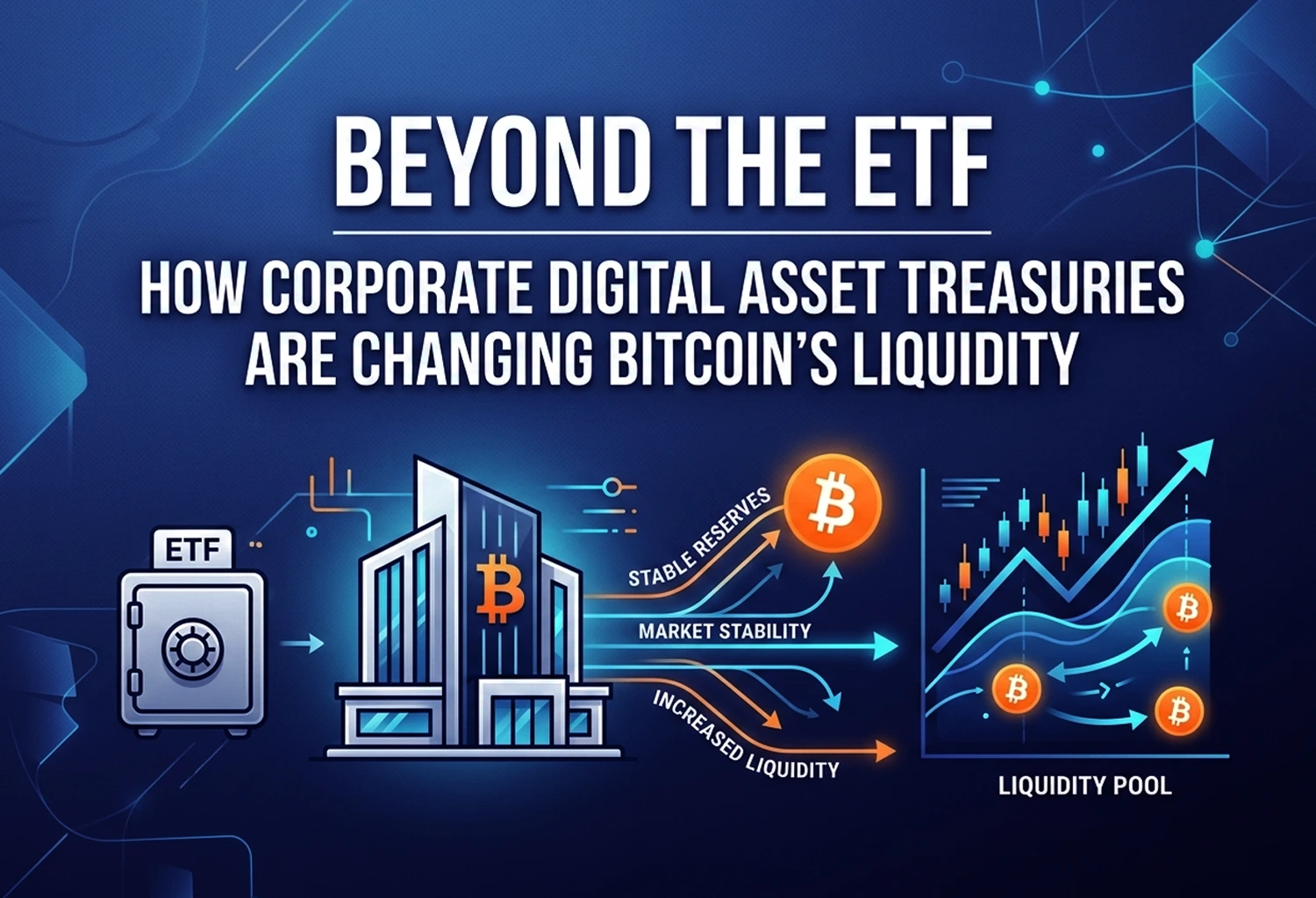
In 2024, the “Spot ETF” was the undisputed king of the Bitcoin narrative. It provided the regulated pipes for trillions in institutional capital to flow into the world’s premier digital asset. But as we move through 2026, a new titan has emerged that is arguably more influential for Bitcoin’s long-term market structure: Corporate Digital Asset Treasuries (DATs).
While ETFs represent passive institutional demand, DATs represent active corporate conviction. From the aggressive accumulation strategies of MicroStrategy to the emerging “Sovereign Miner” model in nations like Bhutan, the shift from cash to “Digital Gold” on the balance sheet is fundamentally rewriting the rules of liquidity.
A Digital Asset Treasury refers to a corporate strategy where a company holds Bitcoin (and increasingly Ethereum or Solana) as a primary reserve asset instead of traditional fiat currency or short-term government bonds.
Unlike an ETF, where an investor owns a share of a fund that holds Bitcoin, a DAT involves the company owning the underlying asset directly. This allows corporations to:
Hedge against fiat debasement: Protecting purchasing power in an era of rising public debt.
Leverage capital markets: Issuing convertible notes or “Digital Credit” to fund further Bitcoin acquisition.
Signal Innovation: Attracting a specific class of “HODL” investors who seek leveraged exposure to Bitcoin through equity.
The scale of corporate adoption has reached a tipping point. As of early 2026, public companies collectively hold approximately 1.13 million BTC—roughly 5.4% of the total supply.
MicroStrategy (Strategy): Led by Michael Saylor, the company remains the apex predator of the DAT space. By early 2026, its holdings have surpassed 700,000 BTC, with analysts predicting a move toward 1 million BTC.
Metaplanet: Often called “The MicroStrategy of Asia,” this firm has pioneered the DAT model in Japan, targeting a multi-year accumulation goal to hedge against Yen volatility.
BitMine: While Bitcoin is the focus for most, BitMine has emerged as a leader in Ether treasuries, recently amassing over 3.4% of the total ETH supply.
The most significant impact of the DAT trend isn’t just the price increase; it’s the structural change in liquidity.
ETFs are often used by tactical traders who enter and exit positions based on macro trends. In contrast, DAT companies typically operate with a “Forever HODL” mentality. When a corporation moves Bitcoin into its treasury, that supply is effectively removed from the active trading market for years, creating a supply crunch that amplifies price sensitivity to new demand.
2026 has seen the birth of a new $7 billion+ asset class: Bitcoin-backed preferred securities. Companies are no longer just buying BTC; they are securitizing it. By issuing high-dividend “Digital Credit” instruments (like STRK or STRC), companies provide investors with an income-generating way to bet on Bitcoin’s growth without the volatility of common stock.
Research indicates that as Bitcoin becomes a “Mature” asset on corporate balance sheets, its 1-year rolling volatility has begun to trend downward. In early 2026, Bitcoin’s volatility (approx. 36%) was actually lower than high-growth tech stocks like Nvidia. This “stabilization effect” is a direct result of long-term corporate holders acting as a ballast against speculative swings.
The DAT model is not without its perils. The “Brutal Pruning” predicted for 2026 highlights the risks of leverage:
Margin Calls on the Balance Sheet: Companies that used heavy debt to fund BTC purchases at the top of the market face extreme pressure during drawdowns.
Treasury Consolidation: Smaller firms with weak cash flows are being acquired by “well-capitalized titans,” leading to a concentration of Bitcoin supply in fewer corporate hands.
If 2024 was about the “Inflow,” 2026 is about the “Infrastructure.” Corporate Digital Asset Treasuries have moved beyond the experimental phase and are now a cornerstone of modern corporate finance. By treating Bitcoin as a strategic reserve, companies are not just seeking profit—they are providing the “hard money” foundation that ensures Bitcoin’s liquidity remains robust, even as its available supply becomes increasingly scarce.
A Corporate Digital Asset Treasury (DAT) is a financial strategy where a company holds cryptocurrencies, primarily Bitcoin, as a core reserve asset on its balance sheet. Unlike traditional treasuries that hold cash or government bonds, a DAT uses digital assets to hedge against fiat currency inflation and diversify corporate wealth.
DATs reduce the active circulating supply of Bitcoin by moving coins into long-term “cold storage.” This creates an “illiquid supply” effect; as corporations “HODL” their reserves for years, the available supply on exchanges decreases, which can lead to higher price volatility during periods of high demand.
A Bitcoin ETF (Exchange-Traded Fund) is a regulated investment vehicle that allows investors to gain price exposure to Bitcoin without owning it directly. A Corporate DAT is a direct ownership model where a company buys and secures the actual Bitcoin (the underlying asset) on its own balance sheet, often using it as collateral for corporate financing.
In 2026, companies are pivoting to Bitcoin treasuries to protect against “fiat debasement”—the loss of purchasing power in traditional currencies. Bitcoin’s programmed scarcity (the 21 million cap) makes it an attractive “hard money” alternative to cash, which can be devalued by central bank policies and rising national debts.
The main risks include price volatility, which can impact a company’s reported earnings, and liquidity risk if a company is forced to sell its Bitcoin during a market downturn to cover debt. Additionally, companies using high leverage (debt) to buy Bitcoin face the risk of margin calls if the asset’s price drops significantly.


 English
  Arabic