
Real Asset Tokenization (RWA)
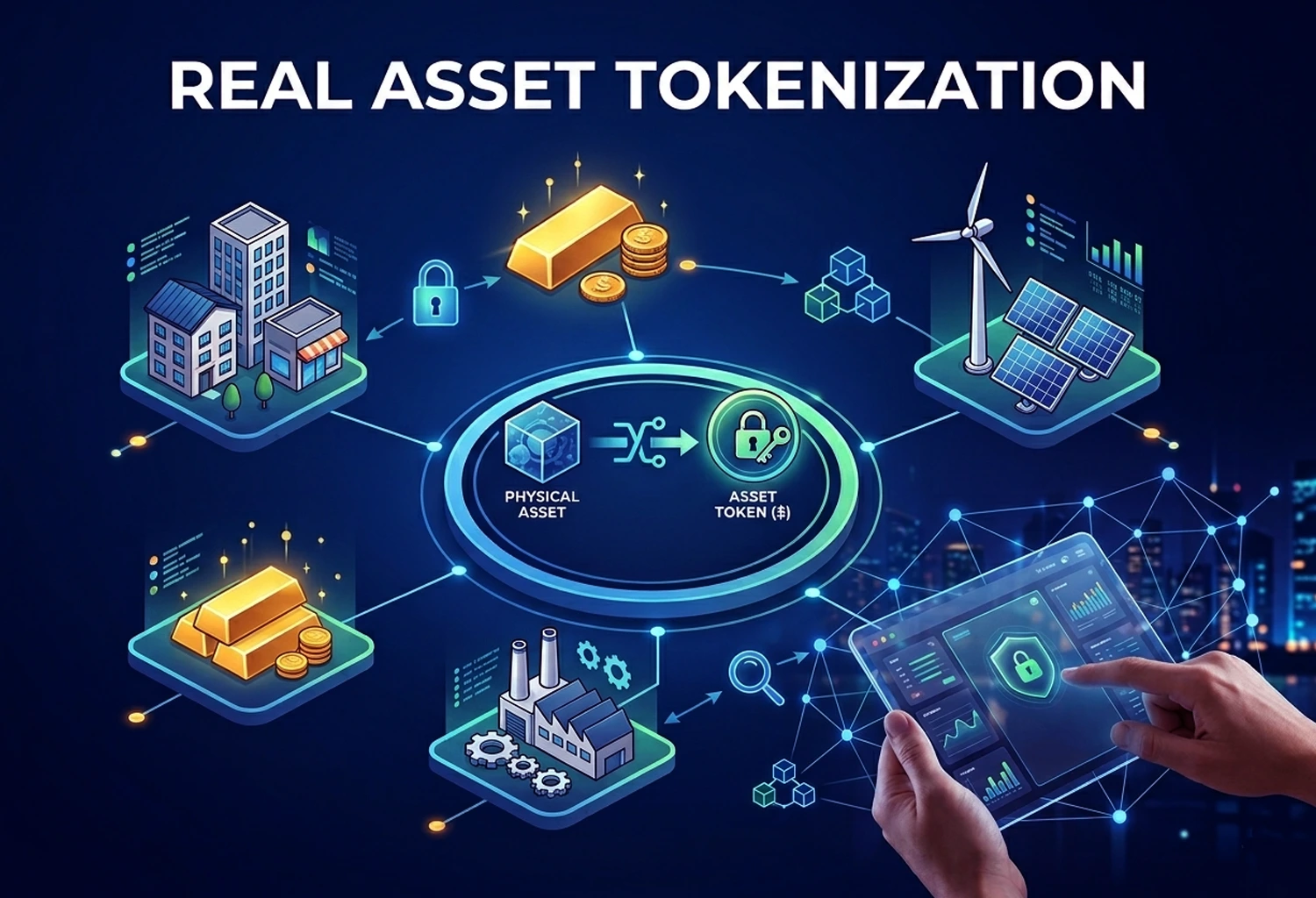
What Is Real Asset Tokenization?
Real Asset Tokenization, often called RWA tokenization, is the process of representing real-world assets as blockchain-based tokens. These assets can include government bonds, private credit, real estate, commodities, funds, invoices, carbon credits, or other traditional financial and physical assets. But the real story is bigger than creating tokens. RWA tokenization is about building a new market layer where real-world value can move with blockchain speed, transparency, programmability, and global accessibility. In simple words, RWA tokenization connects traditional finance with crypto infrastructure. It allows assets that normally live in banks, brokers, legal contracts, custodians, and private databases to be represented, transferred, settled, and managed on-chain. The promise is powerful. But tokenization does not magically make every asset liquid, safe, or legally simple. The token is only useful if the asset, legal rights, custody, compliance, and market demand are real.
Why RWA Is Becoming a Bigger Crypto Trend
For years, crypto markets were mostly about native digital assets: Bitcoin, Ethereum, stablecoins, DeFi tokens, NFTs, and exchange tokens. These assets were born on-chain. RWA is different. It brings off-chain value into blockchain markets. This matters because the world’s largest markets are not crypto-native. Bonds, real estate, commodities, credit, equities, funds, and money markets are much larger than the crypto market. If even a small part of these assets moves on-chain, the impact could be significant. That is why RWA is becoming one of the most important bridges between traditional finance and Web3. The trend is also changing. Earlier RWA discussions focused mainly on “Can real estate be tokenized?” or “Can gold be represented on-chain?” Today, the conversation is more serious. Institutions are looking at tokenized Treasuries, tokenized funds, collateral mobility, faster settlement, programmable compliance, and 24/7 asset transfer. RWA is no longer just a crypto experiment. It is becoming financial infrastructure.
From Tokenization to Market Infrastructure
The first wave of tokenization focused on representation. Could a real asset be turned into a token? Could a property, bond, or commodity be represented digitally? The next wave is about market infrastructure. A tokenized asset needs more than a token contract. It needs:
- Legal ownership structure
- Asset custody
- Reserve verification
- Investor eligibility checks
- Transfer restrictions
- Pricing data
- Redemption rules
- Secondary-market liquidity
- Compliance reporting
- Exchange or marketplace access
- Wallet and custody support
This is why RWA tokenization is more complex than launching a normal crypto token. A meme coin can exist with code and community. A tokenized bond cannot. It needs legal enforceability, issuer credibility, custody, regulation, and reliable settlement. That is why the best RWA projects will likely look less like crypto launches and more like financial products built on blockchain rails.
What Types of Assets Are Being Tokenized?
RWA can include many asset classes, but some categories are gaining more traction than others.
1. Tokenized Treasuries
Tokenized government bond products are one of the strongest RWA categories because they connect blockchain users with traditional yield. They are especially attractive to institutions, stablecoin issuers, DeFi protocols, and treasury managers.
2. Private Credit
Private credit tokenization allows loans and credit products to be represented on-chain. This can connect capital providers with real-world borrowers, but it also introduces credit risk and due diligence requirements.
3. Real Estate
Real estate is one of the most discussed RWA categories because it is valuable and often illiquid. Tokenization can support fractional exposure, but legal ownership and local property law remain major challenges.
4. Commodities
Gold and other commodities can be tokenized through products backed by reserves held by custodians. The key question is whether the token holder has clear redemption or claim rights.
5. Funds and Index Products
Tokenized funds can bring traditional portfolio products on-chain. This may become important as crypto platforms move toward super-app models and institutional asset management.
6. Equities and Tokenized Stocks
Tokenized stocks and equity-like products are growing, but users must understand whether they own real shares, a claim through a custodian, or only synthetic price exposure.
Why RWA Matters for Crypto Exchanges
RWA could change what crypto exchanges offer. Today, many exchanges mainly list crypto-native assets. Users trade Bitcoin, Ethereum, stablecoins, altcoins, futures, and sometimes DeFi tokens. But if RWA grows, exchanges could become gateways to tokenized financial markets. A future crypto exchange may offer:
- Tokenized Treasury products
- Tokenized gold
- Tokenized stocks
- Tokenized real estate funds
- Private credit markets
- On-chain bond products
- RWA collateral for lending
- Stablecoin settlement
- Index baskets of tokenized assets
This would move exchanges closer to full digital finance platforms. For users, that means one account or wallet could access both crypto-native assets and real-world financial products. For exchange operators, it creates new product lines, but also new regulatory and compliance responsibilities. RWA is not just another token category. It may become a new business model for exchanges.
The Liquidity Question: Tokenized Does Not Mean Liquid
One of the biggest misunderstandings about RWA is the idea that tokenization automatically creates liquidity. It does not. Tokenization can make an asset easier to transfer, divide, and record. But liquidity only exists when there are real buyers and sellers. A tokenized real estate asset may still be hard to sell. A tokenized private credit product may still be risky and illiquid. A tokenized fund may have redemption windows, transfer restrictions, or limited market depth. This distinction is critical: Tokenization creates digital representation. Liquidity requires market demand. A token can exist on-chain and still have low trading activity, concentrated holders, and limited exits. That is why users should look beyond TVL or market size. They should ask whether the asset actually trades, who holds it, how redemption works, and whether there is a real secondary market. The future of RWA will depend not only on issuance, but on liquidity quality.
Legal Rights Matter More Than the Token
With RWA, the most important question is not only “What blockchain is this on?” The better question is: What legal rights does this token give me? A token may represent direct ownership, a fund share, a debt claim, a revenue right, a redemption claim, or synthetic exposure. These are very different things. For example, two tokenized gold products may look similar in a wallet, but one may offer redemption for physical gold while another may only track price exposure. Two tokenized real estate products may both show property exposure, but one may represent shares in a legal entity while another may represent only a contractual claim. The blockchain shows token movement. It does not automatically enforce off-chain ownership. This is why RWA tokenization depends on legal wrappers, custodians, trustees, auditors, and jurisdiction-specific rules. In RWA, law and code must work together.
Compliance Is Not Optional
Crypto-native tokens can sometimes launch globally with limited structure. RWA products cannot usually operate that way. Many RWAs may be securities, fund interests, debt instruments, commodities, or regulated financial products. This means issuers may need KYC, investor eligibility checks, transfer restrictions, disclosures, audits, and regulatory approvals. This may seem less “open” than traditional crypto, but it is necessary for real-world finance. Institutions will not move serious assets on-chain unless compliance is built into the system. Banks, asset managers, exchanges, and enterprises need rules they can explain to regulators, auditors, and clients. That is why programmable compliance is one of the most important RWA features. Smart contracts can help enforce who can hold, transfer, redeem, or trade certain assets. The future of RWA may be permissioned at the asset level but blockchain-based at the settlement layer.
RWA and DeFi: A Powerful but Risky Combination
RWA can make DeFi more connected to the real economy. Instead of DeFi yield coming only from token emissions, leverage, or crypto trading activity, RWA can bring external yield from bonds, credit, commodities, and money-market products. This could make DeFi more sustainable. For example, tokenized Treasury assets may be used as collateral, stablecoin reserves, or yield-bearing instruments. Tokenized credit could connect DeFi capital with real-world borrowers. Tokenized funds could create more diversified on-chain portfolios. But RWA also adds new risks to DeFi. DeFi users must understand not only smart contract risk, but also issuer risk, custody risk, legal risk, credit risk, and redemption risk. A protocol may be decentralized, but the asset behind an RWA token may depend on a centralized custodian or issuer. That is not necessarily bad, but it must be transparent. RWA can strengthen DeFi, but only if risk is clearly understood.
Benefits of Real Asset Tokenization
RWA tokenization can create several important benefits.
1. Faster Settlement
Blockchain settlement can reduce delays in asset transfers, especially compared with traditional systems that rely on multiple intermediaries.
2. Fractional Access
Tokenization can divide expensive assets into smaller units, making some markets more accessible.
3. Better Transparency
On-chain records can show token supply, transfers, and certain asset flows more clearly than private databases.
4. Programmability
Smart contracts can automate compliance, transfers, distributions, reporting, and collateral rules.
5. 24/7 Market Access
Tokenized assets can potentially move outside traditional banking hours, depending on the product and regulation.
6. New Collateral Markets
RWAs can be used in lending, stablecoin reserves, DeFi, structured products, and institutional trading.
Risks of RWA Tokenization
RWA tokenization also carries important risks. The first risk is legal uncertainty. Token holders may not fully understand their rights. The second risk is issuer risk. If the issuer fails, token holders may be affected. The third risk is custody risk. The real asset must be held and verified properly. The fourth risk is liquidity risk. Tokenized assets may still be difficult to sell. The fifth risk is valuation risk. The underlying asset may be hard to price accurately. The sixth risk is regulatory risk. Rules differ across countries and may change over time. The seventh risk is smart contract risk. Bugs or poor design can affect token transfers, redemptions, or collateral use. The eighth risk is documentation risk. If users cannot clearly understand redemption, voting rights, fees, legal jurisdiction, or dispute processes, the product is not mature enough. A serious RWA product should explain these risks clearly.
What Makes a Good RWA Product?
A strong RWA product should be transparent, liquid enough for its purpose, legally clear, and operationally reliable. Users should be able to answer:
- What asset backs the token?
- Who is the issuer?
- Who holds the asset?
- What rights does the token provide?
- Can the token be redeemed?
- Is there a secondary market?
- How is the asset priced?
- Are reserves or holdings verified?
- What fees apply?
- What jurisdiction governs the product?
- What happens if the issuer fails?
- Is the smart contract audited?
If these answers are unclear, the token may be risky no matter how attractive the idea sounds.
Why RWA Could Define the Next Phase of Crypto
The first phase of crypto was about digital money. The second phase was about DeFi, NFTs, and Web3 applications. The next phase may be about connecting blockchain infrastructure to real financial assets. RWA is important because it gives crypto a larger role in global finance. It allows blockchain to support not only speculation, but settlement, collateral, fund distribution, treasury management, and market access. This is why institutions care about RWA. It is not only about buying tokens. It is about upgrading financial infrastructure. If RWA succeeds, crypto exchanges, wallets, DeFi protocols, custodians, and fintech platforms may become part of a larger on-chain capital market. But success will depend on trust. The winners will not be the projects with the best marketing. They will be the ones with strong legal design, reliable custody, real liquidity, transparent risk, and useful market access.
Final Thoughts
Real Asset Tokenization is one of the most important bridges between crypto and traditional finance. But the future of RWA is not just about turning everything into tokens. It is about building better markets. A useful RWA product must connect the token, the asset, the law, the custodian, the exchange, and the user into one reliable system. That is why RWA is both exciting and difficult. It promises faster settlement, broader access, programmable finance, and new liquidity. But it also brings legal, regulatory, custody, and market-quality challenges. For beginners, the key lesson is simple: do not ask only what the token is called. Ask what it represents, who stands behind it, and how you can exit. For crypto platforms, the lesson is bigger: RWA may be the market layer that brings the next wave of institutions on-chain. The future of finance may not be fully traditional or fully crypto-native. It may be tokenized.
Frequently asked questions
What does RWA mean in crypto?
RWA means Real-World Assets. It refers to traditional financial or physical assets represented on blockchain networks.
What is Real Asset Tokenization?
Real Asset Tokenization is the process of creating blockchain-based tokens that represent rights, claims, or exposure connected to real-world assets.
What assets can be tokenized?
Assets such as Treasuries, bonds, real estate, gold, commodities, private credit, funds, invoices, stocks, and carbon credits can potentially be tokenized.
Does an RWA token mean I own the real asset?
Not always. It depends on the legal structure. The token may represent ownership, a claim, fund shares, debt rights, redemption rights, or synthetic exposure.
Why do exchanges care about RWA?
Exchanges care about RWA because tokenized assets can expand their product offering beyond crypto-native tokens into Treasuries, commodities, stocks, credit, and other financial markets.
Latest Post
 06 Sep, 2026
How to Build a Crypto Options Trading Platform
 05 Sep, 2026
How to Launch a Crypto Prop Trading Platform
 03 Sep, 2026
How to Scale a Crypto Exchange for High Trading Volume
 02 Sep, 2026
How to Design a Crypto Exchange Fee Structure
 01 Sep, 2026
Market Makers vs Liquidity Providers: What Is the Difference?
Build with Javizen.
Planning an exchange, token or blockchain product? Talk to our team and turn the ideas in this article into a launch-ready platform.