
Solana From DeFi to Institutional Tools
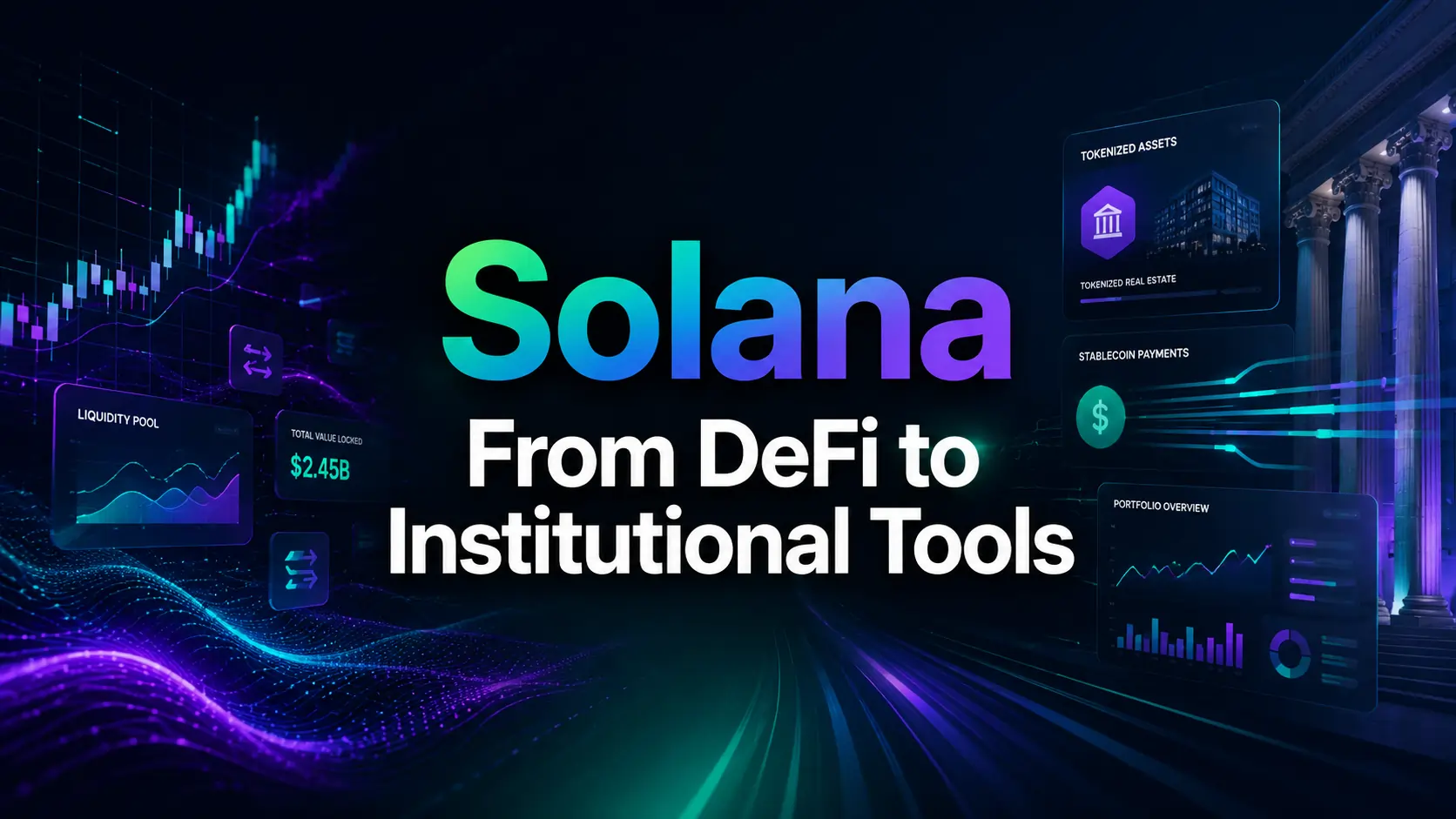
How Is Solana Moving From DeFi to Institutional Tools?
Solana is moving from a DeFi-focused blockchain into a broader financial infrastructure layer for institutions. It is no longer only known for fast swaps, meme coins, NFTs, and retail trading. Solana is now being used for stablecoins, tokenized assets, payments, institutional trading tools, staking products, and high-performance on-chain finance. In simple words, Solana is trying to become a blockchain for real financial activity, not just crypto-native speculation. This shift matters because institutions need speed, low transaction costs, liquidity, compliance options, reliable infrastructure, and strong developer tools. Solana’s value proposition is that it can support high-volume financial applications at lower cost than many older blockchain networks. The big question is whether Solana can turn its technical speed into long-term institutional trust.
Why Solana Became Popular in DeFi First
Solana first became popular because it was fast and cheap. DeFi users need quick transactions. Traders want low fees. NFT users want smooth minting. Developers want applications that do not feel slow or expensive. Solana attracted attention because it could support high activity without making every transaction costly. This made it useful for:
- Decentralized exchanges
- NFT marketplaces
- Meme coin trading
- Lending protocols
- Yield products
- Wallet apps
- Perpetual futures
- Consumer crypto apps
Solana became known as a chain where users could trade often, move quickly, and experiment without paying high gas fees. But that early identity also created a limitation. Many people saw Solana mainly as a retail trading chain. It was often associated with speculation, high-speed DeFi, and meme coin activity. Now the narrative is changing.
The Shift: From Retail Activity to Financial Infrastructure
The next phase of Solana is not only about more DeFi apps. It is about becoming useful to financial institutions. Institutions do not only care about speed. They care about settlement, compliance, custody, reporting, liquidity, risk control, and market infrastructure. That means Solana must prove it can support serious financial use cases such as:
- Stablecoin settlement
- Tokenized Treasuries
- Tokenized equities
- RWA markets
- Institutional custody
- Payment rails
- Staking products
- On-chain trading infrastructure
- Treasury operations
- Data and compliance tools
This is a major shift. A DeFi user may ask, “Can I swap this token quickly?” An institution asks, “Can this network support regulated financial workflows at scale?” That is a much harder question.
Solana and Stablecoins: The Payment Rail Narrative
Stablecoins are one of the strongest institutional use cases for blockchains. They allow digital dollars and other fiat-backed assets to move 24/7, often with faster settlement and lower friction than traditional systems. For companies dealing with cross-border payments, treasury management, merchant settlement, and crypto trading, stablecoins are becoming increasingly important. Solana fits this trend because it offers low-cost and high-speed transactions. This makes it attractive for payment flows where users may need to send small or frequent transfers. For institutions, stablecoins on Solana could support:
- Cross-border settlement
- Merchant payouts
- Exchange settlement
- Treasury movement
- Payroll in digital dollars
- Remittance flows
- On-chain collateral
- Machine-to-machine payments
This does not mean Solana will replace card networks or banks immediately. Traditional finance still has compliance, consumer protection, dispute resolution, and regulatory advantages. But Solana can become part of the new payment infrastructure underneath digital finance.
Tokenized Assets on Solana
Real-world asset tokenization is one of the biggest reasons institutions are watching blockchain again. Tokenized assets can include Treasuries, stocks, funds, credit products, commodities, and other financial instruments represented on-chain. Solana’s speed and low transaction costs make it suitable for tokenized markets where transfers, settlement, and rebalancing may happen frequently. This matters because tokenization is not only about creating a token. It is about creating a better market structure. A tokenized asset needs:
- Clear legal rights
- Reliable custody
- Transfer rules
- Investor eligibility controls
- Pricing data
- Redemption systems
- Compliance monitoring
- Secondary market liquidity
- Wallet and exchange support
If Solana can support these requirements, it can become more than a DeFi chain. It can become a venue for on-chain capital markets. That is why the phrase “institutional tools” matters. Institutions do not just need assets. They need systems.
Solana ETFs and Staking Products
Another reason Solana is gaining institutional attention is the growth of investment products linked to SOL. Crypto ETFs and staking products allow investors to gain exposure without managing wallets directly. For institutions, this matters because many funds cannot or do not want to hold crypto assets directly on-chain. A Solana ETF or staking product can make SOL easier to access through traditional investment accounts. This can bring Solana into the same conversation as Bitcoin and Ethereum for portfolio allocation. The ETF narrative also changes how investors view Solana. Instead of seeing SOL only as a trading token, institutions may evaluate it as:
- A network asset
- A staking asset
- A technology infrastructure play
- A digital asset portfolio component
- A proxy for high-performance on-chain finance
This does not remove risk. SOL remains volatile, and investment products have fees, structure, and market risks. But ETFs and staking products can make Solana more visible to traditional investors.
Why Institutions Care About Speed and Cost
In traditional finance, settlement can be slow and expensive. Payments may pass through several intermediaries. Cross-border transactions can take days. Reconciliation can be messy. Market infrastructure is often fragmented. Blockchains offer a different model: shared settlement, transparent records, programmable assets, and 24/7 availability. Solana’s main argument is that financial applications need high performance. If a blockchain is too slow or too expensive, it cannot support mainstream finance at scale. A chain used for payments, trading, tokenized assets, and real-time settlement needs to process activity efficiently. This is where Solana’s low-cost, high-throughput design becomes important. For institutions, performance is not just a technical detail. It affects user experience, liquidity, operations, and profitability.
Solana DeFi Is Becoming More Professional
Solana’s DeFi ecosystem is also maturing. Earlier DeFi growth often depended on incentives, speculation, and retail trading. Today, the focus is shifting toward more serious financial products. Solana now supports or attracts activity around:
- Perpetual futures
- Liquid staking
- Stablecoin liquidity
- RWA protocols
- Lending markets
- Institutional dashboards
- Portfolio tools
- Tokenized equity trading
- On-chain order flow
- Payment applications
This does not mean speculation has disappeared. It has not. Solana still has meme coins, high-risk trading, and retail-driven volatility. But the ecosystem is becoming more layered. Retail activity, DeFi liquidity, stablecoins, tokenization, and institutional tools are starting to exist together. That mix could become a major advantage if managed well.
The Compliance Challenge
Institutional adoption cannot happen without compliance. Many crypto users value open access and permissionless systems. Institutions operate differently. They need KYC, AML controls, reporting, audit trails, custody standards, legal clarity, and risk management. This creates a challenge for Solana and other blockchains. How can a public blockchain support open innovation while also serving regulated finance? The answer may be application-level compliance. The base chain can remain open, while specific assets, platforms, wallets, and protocols enforce rules for regulated products. For example, a tokenized fund on Solana may limit transfers to approved wallets. A stablecoin issuer may monitor compliance. A trading platform may require user verification. A custodian may provide institutional controls. This is likely how institutional tools will grow: not by making the entire blockchain permissioned, but by adding compliance where financial products require it.
Risks Solana Must Overcome
Solana’s institutional future is promising, but not guaranteed. The main risks include:
1. Network Reliability
Institutions need confidence that infrastructure will remain stable during high activity.
2. Regulatory Risk
Tokenized assets, stablecoins, staking products, and DeFi tools may face changing rules.
3. Concentration Risk
If key infrastructure depends on a small number of providers, institutions may be cautious.
4. Security Risk
Smart contracts, wallets, bridges, and DeFi protocols can be attacked or exploited.
5. Reputation Risk
Solana must balance serious institutional use cases with meme coin speculation and risky retail markets.
6. Liquidity Risk
Tokenized assets and DeFi markets need real liquidity, not just headline TVL.
7. Competition
Ethereum, Layer 2s, Avalanche, Polygon, Aptos, Sui, and other networks also want institutional adoption.
Solana’s success will depend on execution, not just speed.
What This Means for Exchanges
Solana’s evolution matters for crypto exchanges. If Solana becomes a major institutional infrastructure layer, exchanges may need to support more than basic SOL trading. They may need to support Solana-based stablecoins, tokenized assets, staking products, RWA markets, and on-chain settlement. Future exchange products could include:
- SOL staking access
- Solana stablecoin deposits and withdrawals
- Tokenized asset trading
- Solana RWA marketplaces
- Perp markets based on Solana assets
- Solana ecosystem index products
- Wallet-native trading tools
- Institutional custody and reporting
This creates an opportunity for platforms that want to serve both retail and professional users. For an exchange, Solana is not only a listing. It can become a financial ecosystem.
What This Means for Investors
For investors, Solana’s institutional shift changes the research framework. Instead of asking only “Will SOL price go up?” investors should ask:
Is stablecoin activity growing? Are tokenized assets gaining traction? Are developers building useful financial tools? Are institutions using Solana infrastructure? Is liquidity deepening? Are ETF and staking products attracting capital? Is the network reliable under pressure? Are compliance solutions improving?
These questions help investors evaluate Solana as infrastructure, not just as a token. The strongest blockchain investments often depend on real usage. If Solana becomes a key venue for payments, trading, and tokenized assets, the network’s long-term value proposition may become stronger.
Is Solana Becoming an Institutional Blockchain?
Solana is not fully institutional yet, but it is clearly moving in that direction. Its DeFi roots gave it liquidity, users, wallets, and developer energy. Now the network is trying to build financial tools that can attract banks, asset managers, payment companies, fintech platforms, and professional traders. This is the natural evolution of a high-performance blockchain. First, it proves users can trade and transact cheaply. Then, it proves applications can scale. Finally, it tries to prove institutions can trust it. That final step is the hardest. But if Solana succeeds, it could become one of the most important networks in on-chain finance.
Final Thoughts
Solana’s story is changing. It started as a fast blockchain for DeFi, NFTs, retail traders, and consumer crypto apps. Today, it is increasingly being positioned as infrastructure for institutional finance. Stablecoins, tokenized assets, payments, staking products, DeFi markets, and on-chain trading tools are pushing Solana into a new category. This does not mean the risks are gone. Solana still faces competition, regulation, reliability concerns, and market volatility. But the direction is clear: Solana is trying to become more than a crypto trading chain. It wants to become a financial operating system for the internet capital market. If it succeeds, the next phase of Solana will not be defined only by DeFi. It will be defined by the institutions, assets, and financial tools that move on-chain.
Frequently asked questions
Why is Solana important for institutional crypto?
Solana is important because it offers fast, low-cost blockchain infrastructure that can support payments, stablecoins, tokenized assets, trading, and on-chain financial applications.
Is Solana only a DeFi blockchain?
No. Solana is still active in DeFi, but it is also expanding into stablecoins, RWAs, payments, ETFs, staking products, and institutional tools.
What are Solana institutional tools?
Solana institutional tools can include custody, staking, stablecoin settlement, tokenized assets, compliance systems, trading infrastructure, and portfolio products.
Why are stablecoins important for Solana?
Stablecoins can turn Solana into a payment and settlement network for exchanges, fintech companies, merchants, and treasury teams.
Can tokenized assets grow on Solana?
Yes. Solana’s speed and low fees make it suitable for tokenized assets, but success depends on legal clarity, custody, compliance, and liquidity.
Are Solana ETFs good for institutional adoption?
Solana ETFs and staking products can make SOL easier for traditional investors to access, but they do not remove market risk.
What risks does Solana face?
Solana faces network reliability risk, regulatory uncertainty, security risk, competition, liquidity risk, and reputation challenges.
Could Solana compete with Ethereum for institutions?
Solana can compete in high-speed and low-cost use cases, while Ethereum remains strong in liquidity, security, and institutional familiarity. Both may serve different parts of on-chain finance.
Latest Post
 06 Sep, 2026
How to Build a Crypto Options Trading Platform
 05 Sep, 2026
How to Launch a Crypto Prop Trading Platform
 03 Sep, 2026
How to Scale a Crypto Exchange for High Trading Volume
 02 Sep, 2026
How to Design a Crypto Exchange Fee Structure
 01 Sep, 2026
Market Makers vs Liquidity Providers: What Is the Difference?
Build with Javizen.
Planning an exchange, token or blockchain product? Talk to our team and turn the ideas in this article into a launch-ready platform.