
Best Features for a Crypto Exchange Platform
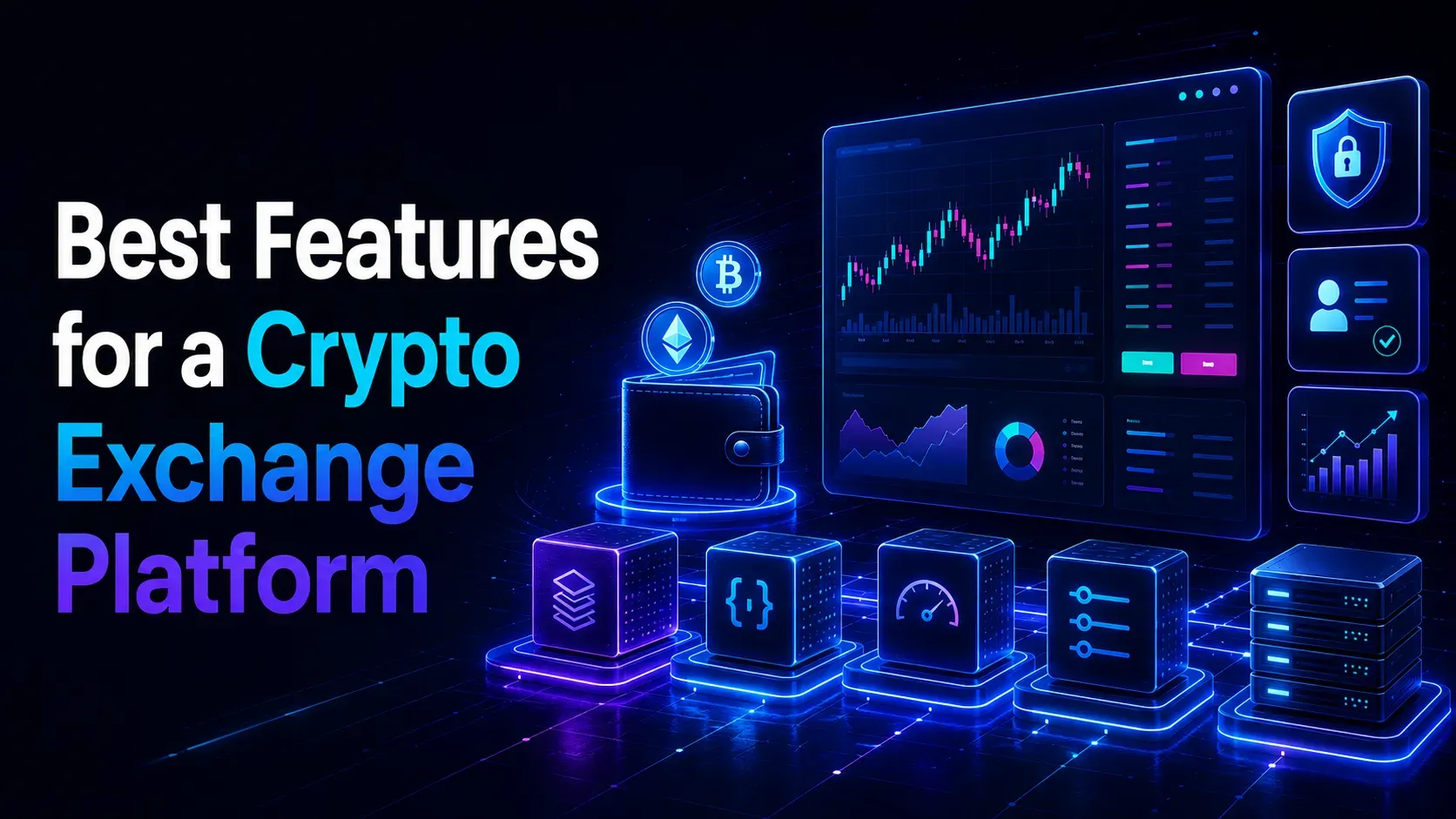
What Features Should a Crypto Exchange Have?
The best crypto exchange platforms usually provide:
1.High-performance matching engine 2.Secure hot and cold wallets 3.KYC, KYB, AML, and transaction monitoring 4.Multi-layer account and API security 5.Liquidity and market-making connections 6.Advanced trading tools and order types 7.Crypto and fiat deposit and withdrawal rails 8.Administrative, reporting, and risk controls 9.Scalable APIs and modular architecture 10.Optional P2P, futures, options, staking, and prop-trading products These capabilities must operate as one connected financial system. A long feature list has little value if balances, custody, compliance, or execution are unreliable.
1. High-Performance Matching Engine
The matching engine is the core of a centralized crypto exchange. It receives orders, applies the platform’s matching rules, executes compatible trades, and updates the order book. A strong matching engine should provide low-latency processing, deterministic execution, protection against duplicate trades, and stable performance during sudden volume spikes. It should support important order types such as market, limit, stop-limit, post-only, fill-or-kill, and immediate-or-cancel orders. Platforms offering futures or other derivatives may also require reduce-only orders, position-closing controls, liquidation logic, funding calculations, and margin checks. Performance alone is not enough. The matching engine must integrate correctly with account balances, trading fees, risk controls, market data, and trade history. Every execution should produce an auditable record, while failed or repeated requests must not create duplicate orders or inconsistent balances.
2. Secure Wallet and Custody Infrastructure
A custodial exchange controls user deposits and withdrawals, making wallet security one of the most important crypto exchange platform features. The platform should separate operational hot wallets from cold storage. Only the funds required for normal withdrawal activity should remain in internet-connected wallets, while the majority of customer assets can be held in more restricted storage environments.
A production-ready wallet system should handle:
- Address generation
- Blockchain transaction monitoring
- Network confirmation requirements
- Deposit reconciliation
- Withdrawal queues
- Transaction fee management
- Multi-network assets
- Memo or tag-based deposits
- Failed transaction recovery
Operators also need configurable withdrawal limits, address allowlisting, manual review for high-risk transactions, multi-step approval workflows, and real-time wallet alerts. The exchange’s internal ledger should remain logically separate from its blockchain balances. This allows the operator to reconcile customer liabilities, wallet balances, pending withdrawals, and network transactions independently.
3. KYC, KYB, AML, and Travel Rule Readiness
Compliance should be part of the exchange architecture from the beginning rather than being added as a simple verification form after launch. Depending on its jurisdiction and business model, a crypto exchange may need identity verification for individuals, business verification for corporate customers, sanctions screening, politically exposed person screening, transaction monitoring, customer risk scoring, and suspicious-activity review. FATF guidance expects virtual asset service providers to use risk-based anti-money laundering and counter-terrorist financing controls. Its Travel Rule framework also requires covered providers to obtain, retain, and securely transmit specified information about transaction originators and beneficiaries. Because requirements differ between jurisdictions, the compliance module should be configurable. Operators may need different verification levels, document requirements, account limits, manual review steps, and data-retention rules. Using replaceable API integrations also allows an exchange to change identity-verification, blockchain-analysis, or sanctions-screening providers without rebuilding the entire platform.
4. Multi-Layer Security
Crypto exchange security must protect customers, employees, infrastructure, wallets, APIs, and external integrations. User-account security should include multi-factor authentication, anti-phishing codes, device and session management, login alerts, withdrawal confirmation, and address allowlisting. Temporary withdrawal restrictions can also be applied after password resets or other sensitive account changes. Administrative security should include role-based access control, least-privilege permissions, approval workflows, audit logs, and restricted access to financial operations. Sensitive data should be encrypted, system secrets should remain outside the application source code, and production environments should be segmented from development and testing systems. API security is equally important. OWASP identifies broken authorization, broken authentication, unrestricted resource consumption, security misconfiguration, and unsafe use of third-party APIs among significant API risks. Crypto exchange APIs should therefore use rate limiting, request signing, idempotency controls, input validation, endpoint inventories, access scopes, and continuous security monitoring.
5. Liquidity and Market-Making Tools
A technically complete exchange may still struggle if its markets have thin order books, wide spreads, and high slippage. The platform should be capable of connecting to external liquidity providers, aggregating prices, managing authorized market-maker accounts, and monitoring order-book depth.
Operators also need controls for:
- Minimum order quantities
- Minimum order values
- Price increments
- Quantity increments
- Price bands
- Market availability
- Abnormal trading activity
Market-making activity should remain auditable and separate from customer trading. Special liquidity accounts should never bypass normal permission, accounting, or risk controls. Strong liquidity improves execution quality and creates a more reliable experience for both retail and professional traders.
6. Professional Trading Experience
The trading interface is where customers directly judge the quality of a crypto exchange. A professional interface should provide a responsive order book, recent trades, interactive charts, available balances, open orders, order history, and transparent fee information. Advanced traders may also expect multiple order types, API trading, subaccounts, chart indicators, saved layouts, and downloadable reports. Mobile responsiveness is especially important because many users monitor markets, cancel orders, and manage positions from their phones. Good user experience also requires clear error messages. Instead of returning a generic failure, the exchange should explain whether an order was rejected because of insufficient balance, minimum-order rules, price-band restrictions, market maintenance, or a compliance limitation.
7. Reliable Deposits, Withdrawals, and Fiat Rails
Users must be able to fund their accounts and withdraw assets reliably. Crypto deposits should support multiple blockchain networks where appropriate, configurable confirmation requirements, network maintenance mode, and clear fee information. Depending on the exchange’s target market and licensing model, fiat functionality may include bank transfers, payment gateways, verified bank accounts, reference-based deposits, and withdrawal approval workflows. Every external transaction should be reconciled against the exchange’s internal ledger. Unmatched, duplicated, delayed, or failed transactions should be automatically flagged for investigation. Administrators also need treasury dashboards, wallet balance alerts, withdrawal exposure limits, failed-transaction recovery tools, and complete transaction histories.
8. Admin, Reporting, and Risk Management
A crypto exchange cannot be managed safely through database access and developer tools. Its admin panel should provide controlled access to user accounts, verification reviews, wallets, markets, fees, orders, transactions, support requests, and platform settings. Risk teams need tools for account restrictions, transaction holds, withdrawal reviews, exposure limits, abnormal-activity alerts, and emergency market controls. Finance teams require fee reports, ledger exports, settlement records, and reconciliation tools. Customer-support agents need access to a complete customer timeline without receiving unnecessary permission to approve withdrawals or change balances. Every sensitive administrative action should record who performed it, what changed, when it happened, and whether another employee approved it.
9. Scalable APIs and Modular Architecture
A crypto exchange platform is rarely finished at launch. Operators usually add new blockchains, payment methods, mobile applications, compliance providers, and trading products over time. A modular architecture allows the platform to expand without rewriting its core systems. Wallet services, KYC providers, notifications, market data, payment methods, and liquidity connections should use defined interfaces. Public and private APIs should also be versioned, documented, and suitable for mobile applications, institutional clients, and algorithmic traders. Javizen uses this modular model so products such as P2P trading, futures, options, prop trading, and token-sale platforms can operate independently or connect to a larger crypto exchange ecosystem.
10. Growth and Revenue Modules
Once the core exchange is stable, operators can introduce additional products to improve retention and create new revenue streams. These may include P2P trading, futures, options, staking, referral programs, loyalty systems, token launchpads, OTC services, copy trading, and prop-trading challenges. However, additional modules should be selected according to customer demand, operational capacity, regulatory scope, and revenue strategy. Every new product introduces additional accounting, liquidity, compliance, customer-support, and risk requirements. Features should therefore be introduced through a planned roadmap rather than added simply to make the platform appear more complete.
A practical development roadmap should prioritize:
1.Ledger accuracy, matching, custody, security, and compliance 2.Deposits, withdrawals, liquidity, and core spot trading 3.Administrative operations, reporting, monitoring, and support 4.APIs, mobile experience, localization, and external integrations 5.P2P, derivatives, staking, launchpads, or prop 6.P2P, derivatives, staking, launchpads, or prop trading
This sequence reduces the risk of building attractive growth features on an unstable financial core.
Final Thoughts
The best crypto exchange platform is not necessarily the one with the longest feature list. It is the platform that combines secure custody, accurate accounting, reliable execution, effective compliance, usable liquidity, and efficient operations. Founders should begin by defining their target jurisdiction, customer segment, custody model, supported assets, and revenue strategy. These decisions determine which features are essential at launch and which can be added later. Javizen provides production-ready and customizable crypto exchange infrastructure based on a modular architecture. Businesses can launch a branded centralized exchange and expand it with P2P, futures, options, prop trading, token-sale, and other blockchain products as their roadmap develops.
Frequently asked questions
What is the most important feature of a crypto exchange?
No single feature works independently. The essential foundation is an accurate ledger supported by secure wallets, a reliable matching engine, and strong security controls. Which features are required for a basic crypto exchange? A basic centralized exchange needs account management, KYC, wallets, deposits and withdrawals, spot markets, a matching engine, liquidity, fee management, an admin panel, reporting, and security monitoring.
Does every crypto exchange need KYC?
Requirements depend on the business model and jurisdiction. Regulated custodial exchanges generally require identity verification, AML controls, sanctions screening, and transaction-monitoring processes.
Why is liquidity important for a crypto exchange?
Liquidity reduces spreads and slippage, improves order execution, and makes markets more useful. Without sufficient liquidity, a technically functional exchange can still provide a poor trading experience.
What security features should a crypto exchange include?
Important controls include multi-factor authentication, cold storage, withdrawal allowlists, encryption, rate limiting, role-based permissions, audit logs, monitoring, approval workflows, and incident-response procedures.
Can a white-label crypto exchange be customized?
Yes. A modular white-label exchange can usually be adapted with custom branding, assets, markets, fees, payment methods, verification providers, languages, and additional trading modules.
What is a modular crypto exchange platform?
A modular crypto exchange separates major services such as wallets, compliance, trading, payments, and notifications. This allows operators to add or replace components without rebuilding the entire platform.
How long should a crypto exchange feature roadmap be?
The roadmap should begin with a secure spot-exchange foundation and introduce additional products in phases. The exact schedule depends on licensing, integrations, liquidity, development resources, and the complexity of the selected modules.
آخر مقال
 06 Sep, 2026
How to Build a Crypto Options Trading Platform
 05 Sep, 2026
How to Launch a Crypto Prop Trading Platform
 03 Sep, 2026
How to Scale a Crypto Exchange for High Trading Volume
 02 Sep, 2026
How to Design a Crypto Exchange Fee Structure
 01 Sep, 2026
Market Makers vs Liquidity Providers: What Is the Difference?
Build with Javizen.
Planning an exchange, token or blockchain product? Talk to our team and turn the ideas in this article into a launch-ready platform.