
How to Scale a Crypto Exchange for High Trading Volume
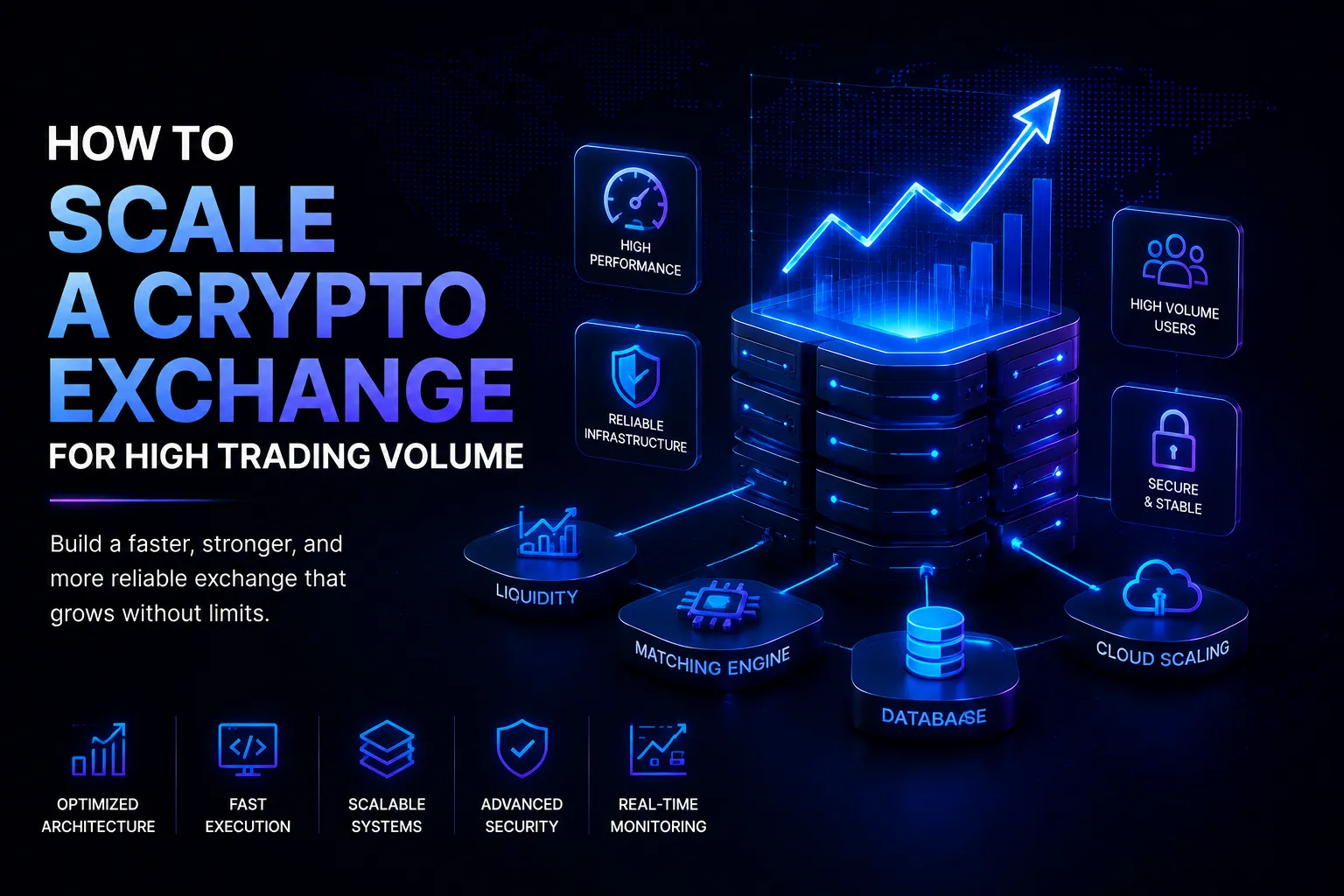
What Does Scaling a Crypto Exchange Mean?
Scaling a crypto exchange means improving the platform’s ability to handle increasing users, trading volume, transactions, and market activity while maintaining performance and reliability. A small exchange may successfully process normal trading activity with a simple infrastructure setup. However, as trading volume increases, the platform faces new challenges.
High-volume exchanges must manage:
- Large numbers of simultaneous orders and trades
- Real-time market data distribution
- Increased wallet and blockchain activity
- Higher API usage from traders and institutions
The goal of scaling is not only supporting more users. It is maintaining fast execution, accurate balances, stable connections, and secure operations during peak demand.
Why Crypto Exchange Scalability Is Challenging
Crypto exchanges are different from many traditional web applications because they operate financial systems where every transaction must be accurate. A social platform can sometimes delay content delivery without major consequences. A trading platform cannot delay order execution, incorrectly update balances, or lose transaction records. Every trade affects multiple systems, including the matching engine, user balances, market data, fees, risk controls, and reporting systems. This means scalability requires optimization across the entire exchange ecosystem, not only the frontend or servers.
1. Build a Modular Exchange Architecture
The foundation of a scalable exchange is a modular architecture. A monolithic system where user accounts, trading, wallets, notifications, payments, and administration are tightly connected becomes difficult to scale as activity increases. A modular exchange separates important services so each component can be optimized independently. For example, the matching engine can scale separately from wallet services, while market data distribution can operate independently from user management.
A typical scalable exchange architecture separates:
- Trading and matching systems
- Wallet and blockchain services
- Internal ledger and accounting
- Market data services
- API gateways
- Risk management systems
- Administrative tools
This approach improves performance and allows businesses to add new products such as futures, P2P trading, staking, or token launch platforms without rebuilding the entire platform. Javizen uses a modular crypto exchange architecture that allows businesses to expand their platforms with additional trading products while maintaining core exchange infrastructure.
2. Optimize the Matching Engine
The matching engine is one of the most important components when scaling a crypto exchange. It processes incoming orders, matches buyers and sellers, and creates executed trades. During periods of high market activity, thousands of orders may arrive within seconds. A poorly optimized matching engine can create delays, failed orders, or inconsistent trading experiences.
A scalable matching engine should support:
- High-speed order processing
- Efficient order-book management
- Low-latency execution
- Reliable trade settlement
The matching engine should also be separated from other systems. Trading execution should not slow down because of unrelated processes such as reporting, notifications, or user-interface requests. Many high-volume exchanges use specialized in-memory processing, optimized data structures, and distributed system designs to maintain execution speed.
3. Design a Scalable Database and Ledger System
The internal ledger is the financial source of truth for an exchange. Every deposit, withdrawal, trade, fee, transfer, and adjustment must be recorded accurately. As trading volume grows, database performance becomes increasingly important.
A scalable exchange should optimize:
- Transaction processing
- Balance calculations
- Trade history storage
- Reporting queries
- Data consistency
The ledger should also support high transaction throughput without creating delays in user balances. Separating operational databases from analytics and reporting systems can improve performance. For example, real-time trading systems should not compete with large historical reporting queries. Database replication, caching strategies, indexing, and optimized data storage can help exchanges maintain performance as activity increases.
4. Scale Market Data Distribution
Market data is one of the highest-volume parts of a crypto exchange. Every price update, order-book change, and executed trade must be delivered to connected users, mobile applications, APIs, and trading systems. A growing exchange can have thousands of users watching markets simultaneously, making efficient data distribution essential. WebSocket infrastructure is commonly used for real-time updates because it allows the exchange to push information instantly instead of requiring users to repeatedly request data.
A scalable market-data system should manage:
- Real-time price updates
- Order-book synchronization
- Trade streams
- User-specific events
Poor market-data architecture can create delayed charts, outdated order books, and inconsistent trading experiences.
5. Improve Liquidity and Market Infrastructure
Technical scalability alone does not create a successful exchange. As trading volume increases, liquidity becomes increasingly important. A high-volume exchange needs deep order books, competitive spreads, and reliable execution across markets. Liquidity management includes connections with liquidity providers, market makers, external exchanges, and institutional trading partners. A scalable liquidity system allows the exchange to support more assets and higher trading activity without creating unstable markets. For example, adding hundreds of trading pairs requires more than creating markets in the database. Each market needs pricing, liquidity, monitoring, risk controls, and operational management.
6. Strengthen API Infrastructure
Professional traders, institutions, and automated systems rely heavily on exchange APIs. As API usage grows, the exchange must handle increasing numbers of requests without affecting core trading performance.
A scalable API infrastructure requires:
- Efficient request handling
- Authentication and permission management
- Rate limiting
- Monitoring
- Reliable documentation
Public APIs provide market information, while private APIs allow users to manage accounts and execute trades. Institutional traders may also require advanced connectivity such as FIX API for professional trading workflows. API performance directly affects user experience because many high-volume traders depend on automated execution.
7. Scale Wallet and Blockchain Operations
Wallet infrastructure becomes more complex as an exchange supports more users and assets. A growing platform must process more deposits, withdrawals, confirmations, and blockchain interactions.
The wallet system should efficiently manage:
- Multiple blockchain networks
- Deposit monitoring
- Withdrawal processing
- Transaction fees
- Blockchain confirmations
Hot wallets, cold storage, withdrawal controls, and reconciliation systems must work together to maintain both security and operational efficiency. Automation is essential. Manual wallet management does not scale when thousands of users are interacting with the platform.
8. Implement Strong Security and Risk Controls
Higher trading volume creates more opportunities for both legitimate users and attackers. A scalable exchange must increase security alongside growth. Security systems should monitor account activity, API usage, withdrawals, authentication attempts, and unusual trading behavior. Risk management is also essential, especially for exchanges offering advanced products such as futures and margin trading. The platform should be able to detect abnormal activity, manage exposure, enforce trading limits, and respond quickly to potential threats. Scaling without improving security can increase the potential impact of incidents.
9. Use Cloud Infrastructure and Performance Monitoring
Infrastructure management becomes increasingly important as exchange activity grows. A scalable exchange environment should support flexible resource allocation, automated deployment, monitoring, and recovery procedures. Cloud infrastructure can help exchanges adjust computing resources based on demand. During periods of high volatility, additional resources can be allocated to critical services.
Monitoring systems should track:
- Server performance
- API response times
- Trading latency
- Database performance
- Blockchain service health
Real-time monitoring allows teams to identify bottlenecks before they affect users.
10. Prepare for Operational Growth
Technical scaling is only one part of exchange growth. A high-volume exchange also requires operational scalability. Customer support, compliance teams, finance operations, security monitoring, and technical teams must grow alongside user activity. For example, increasing trading volume may create more customer requests, more compliance reviews, more withdrawal checks, and more reporting requirements. A successful exchange combines scalable technology with scalable business processes.
White-Label vs Custom Exchange Scalability
Businesses planning for growth often evaluate whether to use a white-label exchange platform or build a completely custom system. A custom exchange provides maximum control but requires significant investment in architecture, engineering, testing, and long-term maintenance. A modular white-label platform provides an existing foundation that can be customized and expanded. For many businesses, the advantage of a scalable white-label solution is that core systems such as trading, wallets, APIs, administration, and security are already designed, allowing the company to focus on liquidity, customers, and market expansion. The right choice depends on the business model, required customization, target users, and growth strategy.
How Javizen Helps Scale Crypto Exchange Infrastructure
Javizen provides modular crypto exchange infrastructure designed for businesses that need scalable trading platforms. The platform includes core exchange components such as spot trading, futures infrastructure, P2P trading, wallets, APIs, liquidity integrations, administration tools, and reporting systems. With a modular approach, businesses can expand their exchange capabilities as trading volume grows without replacing the entire platform. A scalable foundation helps operators focus on market growth while maintaining reliable trading performance, security, and operational control.
Final Thoughts
Scaling a crypto exchange for high trading volume requires planning across the entire technology stack. The matching engine, ledger, databases, APIs, wallets, liquidity systems, security controls, and operational processes must work together to support growth. The exchanges that successfully scale are not simply the ones with more servers. They are platforms designed with modular architecture, efficient infrastructure, strong risk management, and reliable operational systems. For businesses entering the crypto market, scalability should be a core design principle from day one. A well-built exchange infrastructure allows platforms to support more users, more assets, and higher trading activity while maintaining the performance and reliability traders expect.
Frequently asked questions
How can a crypto exchange handle high trading volume?
A crypto exchange can handle high trading volume through optimized matching engines, scalable databases, efficient APIs, strong liquidity systems, and modular architecture.
What is the most important component for exchange scalability?
The matching engine and internal ledger are among the most critical components because they directly affect order execution and financial accuracy.
Does adding more servers automatically scale a crypto exchange?
No. Hardware improvements help, but true scalability requires architectural optimization, database improvements, efficient services, and operational monitoring.
How does liquidity affect exchange scalability?
Liquidity allows exchanges to support more trading activity by improving order-book depth, reducing spreads, and creating better execution conditions.
Can a white-label exchange scale for large trading volumes?
Yes. A properly designed modular white-label exchange can scale by optimizing infrastructure, adding resources, and expanding components as demand increases.
When should an exchange focus on scalability?
Scalability should be considered during the initial architecture design, not only after the platform starts experiencing performance problems.
آخر مقال
 06 Sep, 2026
How to Build a Crypto Options Trading Platform
 05 Sep, 2026
How to Launch a Crypto Prop Trading Platform
- 03 Sep, 2026
How to Scale a Crypto Exchange for High Trading Volume
 02 Sep, 2026
How to Design a Crypto Exchange Fee Structure
 01 Sep, 2026
Market Makers vs Liquidity Providers: What Is the Difference?
Build with Javizen.
Planning an exchange, token or blockchain product? Talk to our team and turn the ideas in this article into a launch-ready platform.