
Crypto Exchange MVP: What to Launch First?
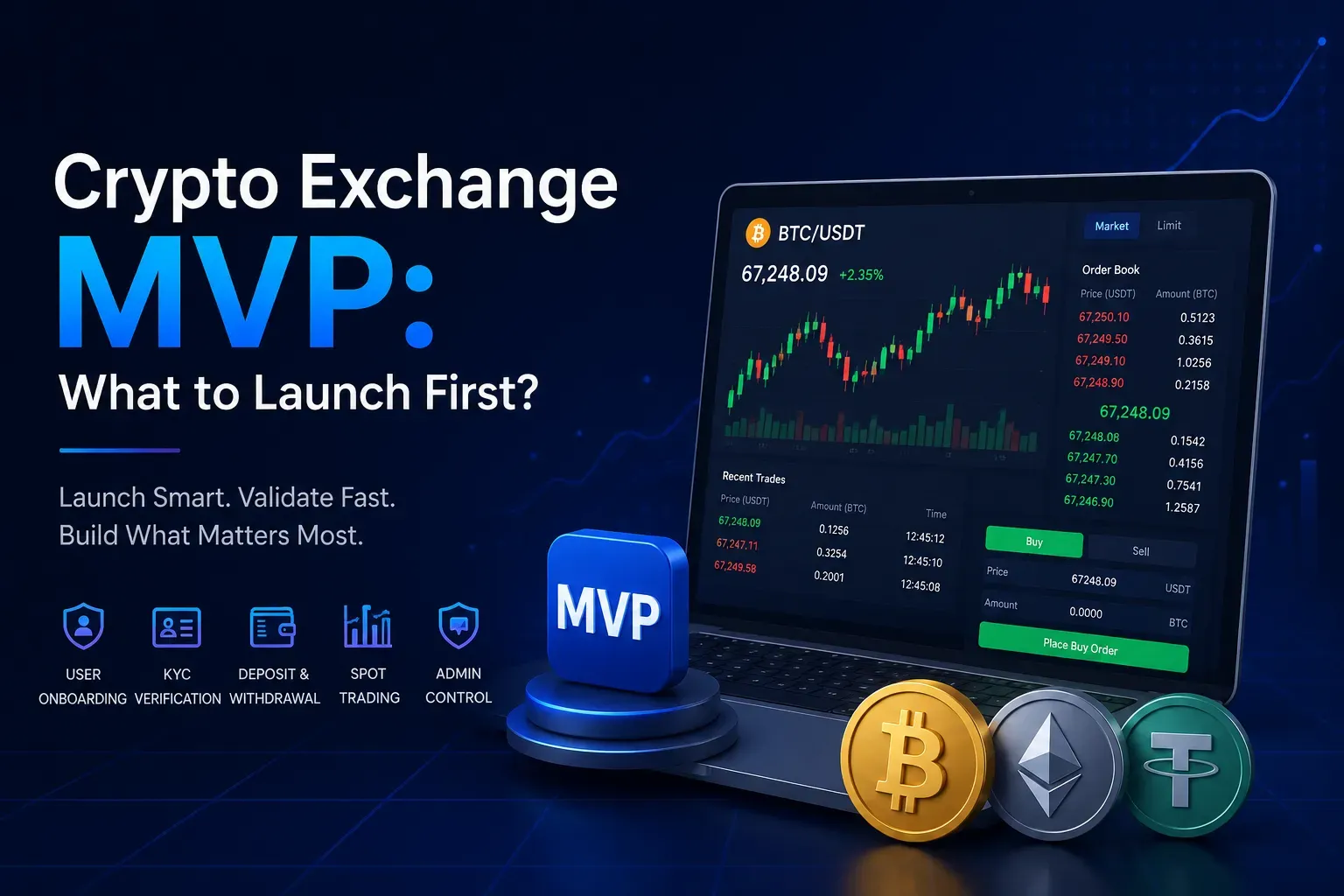
What Is a Crypto Exchange MVP?
A crypto exchange minimum viable product, or MVP, is the first production-ready version of an exchange that can deliver its core value to real users. For a simple software product, an MVP may be allowed to use temporary processes or limited automation. A crypto exchange has less room for shortcuts because it handles identity information, customer balances, blockchain transactions, and potentially regulated financial activity. An exchange MVP must therefore be minimal in product scope but not minimal in security, accounting, compliance, or operational control. The product should solve one clear problem. It might provide a local fiat-to-crypto gateway, a professional spot-trading venue, an institutional OTC platform, a regional P2P marketplace, or an exchange for a specific asset ecosystem. Founders should define the initial customer and primary transaction before selecting features. An MVP designed for first-time retail buyers will be different from one designed for professional API traders.
What Should a Crypto Exchange Launch First?
A centralized crypto exchange MVP should usually launch with the following capabilities:
- Secure registration and authentication: Email or phone registration, password controls, multifactor authentication, session management, device tracking, recovery workflows, and suspicious-login alerts.
- KYC and compliance onboarding: Identity collection, document verification, sanctions and PEP screening, risk classification, approval workflows, and configurable account limits.
- Internal ledger and account balances: Accurate double-entry accounting for available, reserved, pending, locked, and total balances.
- Deposit and withdrawal infrastructure: Supported blockchain networks, deposit addresses, confirmation tracking, withdrawal approvals, fee calculation, address screening, and transaction history.
- Basic spot trading: A limited number of liquid pairs, an order book, market and limit orders, order history, trade history, and clear fee calculation.
- Liquidity integration: A market maker, external liquidity provider, aggregation service, or sufficient committed internal liquidity for every launched market.
- Administrative operations: User management, KYC review, transaction investigation, wallet monitoring, market controls, fee configuration, reporting, and audit logs.
- Customer support and notifications: Support tickets, transactional emails or messages, maintenance notices, security alerts, and status updates.
This is the first of only two lists in this article. These functions create a complete operational loop. A user can register, pass verification, fund an account, trade, and withdraw, while the exchange team can monitor and manage the process.
Start with One Customer Segment
Trying to serve every type of crypto customer from day one creates unnecessary complexity. A retail exchange needs simple onboarding, local payment methods, clear prices, responsive support, and an easy buy-and-sell experience. A professional exchange needs reliable APIs, detailed order books, advanced market data, low latency, and competitive maker-taker fees. An institutional platform may prioritize corporate KYB, role-based organization accounts, higher withdrawal controls, reporting, custody, API execution, and dedicated account management. The MVP should optimize for one of these groups. Additional customer types can be introduced after the platform has validated its initial acquisition, trading, and retention assumptions.
Launch Spot Trading Before Complex Derivatives
For most exchange startups, spot trading is the safest core product to launch first. A spot market allows users to exchange one owned asset for another. Its infrastructure still requires a matching engine, balances, order management, fees, liquidity, and settlement, but it avoids many of the additional risks associated with leverage. A practical MVP can begin with market and limit orders. Coinbase’s official Exchange API documentation identifies these as core order types and notes that submitted orders place the required account funds on hold. Advanced interfaces may later add stop orders, take-profit instructions, bracket orders, and more sophisticated execution settings. Coinbase and Kraken both provide broader order functionality in their mature trading products, but these features are not all required to validate a first exchange release. Futures and margin products should normally be postponed because they require additional infrastructure for margin calculations, mark and index prices, liquidation, insurance funds, position limits, funding, leverage controls, and market-risk monitoring. A malfunction in a spot order may create an incorrect trade. A malfunction in a leveraged system can liquidate users or create losses larger than their available collateral.
Limit the Number of Markets
A new exchange does not need hundreds of trading pairs. Every new market requires liquidity, price monitoring, wallet support, accounting rules, market configuration, customer support, and compliance review. Launching too many pairs fragments trading activity and creates empty order books. A better MVP may begin with a few major assets paired with one primary quote currency, such as a stablecoin or supported fiat currency. Founders should select markets based on customer demand, liquidity availability, wallet reliability, regulatory suitability, and operational capacity. The presence of an asset on another exchange does not automatically make it suitable for the MVP. Each blockchain creates different requirements for confirmations, transaction fees, deposit detection, address formats, maintenance, and chain reorganizations.
Liquidity Must Exist Before Public Launch
The matching engine does not create buyers or sellers. It only matches the orders submitted to it. Without liquidity, users experience wide spreads, partial fills, severe slippage, and prices that differ from larger exchanges. Kraken explains that market orders interact with the best available orders in the book and that limited depth can cause the average execution price to differ from the quoted price. The MVP should therefore have a defined liquidity arrangement before customer acquisition begins. This may involve a professional market maker, an external liquidity provider, cross-exchange aggregation, committed project liquidity, or a hybrid arrangement. The exchange should monitor spread, depth, slippage, provider uptime, and price deviation for each active market. It is better to launch three healthy markets than thirty unusable ones.
Build the Ledger Before Polishing the Interface
The internal ledger is one of the most important components of a custodial exchange. It records what the platform owes each customer and how balances change after deposits, orders, trades, fees, transfers, withdrawals, refunds, or administrative adjustments. A correct ledger should distinguish between funds that are available for use and funds reserved for an open order or pending withdrawal. Coinbase’s exchange documentation similarly notes that funds required for an order are placed on hold while the order remains active. The ledger must be designed for reconciliation. Internal customer liabilities should be compared continuously with blockchain assets, fiat accounts, pending transactions, and wallet movements. A visual design problem can be fixed in a later release. An inaccurate ledger can threaten the solvency and credibility of the entire business.
Minimum Wallet Infrastructure
A custodial exchange MVP needs more than the ability to generate a deposit address. It must detect deposits, apply network-specific confirmation rules, credit the correct customer, calculate withdrawal fees, sign outgoing transactions securely, and track failed or delayed transfers. The exchange should separate routine online funds from larger reserves. Hot-wallet balances should be limited to operational requirements, while greater amounts should be protected through cold or highly restricted storage. Withdrawal workflows should support limits, account-security checks, address screening, manual review triggers, approval rules, and emergency suspension. Private keys must remain outside the normal admin panel. Administrative users should submit controlled transaction requests rather than gain direct access to signing credentials.
KYC and Compliance Are MVP Requirements
Compliance should not be postponed until the platform has attracted customers. FATF states that virtual asset service providers should apply preventive measures comparable to those used by financial institutions, including customer due diligence, record retention, suspicious transaction reporting, and the secure transmission of required originator and beneficiary information for transfers. The exact legal obligations depend on jurisdiction and business model, but the product should be able to identify customers, preserve verification records, assign risk levels, screen transactions, and restrict accounts where necessary. The compliance workflow can initially use third-party providers and manual review. It does not need to be completely automated, but every decision should be traceable. Founders should obtain legal guidance before accepting customer funds. A technically working product is not necessarily a legally launchable product.
Minimum Admin Panel for an MVP
The exchange team needs enough internal control to operate the platform without editing production databases. The first admin panel should allow authorized teams to review users, verification cases, deposits, withdrawals, wallet balances, market status, fees, risk alerts, support cases, and system activity. Permissions should be role-based. Customer support should not automatically have access to withdrawal approval, balance adjustment, or security configuration. Sensitive actions should create immutable audit records. High-risk operations, such as large withdrawals or manual ledger adjustments, should require additional approval. The admin panel does not need extensive business-intelligence dashboards at launch. It needs reliable operational visibility and safe control over critical actions.
Security Features That Cannot Wait
Security is not a post-MVP enhancement. The application should enforce strong authentication, authorization, input validation, rate limiting, secure session handling, encryption, secret management, logging, monitoring, backups, and incident-response controls from the first production release. Exchange APIs require particular attention because they expose account data, orders, market information, and potentially withdrawal functions. The OWASP API Security Top 10 highlights risks such as broken object-level authorization, broken authentication, unrestricted resource consumption, and unrestricted access to sensitive business flows. Founders should also arrange independent security testing before public launch. A platform that has not been tested with real attack scenarios should not be trusted with significant customer assets.
What Should Be Delayed Until After the MVP?
The following features are usually better suited to later phases:
- Futures, margin trading, leveraged tokens, and advanced options
- Staking, lending, borrowing, and yield products
- P2P trading with escrow and dispute management
- Copy trading, trading bots, and strategy marketplaces
- Token launchpads, ICO or IEO modules, and complex listing programmes
- NFT marketplaces, Web3 wallets, and broad DeFi connectivity
- Advanced VIP systems, gamification, competitions, and extensive referral programmes
- Native mobile applications when a responsive web product is sufficient for validation
This is the article’s second and final list. These products can generate additional revenue, but each adds technical, regulatory, financial, and support complexity. They should be introduced only when the core exchange is stable and the market has demonstrated demand.
MVP Does Not Mean Manual Everything
Manual operations can be useful during the early stage, but they must have clear controls. Compliance reviews, large withdrawal approvals, customer-support escalations, and asset-listing decisions may initially involve human teams. However, core financial actions should not depend on spreadsheets, chat messages, or undocumented database changes. Deposits, balances, orders, fees, and withdrawals must follow consistent system rules. A useful principle is to automate high-volume and high-risk financial processes while allowing lower-volume business decisions to remain manual until their workflow is validated.
How to Measure MVP Success
The first release should answer whether the exchange can attract and serve its intended market safely. Important measurements include completed onboarding, verification success, first deposits, first trades, withdrawal completion, active traders, repeat trading, support volume, spread, slippage, failed transactions, fraud attempts, and operational cost per customer. Registered-user count alone is not enough. An exchange with thousands of registrations but few funded and trading accounts has not validated its core business. Founders should also measure operational strain. If every withdrawal, KYC case, or support issue requires engineering involvement, the platform is not ready to scale.
Build, Buy, or Use White-Label Infrastructure?
Building a crypto exchange entirely from scratch provides maximum control but requires significant expertise in trading systems, wallets, security, compliance, liquidity, and financial accounting. A white-label or production-ready infrastructure can reduce development time by providing tested modules for the matching engine, wallets, user management, KYC, liquidity, fees, reporting, and administration. However, founders should still evaluate code quality, customization, security architecture, deployment control, documentation, scalability, and long-term ownership. The right question is not simply whether to build or buy. It is which components create unique value for the business and which components are infrastructure requirements that can be adopted more efficiently.
How Javizen Supports Crypto Exchange MVP Development
Javizen provides modular infrastructure for launching centralized exchanges, P2P platforms, derivatives products, token-sale systems, wallets, and other blockchain services. For an exchange MVP, Javizen can combine user onboarding, KYC/KYB integration, spot trading, matching-engine functionality, custodial wallets, internal ledgers, liquidity connections, deposit and withdrawal workflows, fee management, and administrative controls. The MVP can begin with a focused feature set and later expand into futures, options, staking, P2P, referrals, token sales, institutional services, or other modules. This modular approach allows founders to validate the exchange’s market and operating model without designing every future product before the first launch.
Conclusion
A crypto exchange MVP should launch one complete, secure, and commercially useful trading experience rather than a large collection of incomplete features. For most founders, the best first release is a focused centralized spot exchange with secure accounts, KYC, an accurate ledger, custodial wallets, deposits and withdrawals, a small number of liquid markets, and a capable admin panel. Advanced products should be introduced only after the exchange has validated customer demand, liquidity, security, compliance operations, and unit economics. The MVP should be small enough to launch and learn from, but strong enough to protect customer assets and operate as real financial infrastructure.
Frequently asked questions
What is the minimum feature set for a crypto exchange?
The minimum production feature set includes secure accounts, customer verification, an accurate ledger, deposits, withdrawals, basic spot trading, liquidity, compliance controls, customer support, and an admin panel.
Can an exchange MVP launch without KYC?
That depends on its jurisdiction and activities. However, businesses performing regulated virtual asset services commonly face customer due diligence and AML requirements. Legal advice should be obtained before launch.
How many cryptocurrencies should an MVP support?
There is no fixed number. A small set of high-demand assets with reliable wallets and healthy liquidity is generally better than a large selection of weak markets.
Should a crypto exchange MVP include futures?
Usually not. Futures require additional risk, margin, liquidation, pricing, and compliance infrastructure. Spot trading is generally a more manageable first product.
Does an MVP need a mobile app?
Not necessarily. A responsive web application may be sufficient to validate demand. Native applications can be added when usage data confirms the need.
How long does it take to build a crypto exchange MVP?
The timeline depends on whether the platform is built from scratch, assembled from existing modules, or launched using white-label infrastructure. Security, legal preparation, liquidity, integrations, and operational testing are as important as interface development.
آخر مقال
 06 Sep, 2026
How to Build a Crypto Options Trading Platform
 05 Sep, 2026
How to Launch a Crypto Prop Trading Platform
 03 Sep, 2026
How to Scale a Crypto Exchange for High Trading Volume
 02 Sep, 2026
How to Design a Crypto Exchange Fee Structure
 01 Sep, 2026
Market Makers vs Liquidity Providers: What Is the Difference?
Build with Javizen.
Planning an exchange, token or blockchain product? Talk to our team and turn the ideas in this article into a launch-ready platform.