
How Does Token Listing Work on a Crypto Exchange?
How Does Token Listing Work on a Crypto Exchange?
Token listing is the process of reviewing, integrating, and making a cryptocurrency or blockchain-based asset available for trading on a crypto exchange. For an exchange, listing a token is much more than adding its name to a trading-pair database. The operator must evaluate the project, verify the token and its smart contract, assess legal and compliance risks, integrate the asset into wallet infrastructure, configure trading markets, establish liquidity, and monitor the asset after launch. A professional token listing process protects both the exchange and its users. It also helps operators decide which assets fit their market strategy instead of simply listing every project that requests access. For businesses operating or building a crypto exchange, token listing should therefore be treated as a structured product, compliance, and technical workflow.
What Is Token Listing on a Crypto Exchange?
Token listing means adding a digital asset to an exchange so that users can deposit, withdraw, and potentially trade it against assets such as USDT, BTC, ETH, or fiat currencies. The process varies between exchanges. Some platforms have highly selective listing committees, while others provide a more commercial listing process for projects that meet defined technical and compliance requirements. The listing itself can involve several independent decisions. An exchange may approve a token for deposits and withdrawals first, then activate trading after liquidity and market configuration are ready. This distinction is important because supporting a token technically does not automatically mean the exchange should make it publicly tradable.
Why Do Exchanges Review Tokens Before Listing?
A new token introduces technical, financial, legal, and reputational risks. The exchange is effectively telling its customers that the asset has passed the platform's listing process. If the token has a vulnerable smart contract, misleading supply information, concentrated ownership, insufficient liquidity, or serious compliance concerns, the exchange and its users can be exposed to significant problems. A professional review therefore looks beyond the project's marketing materials. The exchange should understand what the token represents, who controls the project, how the supply works, where liquidity comes from, how the token can be transferred, and whether offering the asset is appropriate for the exchange's target markets. Regulatory requirements also vary by jurisdiction. For example, European crypto-asset rules can impose specific requirements around crypto-asset services and disclosures, making legal and compliance review an important part of the listing process.
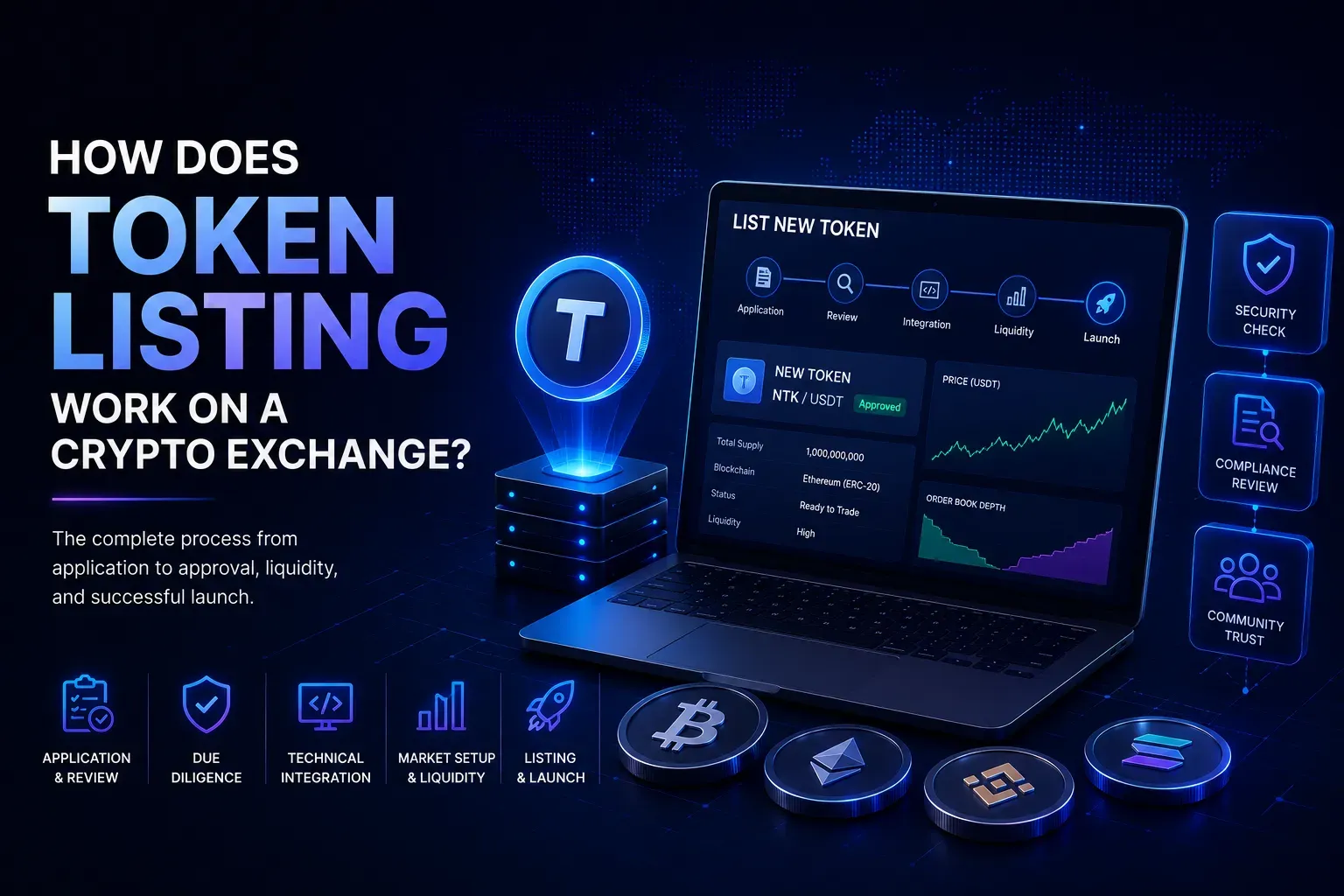
The Crypto Token Listing Process
Although every exchange can define its own procedures, a professional listing workflow generally moves from project application to due diligence, technical integration, market preparation, launch, and ongoing monitoring.
1. Project Application and Initial Screening
The process normally starts when a token project submits a listing application. The exchange collects information about the project, token, team, technology, market strategy, and intended trading markets. The objective at this stage is not to complete the entire due-diligence process but to determine whether the project is appropriate for a deeper review. The exchange may also evaluate the project's existing market activity, community presence, development progress, and business model. At this stage, operators should be careful with projects that focus almost entirely on short-term speculation or promise unrealistic returns. A listing process should evaluate the asset itself rather than relying on promotional claims.
2. Token and Project Due Diligence
Once a project passes initial screening, the exchange performs deeper due diligence. The technical team may inspect the token's smart contract, supported blockchain networks, contract ownership, upgrade mechanisms, minting and burning capabilities, transfer restrictions, and other technical characteristics. The business and compliance teams may review the project's legal structure, team information, token distribution, documentation, jurisdiction, and potential regulatory concerns. Token supply is particularly important. The exchange needs to understand the difference between circulating supply, total supply, and maximum supply because these figures directly affect market capitalization and user expectations. The review should also consider whether a small number of wallets control a large percentage of the circulating supply. Concentrated ownership can create additional market and manipulation risks.
3. Technical Integration
After approval, the token must be integrated into the exchange infrastructure. This usually means connecting the supported blockchain network to the exchange's wallet system and configuring deposit and withdrawal processing. The technical team needs to verify that the token contract and network behave as expected. Deposit detection, confirmation requirements, withdrawal transactions, transaction fees, address formats, and network-specific requirements all need to be tested. If a token is available on multiple networks, the exchange must clearly distinguish between them. Sending an asset through the wrong network can result in permanent loss, so the user interface must make the supported network explicit. The asset also needs to be connected to the internal ledger. Customer deposits and withdrawals must update balances accurately, while blockchain balances should remain reconcilable with internal accounting. Javizen's exchange infrastructure supports multiple blockchain standards and network integrations, including ERC20, TRC20, BEP20, Bitcoin, and other chain infrastructure.
4. Market and Trading Pair Configuration
Technical wallet support does not automatically create a tradable market. The exchange needs to configure one or more trading pairs, such as TOKEN/USDT or TOKEN/BTC. Market parameters may include price precision, quantity precision, minimum order size, trading fees, price limits, and market status. The operator also needs to determine when the market will become available. Some exchanges launch deposits first, allowing users to transfer the token before trading begins. Others coordinate deposits, trading, and withdrawals around a specific launch schedule. The market configuration should be tested before public activation to ensure that orders, balances, fees, order books, and trade history work correctly.
5. Liquidity Preparation
Liquidity is one of the most important factors in a successful token listing. A token can be technically available but still provide a poor trading experience if there are few buyers and sellers. Low liquidity can lead to wide spreads, significant slippage, and unstable price movements. Before activating trading, the exchange should determine where initial liquidity will come from. This may involve the project team, professional market makers, external liquidity providers, or the exchange's existing liquidity infrastructure. The exchange also needs to monitor order-book depth and ensure that liquidity arrangements do not create conflicts with customer trading. Javizen's exchange infrastructure includes market-level liquidity controls and connectivity with liquidity providers, allowing operators to manage liquidity as part of the broader exchange system.
6. Listing Approval and Launch
Once due diligence, technical integration, market configuration, and liquidity preparation are complete, the exchange can approve the final listing. The launch schedule should be communicated clearly. Users need to know when deposits open, when trading starts, and when withdrawals become available. The exchange may also publish information about the asset, trading pairs, supported networks, fees, and relevant risk disclosures. A controlled launch is generally preferable to activating every function simultaneously without monitoring. The operations team should watch deposits, withdrawals, order-book activity, system performance, and unusual trading behaviour during the initial period.
What Are the Main Token Listing Requirements?
There is no universal token-listing standard because every exchange establishes its own criteria. However, professional operators generally evaluate the project across several categories:
- Project legitimacy and team background
- Token utility, economics, supply, and distribution
- Smart-contract and blockchain security
- Legal and regulatory considerations
- Liquidity and market-making arrangements
- Technical compatibility with the exchange
- Community, development activity, and market demand
The weighting of these factors depends on the exchange's business model and jurisdiction. For example, an exchange targeting institutional users may apply more extensive compliance and technical requirements, while a regional retail platform may place greater emphasis on local market demand and payment accessibility.
Token Listing vs Token Launchpad
Token listing and token launchpad services are related but serve different purposes. A token listing makes an already existing asset available for trading on an exchange. A token launchpad helps a project distribute or sell tokens to investors before or during a token offering. A launchpad may support public, private, or staged sales, investor onboarding, KYC/AML, payment processing, referral systems, and token distribution. Javizen offers a standalone ICO/STO/IEO Token Sale Platform that can operate independently and can also be connected to CEX or DEX ecosystems. This distinction matters for exchange operators because a business may need both products. The launchpad can support the initial token offering, while the exchange can later provide secondary-market trading.
How Exchanges Manage Token Listing Fees
Some exchanges charge projects for listing services, while others may use different commercial arrangements or evaluate projects without a direct listing fee. A listing fee should never be treated as a substitute for due diligence. The commercial relationship and the asset's technical, legal, and market evaluation should remain separate. Otherwise, an exchange can create conflicts of interest and weaken the credibility of its listing process. A transparent listing policy can explain what the fee covers, which technical services are included, and which criteria a project must meet before trading is activated.
What Happens After a Token Is Listed?
Listing is not the end of the exchange's responsibility. The asset should continue to be monitored for technical issues, liquidity problems, abnormal trading, blockchain incidents, and significant changes to the project. For example, a smart-contract upgrade, blockchain migration, exploit, major supply change, or loss of liquidity can require the exchange to temporarily suspend deposits, withdrawals, or trading. The exchange should have clear procedures for these situations rather than making decisions manually without an established process. This is especially important for assets that rely on external smart contracts or third-party infrastructure.
How to Build a Token Listing System Into a Crypto Exchange
If you are developing a crypto exchange, token listing should be implemented as an operational workflow rather than a simple admin-panel button. The platform should allow authorized administrators to create assets, configure networks, define contract addresses, set trading pairs, manage fees, control market status, and monitor wallet activity. The system should also separate permissions. A support employee should not be able to activate a new token market or modify a contract address without appropriate authorization. A complete audit trail should record who created or modified an asset, which contract address was configured, when the market was activated, and what changes were made. Javizen's CEX infrastructure provides operator tools for managing assets, markets, fees, wallets, transactions, liquidity, and system services from a centralized administration environment.
Common Mistakes When Listing Tokens
The most dangerous mistake is treating token listing as a purely commercial decision. An exchange may be tempted to list an asset because a project promises a large community or significant trading volume. But volume, social activity, and marketing do not replace technical and compliance due diligence. Another common problem is insufficient liquidity planning. A token can pass every technical test and still fail to provide a usable market if there are not enough active buyers and sellers. Finally, exchanges should avoid treating the listing process as a one-time event. Blockchain projects evolve, contracts change, token supplies can be modified, and liquidity can disappear. Continuous monitoring is therefore part of responsible asset management.
How Javizen Supports Token and Exchange Infrastructure
Javizen provides crypto exchange infrastructure for businesses that want to operate centralized exchanges and expand into related blockchain products. Its CEX Full Suite includes asset and market management, wallet infrastructure, KYC, liquidity integrations, APIs, reporting, administration, and additional modules such as Futures, Options, P2P, Prop Trading, Staking, and Launchpad. For businesses launching their own token ecosystem, Javizen also provides tokenization and token-sale infrastructure. Its tokenization solution covers token creation, tokenomics, whitepaper preparation, and launch-related development, while its token-sale platform supports ICO, STO, and IEO workflows. This creates a path where a business can develop the token ecosystem first and later connect it to exchange infrastructure when the asset is ready for secondary-market trading.
Final Thoughts
Token listing on a crypto exchange is a multi-stage process that combines project due diligence, technical integration, market configuration, liquidity preparation, compliance review, and ongoing monitoring. The actual process can vary significantly between exchanges, but the principle remains the same: an exchange should understand an asset before making it available to customers. For exchange operators, a strong listing system should connect asset management, wallets, internal accounting, markets, liquidity, compliance, and administration. This turns token listing from a manual operational task into a controlled and auditable part of the exchange infrastructure. Javizen provides the infrastructure needed to manage these exchange operations and supports businesses that want to build centralized exchanges, token-sale platforms, launchpads, and broader blockchain ecosystems.
Frequently asked questions
What is token listing on a crypto exchange?
Token listing is the process of reviewing and integrating a cryptocurrency or token so users can deposit, withdraw, and trade it on an exchange.
How does an exchange decide which tokens to list?
Exchanges typically evaluate the project's legitimacy, token economics, technical security, compliance considerations, liquidity, market demand, and compatibility with the exchange infrastructure.
How long does token listing take?
There is no universal timeline. Simple technical integrations can be relatively quick, while projects requiring extensive due diligence, new blockchain support, liquidity arrangements, or regulatory review can take considerably longer.
Does listing a token require liquidity?
A tradable market needs sufficient liquidity to provide reasonable execution. Exchanges generally prepare liquidity or market-making arrangements before activating a new market.
What is the difference between token listing and a launchpad?
A launchpad is generally used to conduct a token offering or distribution, while token listing makes an existing asset available for secondary-market trading.
Can a crypto exchange add new tokens after launch?
Yes. A properly designed exchange should allow authorized operators to add assets, configure blockchain networks, create trading pairs, and manage listing status without rebuilding the platform.
Frequently asked questions
Can Javizen build a token listing system?
Yes. Javizen's exchange infrastructure includes asset, market, wallet, liquidity, administration, and reporting capabilities that can support a structured token-listing workflow.
آخر مقال
 06 Sep, 2026
How to Build a Crypto Options Trading Platform
 05 Sep, 2026
How to Launch a Crypto Prop Trading Platform
 03 Sep, 2026
How to Scale a Crypto Exchange for High Trading Volume
 02 Sep, 2026
How to Design a Crypto Exchange Fee Structure
 01 Sep, 2026
Market Makers vs Liquidity Providers: What Is the Difference?
Build with Javizen.
Planning an exchange, token or blockchain product? Talk to our team and turn the ideas in this article into a launch-ready platform.