
How Long Does It Take to Build a Crypto Exchange?
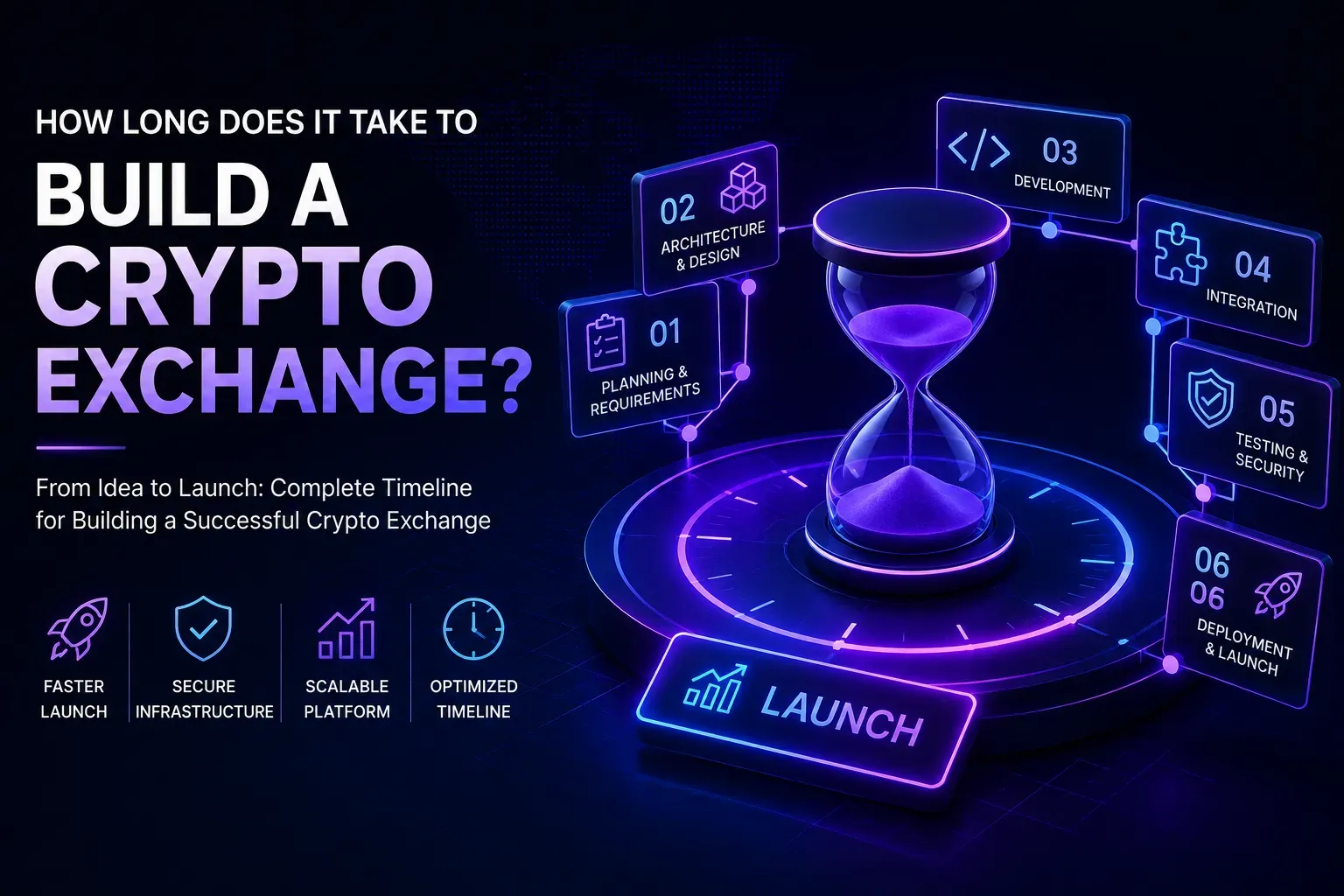
How Long Does It Take to Build a Crypto Exchange?
A typical development timeline can be divided into three broad approaches: White-label exchange: Often several weeks to a few months, depending on customization and integrations. Customized exchange using an existing infrastructure: Usually several months, depending on the number of modules and integrations. Fully custom exchange: Commonly many months to more than a year for a mature platform with advanced trading products. These are not fixed deadlines. Licensing, banking relationships, liquidity, blockchain integrations, payment providers, security audits, and the number of supported products can significantly change the timeline. The fastest route is not necessarily the best route. A business launching an exchange needs to balance speed with security, reliability, compliance, and the ability to scale after launch.
What Determines Crypto Exchange Development Time?
The complexity of the exchange is the biggest factor. A platform supporting only basic spot trading is considerably simpler than an ecosystem offering spot, P2P, futures, options, staking, token launches, OTC trading, and institutional APIs. The target market also matters. An exchange operating in one jurisdiction with a limited number of assets may require fewer integrations than a multi-region platform supporting several fiat currencies, payment methods, verification providers, and blockchain networks. Customization is another major factor. Changing branding, colors, trading pairs, fees, user permissions, and basic workflows is relatively straightforward. Developing a completely different trading model or financial workflow requires much deeper engineering.
1. Planning and Architecture
The first stage is defining what the exchange actually needs to do. Before development begins, the business should determine its target users, jurisdictions, custody model, supported cryptocurrencies, fiat currencies, revenue model, trading products, liquidity strategy, and future expansion plans. This stage is important because architectural decisions made at the beginning can affect every later component. For example, an exchange that plans to introduce futures six months after launching spot trading should prepare its account, ledger, risk, and wallet architecture accordingly. Retrofitting derivatives into an architecture designed only for basic spot trading can create unnecessary development work. A technical architecture is then designed around services such as user management, authentication, KYC, ledger, wallets, matching, market data, notifications, payments, risk management, and administration. A modular architecture can significantly reduce future development time because additional products can connect to existing infrastructure instead of requiring a complete rebuild.
2. User Accounts and KYC
Account management is one of the first functional components of an exchange. The platform needs registration, login, authentication, password management, multi-factor authentication, account restrictions, session management, and user permissions. KYC and, where relevant, KYB must also be integrated into the customer onboarding process. The exact implementation depends on the selected verification provider and regulatory requirements. An exchange may need different verification levels with different trading, deposit, and withdrawal limits. Because compliance requirements vary by jurisdiction, this stage can involve external providers, legal review, document verification, sanctions screening, transaction monitoring, and internal risk rules. The integration itself may be technically straightforward, but compliance configuration and approval processes can extend the overall launch timeline.
3. Matching Engine and Trading Infrastructure
The matching engine is one of the most technically important components of a centralized exchange. It receives orders, applies matching rules, executes trades, and communicates the results to the ledger and market-data services. The development time depends on whether the matching engine is already available or needs to be engineered from scratch. A professional engine must also handle order validation, balance locking, cancellations, partial fills, trading fees, market rules, high-volume activity, and failure recovery. Market-data infrastructure must distribute order books, trades, tickers, and other information to connected users in real time. This is one reason a production crypto exchange cannot be estimated simply by counting frontend pages. A trading interface may look relatively simple, while the systems operating behind it require extensive engineering and testing.
4. Wallets and Blockchain Integrations
Crypto wallets can become another significant part of the development timeline. The exchange needs to generate or manage deposit addresses, monitor blockchain transactions, calculate confirmations, process withdrawals, manage network fees, and reconcile blockchain balances with the internal ledger. Each additional blockchain network can introduce its own technical requirements. Some assets require memo or tag management, while others operate across multiple networks. Blockchain congestion, network upgrades, confirmation rules, transaction failures, and fee changes must also be considered. Withdrawal security adds another layer. Operators may require withdrawal limits, address allowlisting, multi-factor authentication, manual reviews, risk scoring, or multi-person approval for large transactions.
5. Liquidity Integration
A new exchange needs liquidity before it can provide a competitive trading experience. The technical integration can connect the exchange to external liquidity providers, market makers, or other trading venues. However, liquidity is not only an API integration. The business also needs to determine which markets to support, how prices are sourced, how spreads are managed, how orders are hedged, and how counterparty exposure is controlled. If liquidity providers are already selected and their APIs are well documented, integration can move relatively quickly. Negotiating commercial agreements and configuring market-making strategies can take considerably longer.
6. Frontend and Trading Experience
The frontend includes the public website, registration flow, dashboard, wallet pages, trading terminal, account settings, transaction history, and other customer-facing interfaces. The basic trading interface can be implemented relatively quickly when the underlying APIs and design system already exist. However, production-quality trading UX requires extensive testing across different screen sizes, browsers, network conditions, and market scenarios. Mobile applications introduce another development track. A business may choose native iOS and Android applications or a cross-platform solution that consumes the same exchange APIs. The key advantage of a properly designed backend is that web and mobile clients can use the same core trading infrastructure.
7. Admin Panel and Operational Tools
The exchange also needs a complete internal operating environment. Administrators need to manage users, KYC reviews, markets, fees, deposits, withdrawals, wallets, orders, support tickets, payment methods, liquidity settings, and system configuration. Finance teams need ledger reports and reconciliation tools. Compliance teams need investigation workflows. Support agents need access to customer activity without receiving unnecessary financial permissions. A good admin panel should use role-based access control and maintain an audit trail for sensitive actions. Building these tools can take significant time, but they are essential for operating an exchange safely after launch.
8. Security and Testing
Security testing should run throughout development rather than being postponed until the final week. The exchange handles customer identities, private information, financial balances, trading accounts, and cryptocurrency withdrawals. A vulnerability in any of these areas can have serious consequences. Testing should cover both individual services and complete financial workflows.
Important testing areas include:
- Authentication and authorization
- Trading and balance consistency
- Deposits and withdrawals
- API security
- Wallet operations
- High-load and failure scenarios
- Administrative permissions
Penetration testing, code review, infrastructure security assessments, monitoring, backup procedures, and disaster-recovery testing may also be required before production launch. The more financial products an exchange offers, the greater the testing scope becomes.
9. Advanced Trading Modules
The initial spot exchange does not have to contain every possible crypto product. A business can launch a core platform first and introduce additional modules as the customer base grows. P2P trading requires advertisement management, escrow, payment methods, merchant systems, and dispute resolution. Futures require margin management, funding calculations, liquidation mechanisms, mark prices, insurance systems, and additional risk controls. Options, staking, token launches, prop trading, and other products introduce their own technical and operational requirements. This is why a modular exchange architecture is particularly useful. The business can launch a stable core platform and expand it without rebuilding the entire exchange.
White-Label vs Custom Crypto Exchange Development Time
The development approach can make a major difference to the timeline. A white-label exchange starts with existing infrastructure. Core components such as authentication, wallets, matching, trading interfaces, administration, and APIs may already be available. The development team can focus on branding, configuration, integrations, customization, testing, and deployment. A custom exchange starts with a much larger engineering scope. The team needs to design and implement the architecture, ledger, matching engine, wallets, APIs, security systems, administration tools, and customer interfaces. Custom development makes sense when the business requires unique trading workflows, specialized financial products, unusual settlement logic, or deep integration with proprietary systems. For businesses whose requirements are close to a standard centralized exchange, a modular white-label platform can significantly reduce the time and engineering risk involved in reaching the market.
A Practical Crypto Exchange Development Timeline
A typical project can be organized into several stages: Phase 1 — Discovery and architecture: Define requirements, markets, regulatory scope, infrastructure, integrations, and product roadmap. Phase 2 — Core exchange: Develop or configure accounts, KYC, ledger, wallets, matching, markets, trading, deposits, and withdrawals. Phase 3 — Integrations and operations: Connect liquidity, payment providers, blockchain networks, notifications, compliance services, and administrative tools. Phase 4 — Testing and security: Perform functional, integration, load, security, financial-reconciliation, and failure-recovery testing. Phase 5 — Deployment and launch: Configure production infrastructure, monitoring, backups, domains, operational procedures, and controlled user onboarding. The phases can overlap. For example, security testing should begin while the core systems are being developed rather than waiting until everything else is finished.
How to Launch Faster Without Sacrificing Quality
The fastest way to launch is usually to reduce unnecessary scope rather than reduce engineering quality. Start with the markets and features that are essential to your business model. A spot exchange does not necessarily need futures, options, staking, P2P, and a dozen payment providers on day one. Use existing infrastructure for components that do not differentiate the business, while investing custom development resources in the features that create competitive advantage. A modular platform can also allow the business to launch the core exchange first and activate additional modules later.
How Long Does It Take to Build a Crypto Exchange With Javizen?
Javizen provides production-ready crypto exchange infrastructure that can be customized around a business's requirements. Instead of building every exchange component from zero, businesses can start with an existing CEX foundation and customize branding, markets, fees, liquidity, payment integrations, KYC providers, and operational workflows. The platform can then be expanded with modules such as P2P, futures, options, prop trading, staking, token-sale infrastructure, and other blockchain products. The exact timeline depends on the selected configuration, integrations, custom requirements, and launch scope. A simple configuration can move much faster than a heavily customized multi-product exchange.
Final Thoughts
So, how long does it take to build a crypto exchange? There is no single number that applies to every project. A white-label exchange with limited customization can reach launch much faster than a fully custom platform. The timeline increases with additional blockchain networks, payment methods, compliance requirements, trading products, mobile applications, institutional APIs, and custom workflows. The most effective approach is to define a realistic MVP, establish the technical and regulatory foundation, launch the core trading product, and expand through modular components. For businesses that want to enter the market without spending years rebuilding standard exchange infrastructure, a production-ready platform such as Javizen can provide the foundation for a faster and more controlled launch.
Frequently Asked Questions
Frequently asked questions
How long does it take to build a crypto exchange from scratch?
A basic custom exchange can require several months, while a mature platform with advanced trading, custody, compliance, institutional APIs, and multiple products can require considerably longer.
How fast can a white-label crypto exchange launch?
A white-label exchange can potentially launch within weeks or a few months, depending on customization, integrations, regulatory preparation, liquidity, and testing requirements.
What takes the longest to develop in a crypto exchange?
Core financial infrastructure such as the ledger, matching engine, wallet system, security architecture, and advanced trading modules generally require the most engineering and testing effort.
Does adding more cryptocurrencies increase development time?
Yes. Each blockchain or network can require additional wallet integration, deposit monitoring, withdrawal processing, confirmation rules, testing, and operational configuration.
Can a crypto exchange launch with only spot trading?
Yes. Spot trading can serve as the initial product while P2P, futures, options, staking, and other modules are introduced later.
آخر مقال
 06 Sep, 2026
How to Build a Crypto Options Trading Platform
 05 Sep, 2026
How to Launch a Crypto Prop Trading Platform
 03 Sep, 2026
How to Scale a Crypto Exchange for High Trading Volume
 02 Sep, 2026
How to Design a Crypto Exchange Fee Structure
 01 Sep, 2026
Market Makers vs Liquidity Providers: What Is the Difference?
Build with Javizen.
Planning an exchange, token or blockchain product? Talk to our team and turn the ideas in this article into a launch-ready platform.