
How to Choose the Right Jurisdiction for a Crypto Exchange
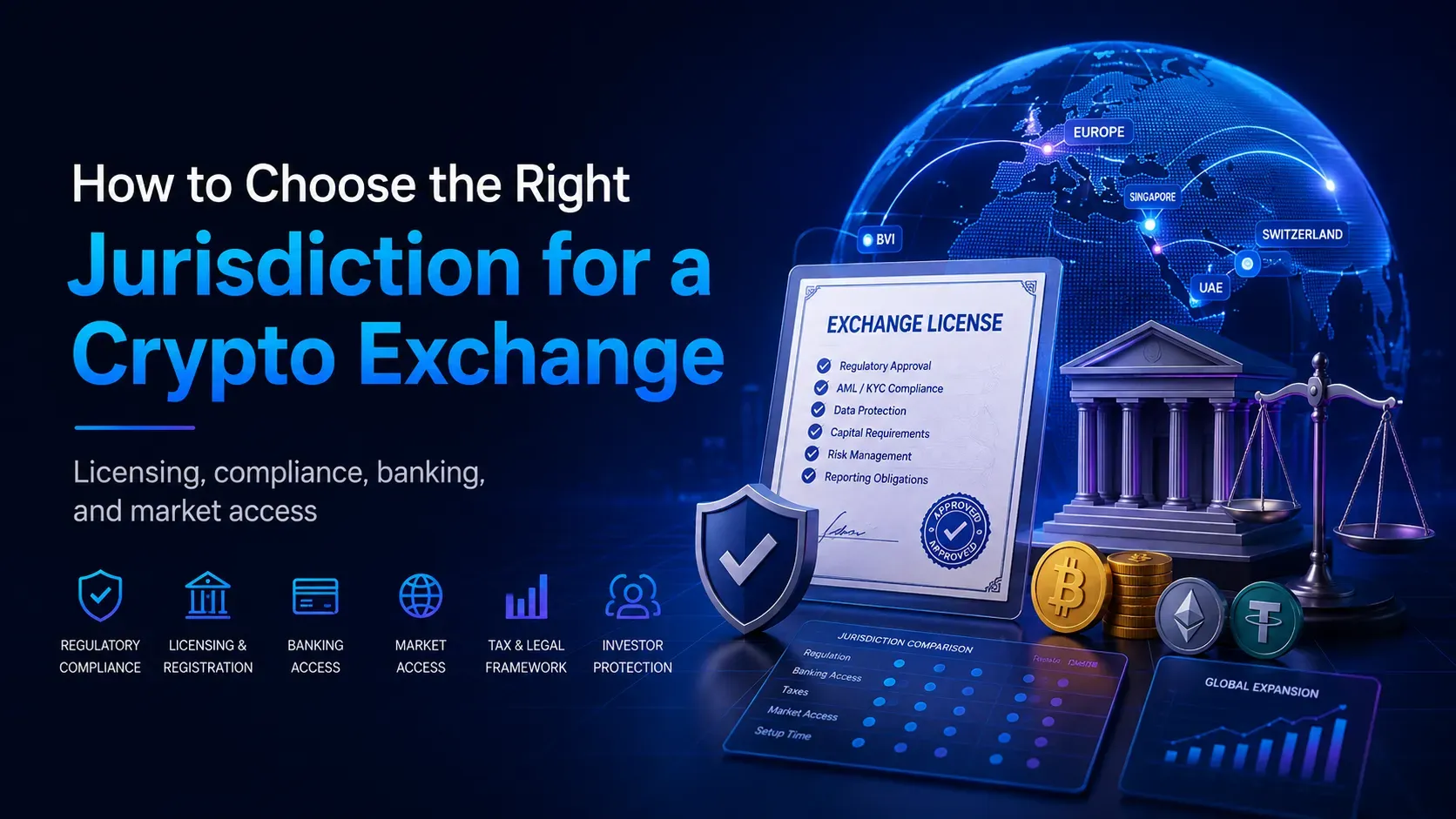
Why Jurisdiction Matters for a Crypto Exchange
A crypto exchange operates at the intersection of technology, finance, and regulation. The jurisdiction where the company is established influences almost every operational area, including licensing, customer onboarding, custody requirements, banking relationships, reporting obligations, and compliance processes. A weak jurisdiction strategy can create serious problems after development has already started. An exchange may discover that its planned products require additional approvals, banking partners are unavailable, compliance costs are higher than expected, or customers from target markets cannot legally be served. A well-selected jurisdiction can provide a stronger foundation for growth. It can improve relationships with investors, liquidity providers, banks, payment companies, and institutional customers while creating clearer expectations for future expansion.
Start by Defining Your Exchange Business Model
There is no universal best jurisdiction for every crypto exchange. The correct location depends on what the exchange actually does. A custodial centralized exchange, for example, manages customer assets and executes trades through its own infrastructure. This creates different regulatory responsibilities compared with a non-custodial platform where users control their own wallets. Before choosing a jurisdiction, founders should clearly define their business model. They need to understand whether the platform will support spot trading, derivatives, fiat payments, staking, lending, token services, P2P trading, institutional accounts, or other products. The customer profile also matters. A platform targeting retail users in one region may require different permissions and payment relationships from an exchange focused on global institutional traders. Jurisdiction selection should happen after this analysis because the required licences and operational controls are directly connected to the exchange model.
Key Factors When Choosing a Crypto Exchange Jurisdiction
When comparing jurisdictions, founders should evaluate the complete business environment rather than focusing on a single advantage.
The most important factors include:
- Regulatory clarity: The jurisdiction should have clear rules defining crypto activities, licensing requirements, custody obligations, AML expectations, and reporting responsibilities.
- Licensing framework: Founders should understand the required authorization, application process, capital requirements, local presence rules, and ongoing obligations.
- Banking and payment access: Reliable banking partners, fiat settlement options, and payment providers are essential for exchange operations.
- Market access: The jurisdiction should support the customer regions where the exchange plans to operate and advertise its services.
- Compliance requirements: The regulatory environment should allow the company to implement effective KYC/KYB, transaction monitoring, sanctions screening, and risk-management systems.
- Business reputation: A recognised regulatory environment can improve trust with customers, investors, liquidity providers, and institutional partners.
A strong jurisdiction is one that supports the exchange throughout its lifecycle, not just during the incorporation stage.
Regulatory Clarity and Licensing Requirements
Regulatory clarity is usually the first consideration when choosing a jurisdiction. Some countries have created dedicated frameworks for crypto businesses, while others regulate exchanges through existing financial laws covering payments, securities, money transmission, or financial services. For example, the European Union introduced the Markets in Crypto-Assets Regulation (MiCA), creating a common framework for many crypto-asset services across EU member states. Under MiCA, crypto-asset service providers such as trading platforms and custodians generally require authorization from national competent authorities before providing regulated services. (esma.europa.eu) A licensing process often requires more than company documents. Regulators may review the business model, ownership structure, compliance programme, technology architecture, security controls, outsourcing arrangements, and management team. Founders should include licensing preparation in the overall product roadmap. Regulatory work, technology development, liquidity preparation, and security testing should move together.
Banking and Payment Infrastructure
A crypto exchange cannot operate successfully without reliable financial connections. Many founders focus heavily on obtaining a licence but underestimate the importance of banking and payment infrastructure. A regulated company still needs access to corporate banking, fiat settlement, payment processors, and financial partners. Before choosing a jurisdiction, founders should evaluate how accessible these services are for crypto businesses. Some jurisdictions may offer clear crypto regulations but limited banking options. Others may provide stronger financial infrastructure but require more complex compliance processes. The exchange’s payment strategy should therefore be considered alongside the regulatory strategy.
Customer Location and Market Access
The best jurisdiction is often connected to the customers the exchange wants to serve. An exchange targeting European users may benefit from a European regulatory framework. A platform focused on a specific regional market may need local payment methods, language support, and customer-protection compliance. A licence in one country does not automatically allow unrestricted operation worldwide. Different markets may have separate rules regarding advertising, onboarding users, and providing financial services. Founders should analyse customer locations before launch and understand whether additional registrations, notifications, or licences are required for expansion.
Compliance Requirements and AML Framework
Compliance is one of the most important operational responsibilities for a crypto exchange. A serious exchange needs systems that identify customers, evaluate risk, monitor transactions, and detect suspicious activity. The compliance framework should connect customer identity, account behaviour, wallet activity, transaction history, and blockchain risk indicators. Regulators commonly expect exchanges to maintain effective controls for customer verification, sanctions screening, suspicious activity monitoring, record retention, and transaction reporting. Compliance should not be treated as a separate department disconnected from technology. The exchange infrastructure should support compliance workflows through integrated KYC/KYB systems, risk scoring, monitoring tools, and administrative controls.
Taxation and Operating Costs
Taxation is an important consideration, but it should not be the only reason for selecting a jurisdiction. A country with lower corporate taxes may still become expensive if it requires significant local staffing, expensive legal support, complex reporting, or difficult banking relationships. Founders should evaluate the complete operating cost of running the exchange, including regulatory expenses, compliance teams, infrastructure, security audits, accounting requirements, and ongoing reporting. The cheapest option at launch is not always the most sustainable option for long-term growth.
Reputation and Customer Trust
Trust is one of the most important assets for a crypto exchange. Customers are more willing to use platforms that demonstrate transparency, security, compliance, and responsible operations. Institutional customers and business partners often evaluate the regulatory environment before entering a relationship with an exchange. Liquidity providers, investors, and payment companies may also consider the jurisdiction when assessing risk. A strong regulatory reputation can become a competitive advantage, especially for exchanges targeting professional users.
Technology and Operational Requirements
Jurisdiction selection affects technical requirements as well. Regulators increasingly expect exchanges to demonstrate secure wallet management, access controls, monitoring systems, audit logs, data protection procedures, incident response plans, and business continuity processes. The technology must match the policies presented during licensing. For example, if an exchange states that large withdrawals require multiple approvals, the wallet system and admin panel must enforce those approvals technically. Written policies without technical implementation create operational and regulatory risks.
Common Mistakes When Selecting a Jurisdiction
One of the most common mistakes is choosing a jurisdiction only because it is advertised as “crypto-friendly.” A favourable reputation alone does not guarantee banking access, regulatory acceptance, or long-term business support. Another mistake is selecting a country before understanding the exchange model. The required licence depends on whether the company provides custody, trading, payments, derivatives, or other financial services. Some founders also focus only on initial setup costs and ignore future expenses such as compliance staffing, audits, reporting, and operational requirements. The right jurisdiction should support the business after launch, not just make incorporation easier.
Popular Jurisdiction Strategies
Different exchange models often require different jurisdiction strategies. A company focused on regulated European customers may prioritise jurisdictions aligned with MiCA requirements. An institutional exchange may prefer locations with strong financial infrastructure and established regulatory systems. A regional exchange may focus on local market access, payment methods, and customer familiarity. Early-stage startups often look for a balance between regulatory clarity, operating costs, and future scalability. The important point is that founders should choose based on their own business goals rather than simply following lists of “best crypto countries.”
Pre-Launch Jurisdiction Checklist
Before finalising the jurisdiction, founders should confirm:
- The required licences and regulatory permissions have been identified.
- The target customer markets are legally accessible.
- Banking and payment options are available.
- Compliance responsibilities and staffing requirements are understood.
- Custody, wallet security, and customer-asset protection requirements are defined.
- Technology architecture supports regulatory obligations.
- Future expansion opportunities have been considered.
This evaluation should involve legal advisers, compliance specialists, financial experts, and technical leaders. Jurisdiction selection is not permanent. Changes in products, ownership, customer markets, or regulations may require additional approvals or adjustments.
How Javizen Supports Licence-Ready Crypto Exchange Development
Javizen provides modular crypto exchange infrastructure designed to support different regulatory and operational models. The platform can integrate KYC/KYB workflows, transaction monitoring, custodial wallets, internal ledgers, trading engines, liquidity connections, administrative controls, reporting systems, and security processes. Because every jurisdiction has different requirements, exchange infrastructure should be flexible and configurable. A properly designed platform allows founders to adapt compliance workflows, user restrictions, payment methods, supported assets, and operational processes based on the markets they enter. Javizen provides the technical foundation, while founders and legal professionals determine the appropriate licensing strategy.
Frequently Asked Questions
Conclusion
Choosing the right jurisdiction for a crypto exchange is one of the most important strategic decisions before launch. The best location balances regulatory clarity, market access, banking relationships, operating costs, compliance requirements, and future growth potential. Founders should avoid selecting a jurisdiction only because it appears inexpensive or easy to establish. A successful exchange requires a legal and operational environment that supports the entire business lifecycle. When regulatory strategy, technology infrastructure, compliance operations, and business objectives are aligned from the beginning, the exchange has a stronger foundation for sustainable growth.
Frequently asked questions
What is the best jurisdiction for a crypto exchange?
There is no single best jurisdiction. The right choice depends on the exchange model, target customers, licensing requirements, banking access, and long-term business strategy.
Can a crypto exchange operate without a licence?
In many jurisdictions, regulated crypto activities require registration or licensing. Operating without proper authorization can create significant legal and financial risks.
Does a crypto licence allow global operation?
No. A licence usually applies to specific activities and jurisdictions. Expansion into other markets may require additional analysis, approvals, or registrations.
Should founders choose a jurisdiction before building the exchange?
Yes. Regulatory requirements directly affect technology architecture, compliance systems, custody design, and operational processes.
Is a crypto-friendly country always the best option?
Not necessarily. A good jurisdiction should also provide banking access, regulatory stability, customer trust, and long-term business opportunities.
آخر مقال
 06 Sep, 2026
How to Build a Crypto Options Trading Platform
 05 Sep, 2026
How to Launch a Crypto Prop Trading Platform
 03 Sep, 2026
How to Scale a Crypto Exchange for High Trading Volume
 02 Sep, 2026
How to Design a Crypto Exchange Fee Structure
 01 Sep, 2026
Market Makers vs Liquidity Providers: What Is the Difference?
Build with Javizen.
Planning an exchange, token or blockchain product? Talk to our team and turn the ideas in this article into a launch-ready platform.