
AML and Transaction Monitoring for Crypto Exchanges
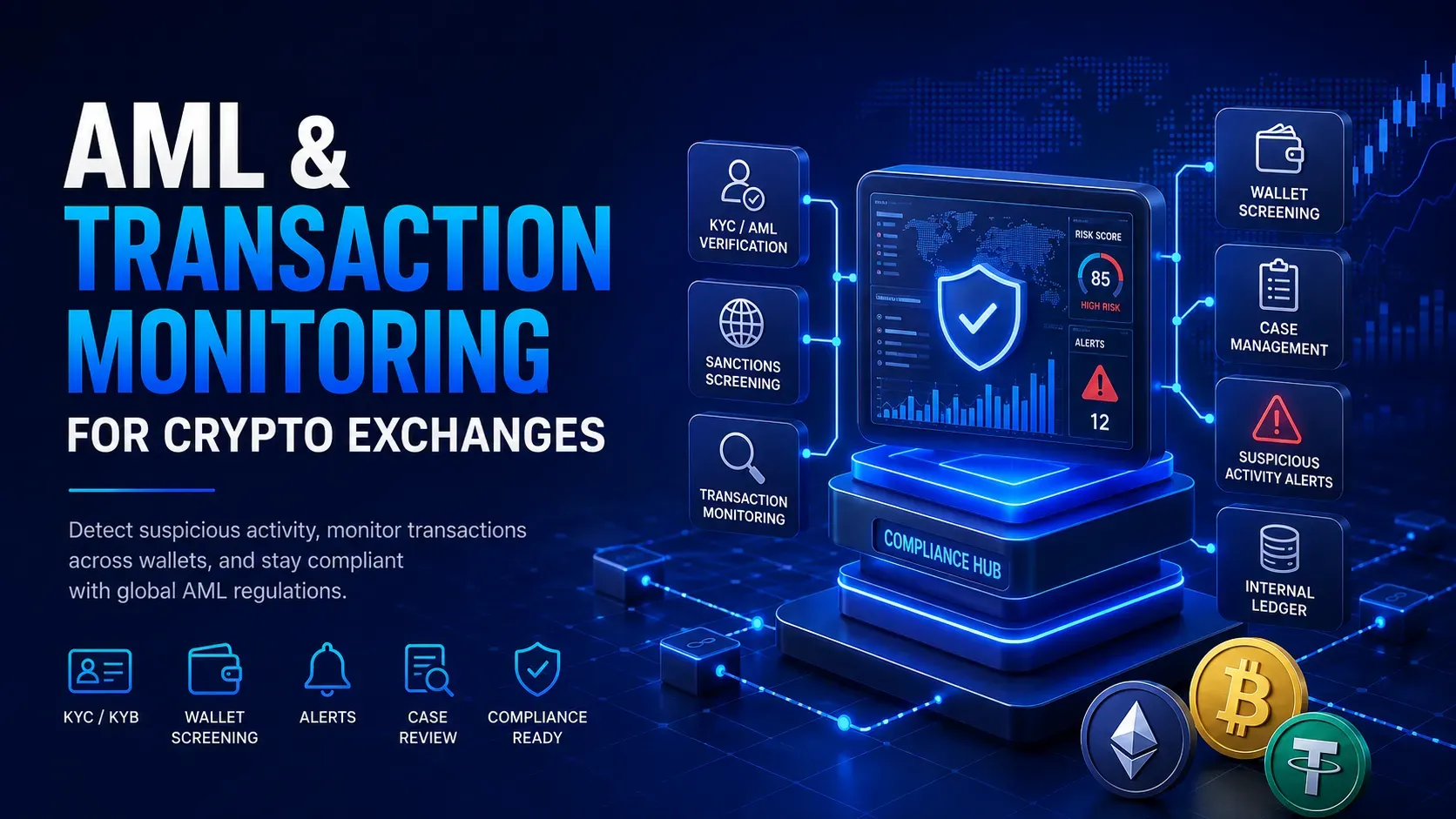
What Is AML in a Crypto Exchange?
Anti-Money Laundering, or AML, refers to the policies, procedures, technologies, and operational controls used to prevent a financial platform from being used to move or disguise illicit funds. For a crypto exchange, AML goes far beyond checking an identity document during registration. The platform must understand who the customer is, assess their risk level, evaluate where funds originate, monitor how the account is used, identify unusual behaviour, and escalate potentially suspicious activity when required. Crypto exchanges face a particular challenge because transactions can move rapidly between exchanges, self-hosted wallets, smart contracts, bridges, and multiple blockchain networks. Blockchain transparency can help investigations because many transactions are publicly traceable. However, public blockchain data does not automatically reveal the identity or purpose behind an address. This means effective AML monitoring usually requires a combination of customer information and blockchain intelligence.
Why Transaction Monitoring Matters
A customer can successfully complete KYC and still engage in suspicious activity months later. Transaction monitoring exists to detect these changes. A customer who originally declared that they would trade occasionally may suddenly receive large amounts of crypto from unrelated wallets. Another user may deposit funds and immediately withdraw them through multiple addresses. A corporate account may begin processing transaction volumes far beyond its expected activity. These behaviours are not automatically criminal. They are signals that may require further investigation. The European Banking Authority’s crypto-related AML guidance states that crypto-asset service providers should monitor transactions for unexpected behaviours and patterns and adjust the intensity of monitoring according to risk. A transaction monitoring system should therefore help analysts identify risk rather than simply produce large numbers of alerts.
Core Components of an Exchange AML Programme
A production-ready AML framework normally combines several controls:
- Customer risk profiling: Each customer receives a risk classification based on factors such as jurisdiction, occupation, business type, expected activity, products used, source of funds, ownership structure, and sanctions exposure.
- KYC and KYB: Individuals and businesses are identified and verified before gaining access to regulated exchange services.
- Sanctions and PEP screening: Customers and related parties are checked against applicable sanctions lists, politically exposed person data, and other risk sources.
- Blockchain transaction monitoring: Wallet addresses and transfers are evaluated for exposure to scams, stolen funds, ransomware, sanctioned entities, mixers, darknet markets, or other high-risk services.
- Behavioural monitoring: Account activity is compared with historical behaviour and declared expectations.
- Case management: Alerts can be investigated, documented, escalated, resolved, or linked to additional information requests.
- Suspicious activity reporting: Where required, potentially suspicious activity is reported to the relevant authority according to local rules.
- Ongoing review: Customer risk, identification data, sanctions status, and expected activity are updated throughout the relationship.
These controls should share data. A blockchain alert is much more useful when the analyst can immediately see the customer’s identity, previous transactions, devices, source-of-funds information, and other connected accounts.
How Crypto Transaction Monitoring Works
Transaction monitoring usually begins when the exchange receives an event involving money or crypto assets. This may include a deposit, withdrawal, fiat transfer, internal transfer, trade, P2P transaction, or change in account behaviour. The monitoring engine evaluates the activity against predefined and dynamic risk rules. For blockchain transfers, the system may analyse the origin or destination address, transaction history, exposure to risky entities, path of funds, and relationship with other wallets. For internal activity, it may evaluate transaction size, frequency, timing, account age, customer risk level, and whether behaviour matches the customer profile. A risk score can then determine whether the transaction is allowed automatically, delayed for additional checks, or escalated to a compliance analyst. The important point is that transaction monitoring should not rely on one fixed threshold. A $20,000 transfer may be normal for an institutional customer but highly unusual for a newly registered retail account.
Red Flags Crypto Exchanges Should Monitor
FATF has published red-flag indicators specifically related to virtual assets based on more than 100 cases gathered across its global network. These include unusual transaction patterns, suspicious transaction sizes or frequencies, anonymity-enhancing activity, geographic risk, and unusual sender or recipient behaviour.
Important monitoring scenarios can include:
- Rapid movement of deposited funds to external wallets with little normal trading activity
- Repeated transfers involving sanctioned or high-risk wallet clusters
- Exposure to ransomware, scams, stolen assets, darknet services, or suspicious mixing services
- Structuring activity into many smaller transactions that appear designed to avoid internal controls
- Sudden increases in transaction value or frequency inconsistent with the customer profile
- Multiple customer accounts interacting with the same external wallets, devices, or payment sources
- Unusual use of privacy-enhancing services combined with other risk indicators
- Complex movement across chains or services without an apparent economic purpose
No single indicator should automatically prove financial crime. The exchange should evaluate the complete context before making a decision.
Blockchain Analytics and Wallet Screening
Blockchain analytics is one of the most important differences between traditional banking AML and crypto exchange AML. A bank typically evaluates transfers between identifiable financial institutions. A crypto exchange may receive funds from an address with no visible owner. Blockchain analytics platforms attempt to associate addresses with known services, entities, illicit activity, or behavioural patterns. When a customer deposits crypto, the exchange can analyse the address and previous transaction paths before or after crediting funds. The same process can be applied to withdrawal destinations. This enables the exchange to identify direct and indirect exposure to known high-risk activity. However, wallet risk should not be treated as an absolute result. Blockchain attribution can change as new information becomes available, and indirect exposure alone does not necessarily mean that the customer knowingly interacted with an illicit source. Transaction monitoring should therefore combine blockchain analytics with customer context.
Risk-Based Monitoring
A good AML programme does not treat every user identically. FATF’s framework is based on the risk-based approach, meaning stronger controls should be applied where money-laundering or terrorist-financing risk is higher. A low-risk customer performing ordinary transactions may pass through automated monitoring. A higher-risk customer may require lower thresholds, additional blockchain analysis, more frequent profile review, enhanced source-of-funds checks, or manual approval for selected transactions. Customer risk should also be dynamic. An account initially classified as low risk may become higher risk after unusual activity, a sanctions update, changes in beneficial ownership, exposure to problematic wallets, or a substantial change in transaction volume. The platform should therefore be capable of changing monitoring intensity automatically when new risks appear.
AML Monitoring for Deposits
Crypto deposits should be evaluated before they become fully available where the exchange’s policies require it. The system can screen the sending address and analyse the transaction path for relevant risk indicators. If exposure exceeds the exchange’s thresholds, the funds may be held while compliance teams investigate. Analysts may request an explanation, proof of wallet ownership, source-of-funds information, exchange statements, transaction records, or other supporting evidence. The appropriate response should depend on the customer, amount, jurisdiction, type of exposure, and applicable regulations rather than a universal rule.
AML Monitoring for Withdrawals
Withdrawals are particularly important because they represent assets leaving the exchange’s control. Monitoring should consider the destination wallet, transaction amount, customer profile, recent account changes, login history, and behavioural patterns. A withdrawal to a newly created external address immediately after password recovery or device changes may indicate account compromise rather than money laundering. This illustrates why fraud monitoring and AML monitoring should share information. A suspicious transaction may involve financial crime, while an unusual withdrawal may involve a hacked customer account. The platform needs enough context to distinguish between these scenarios.
Fiat and Crypto Monitoring Should Be Connected
AML systems become weaker when fiat and crypto activity are analysed separately. A customer may deposit large amounts through a bank account, buy cryptocurrency immediately, and withdraw assets to external wallets. If the payment monitoring system sees only the fiat deposit and the blockchain system sees only the withdrawal, neither system understands the complete behaviour. The exchange should create a unified transaction history covering fiat deposits, crypto deposits, trades, internal transfers, P2P activity, and withdrawals. This allows analysts to follow the entire flow of funds through the platform.
Alert Scoring and False Positives
One of the biggest operational problems in transaction monitoring is excessive alert volume. If every unusual transaction creates a high-priority case, analysts spend most of their time reviewing legitimate behaviour. The monitoring engine should combine multiple risk factors and produce different levels of severity. For example, a large transaction alone may create a low-level signal. A large transaction involving a high-risk wallet, a newly registered account, and an unusual jurisdiction may produce a much higher score. Rules should also be reviewed based on investigation results. If a scenario repeatedly produces false positives, it may need additional conditions. If suspicious cases are being missed, thresholds or risk indicators may need to be adjusted. Transaction monitoring is therefore an ongoing risk programme, not a configuration completed once during development.
Suspicious Activity Investigations
When an alert requires investigation, analysts need access to complete information. The case interface should show the customer profile, risk rating, KYC documents, transaction timeline, blockchain exposure, linked wallets, device information, previous alerts, and internal notes. Analysts should be able to document why an alert was closed or escalated. Where local law requires suspicious activity reporting, the platform should preserve the evidence needed for the filing and maintain confidentiality around the investigation. In the United States, FinCEN requires covered financial institutions, including applicable money transmitters, to identify and report qualifying suspicious activity under the Bank Secrecy Act framework. FinCEN has also repeatedly published virtual-currency advisories and red flags to support detection of suspicious activity.
Travel Rule and Counterparty Monitoring
AML controls also extend to transfers between virtual asset service providers. The Travel Rule can require originator and beneficiary information to accompany qualifying transfers. FATF’s virtual asset guidance treats this information exchange as part of the broader AML/CFT framework for VASPs. An exchange may therefore need to determine whether a withdrawal is going to another regulated provider or a self-hosted wallet. Counterparty institutions may also need risk assessment. The exchange should understand whether another service operates in a high-risk jurisdiction, has appropriate compliance controls, or presents significant sanctions or financial-crime concerns.
Self-Hosted Wallets
Transactions involving self-hosted wallets require careful risk assessment but should not automatically be considered suspicious. A user may legitimately control a personal hardware or software wallet. The exchange should instead evaluate the wallet’s blockchain history, transaction behaviour, customer profile, and other available information. The EBA has specifically noted in consultation responses that self-hosted wallets should not automatically be equated with anonymity and that blockchain monitoring and wallet screening can still identify illicit-finance risks. Risk should therefore be based on evidence and behaviour rather than wallet type alone.
AML Architecture for a Crypto Exchange
Transaction monitoring should be connected directly to the exchange’s operational infrastructure. The user service provides identity and risk information. The ledger provides financial history. Wallet services provide blockchain transactions. Payment systems provide fiat activity. Blockchain analytics provides wallet exposure. The compliance engine combines these signals and generates cases. The admin panel should allow authorized compliance teams to investigate alerts, request additional documents, change risk levels, restrict transactions, and document decisions. Sensitive compliance actions should create immutable audit records. This architecture prevents AML from becoming a separate manual process disconnected from the exchange.
AML and Transaction Monitoring Checklist
Before launching, an exchange should confirm that it can:
- Connect KYC/KYB profiles with fiat and blockchain transaction history
- Screen relevant customers and counterparties for sanctions and PEP exposure
- Monitor deposits, withdrawals, trades, internal transfers, and P2P activity
- Perform blockchain wallet and transaction-risk analysis
- Apply configurable rules according to customer, product, jurisdiction, and risk level
- Generate, assign, investigate, and escalate compliance alerts
- Preserve evidence, decisions, account restrictions, and complete audit logs
- Support applicable suspicious activity reporting and Travel Rule workflows
This is the second and final list in the article. The exact monitoring scenarios and reporting requirements should be defined according to the exchange’s jurisdiction, licences, products, and legal advice.
How Javizen Supports AML-Ready Crypto Exchange Infrastructure
Javizen develops modular crypto exchange infrastructure that can integrate KYC/KYB, customer risk profiles, blockchain analytics, transaction monitoring, wallet controls, account restrictions, and compliance case management. Monitoring can be connected to deposits, withdrawals, fiat payments, internal transfers, P2P transactions, and other exchange activity. The administrative environment can provide compliance teams with customer histories, transaction details, risk indicators, review workflows, and audit records without requiring direct database access. Because AML requirements vary between jurisdictions, monitoring rules, thresholds, account limits, and escalation procedures should remain configurable. Javizen provides the technical infrastructure needed to implement these controls, while each exchange operator should define its final AML framework with qualified legal and compliance professionals.
Frequently Asked Questions
Frequently asked questions
What is AML transaction monitoring in crypto?
AML transaction monitoring analyses customer and transaction activity to identify patterns that may indicate money laundering, terrorist financing, fraud, sanctions evasion, or other suspicious behaviour.
Is KYC enough for a crypto exchange?
No. KYC verifies customer identity at onboarding, while ongoing transaction monitoring evaluates what the customer does after the account becomes active.
Can blockchain transactions be monitored?
Yes. Blockchain analytics can analyse transaction paths, wallet relationships, known entities, and exposure to identified high-risk activity.
Should every high-risk wallet transaction be blocked?
Not automatically. The appropriate response depends on the type of exposure, customer context, applicable regulations, and the exchange’s risk policies.
Do self-hosted wallets create AML risk?
They can create additional risk considerations, but self-hosted wallets are not inherently illicit. Transactions should be assessed using risk-based monitoring.
Does every crypto exchange need transaction monitoring?
Requirements depend on jurisdiction and regulated activity, but transaction monitoring is a central component of AML/CFT programmes for regulated crypto service providers.
Conclusion
AML and transaction monitoring are fundamental parts of operating a crypto exchange safely and responsibly. Effective monitoring connects customer identity with blockchain activity, fiat transactions, account behaviour, wallet exposure, and historical risk. The goal is not to block every unusual transaction. It is to identify activity that differs meaningfully from expected behaviour, investigate it efficiently, and take proportionate action. For founders, the strongest approach is to build AML into the exchange architecture from the beginning. When KYC, transaction monitoring, blockchain analytics, case management, wallet controls, and audit logs operate as one system, compliance teams can respond faster while the platform remains scalable. AML is not a one-time integration. It is a continuous risk-management process that should evolve as the exchange, customer base, regulations, and financial-crime methods change.
آخر مقال
 06 Sep, 2026
How to Build a Crypto Options Trading Platform
 05 Sep, 2026
How to Launch a Crypto Prop Trading Platform
 03 Sep, 2026
How to Scale a Crypto Exchange for High Trading Volume
 02 Sep, 2026
How to Design a Crypto Exchange Fee Structure
 01 Sep, 2026
Market Makers vs Liquidity Providers: What Is the Difference?
Build with Javizen.
Planning an exchange, token or blockchain product? Talk to our team and turn the ideas in this article into a launch-ready platform.