
Crypto Exchange Liquidity: What Founders Need to Know
What Is Crypto Exchange Liquidity?
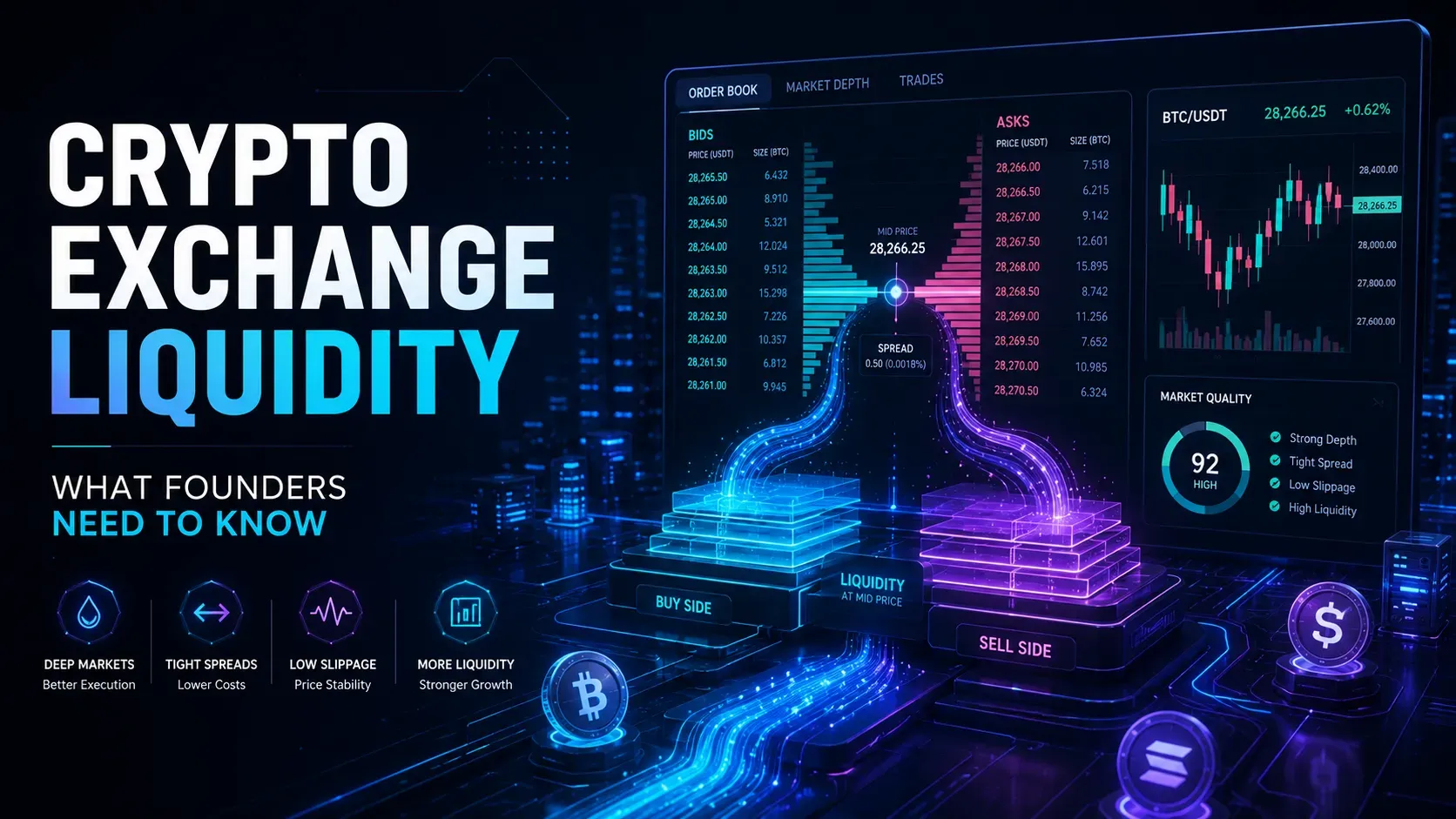
Liquidity describes how easily an asset can be traded without materially changing its market price. A liquid market has enough genuine buy and sell interest near the current price to absorb normal trading activity. On a centralized exchange, liquidity is visible through the order book. Buy orders create the bid side, while sell orders create the ask side. The highest bid and lowest ask form the best available prices. The difference between those prices is known as the bid-ask spread. Narrow spreads generally indicate that buyers and sellers are competing close to the market price. Wide spreads can make trading more expensive and suggest that the market has limited participation or weak market-making activity. Order-book liquidity also depends on depth. A market may display an attractive best price but contain very little volume behind it. When a customer submits a larger market order, the matching engine may consume several price levels, causing the average execution price to differ from the price initially displayed. Coinbase’s trading rules note that market orders may execute at several prices based on the order size and the quantities available in the book. Kraken similarly explains that the difference between the expected price and average execution price is slippage and that it can vary significantly with liquidity and order-book depth.
Why Liquidity Is Critical for a New Crypto Exchange
Liquidity is one of the strongest signals users use to judge whether an exchange is reliable. When traders see narrow spreads, active order books, frequent executions, and stable prices, they are more likely to place orders and keep funds on the platform. When they encounter empty books, severe slippage, or prices that differ greatly from the wider market, they may leave immediately. Poor liquidity can create a negative cycle. Limited activity produces weak order books, weak order books discourage traders, and declining participation makes it even harder to attract professional liquidity providers. Liquidity also affects revenue. Exchanges typically earn trading fees only when orders execute. A market with hundreds of registered users but little executable liquidity may generate less income than a smaller platform with active traders and healthy order flow. For founders, liquidity should therefore be treated as part of the product architecture, user-acquisition strategy, and financial model.
How to Measure Crypto Exchange Liquidity
No single metric provides a complete picture. Founders should evaluate liquidity through a combination of indicators:
- Bid-ask spread: The percentage difference between the best available buy and sell prices. Narrower spreads usually create more competitive execution.
- Order-book depth: The amount of buy and sell volume available within defined percentages of the mid-market price.
- Slippage: The difference between the expected price and the actual average execution price for a particular order size.
- Market impact: The extent to which executing an order changes the market price or consumes visible depth.
- Executable volume: The amount that can actually be traded near the current market price, rather than the total volume shown across distant price levels.
- Trading frequency: The number and consistency of genuine executions across a market.
- Recovery time: How quickly the order book returns to normal after a large order or sudden price movement.
- Price deviation: The difference between prices on the exchange and credible external reference markets.
Depth should never be evaluated in isolation. Kraken has highlighted that an order book can appear large while still being illiquid if buy and sell orders are positioned far apart, producing a very wide spread. Founders should also measure liquidity at different order sizes. A market may provide excellent execution for a $100 trade but produce unacceptable slippage for a $10,000 order.
Order-Book Liquidity on Centralized Exchanges
Centralized exchanges generally use a central limit order book and matching engine. Market makers place limit orders on both sides of the book. These orders add liquidity because they remain available for other traders to execute against. Takers remove liquidity by submitting orders that immediately match existing orders. This distinction is also reflected in exchange fee models. Coinbase Exchange and Kraken apply different fee treatment to maker orders that add liquidity and taker orders that remove it. For founders, the matching engine must process orders quickly and consistently, but speed alone is insufficient. The platform also needs reliable market-data feeds, accurate balances, predictable order priority, cancellation handling, and stable APIs. Professional market makers may connect through REST, WebSocket, or FIX interfaces. They need low-latency market data, order acknowledgements, execution reports, account information, and tools for managing large numbers of orders. If API performance is unstable, market makers may widen their spreads, reduce quote sizes, or disconnect entirely. A technical outage that lasts only a few minutes can therefore produce immediate liquidity deterioration.
Where New Exchanges Get Liquidity
A new exchange rarely generates deep organic liquidity from the first day. It usually needs external support while building its own user base.
Common liquidity sources include:
- Professional market makers that continuously quote buy and sell orders under a commercial agreement
- Liquidity providers and brokers that provide access to pricing or execution from established venues
- Exchange liquidity aggregation that routes or mirrors available depth from multiple sources
- Internal market-making systems operated by the exchange or an affiliated entity, subject to appropriate legal and conflict-of-interest controls
- Institutional and API traders attracted through competitive fees, low latency, strong infrastructure, and reliable execution
- Retail order flow generated through marketing, fiat access, local payment methods, and useful trading products
- Project-provided liquidity for newly listed tokens, managed under clear listing and market-making agreements
- Cross-exchange arbitrage traders that help align prices between the new platform and larger markets
Aggregating several providers can improve resilience, but it also increases technical complexity. Each source may use different symbols, minimum quantities, price increments, settlement rules, API behaviour, and risk limits. The exchange must normalize market data and ensure that orders displayed to users are genuinely executable. Displaying external prices without reliable execution or inventory can create failed orders and unexpected losses.
Liquidity Provider vs Market Maker
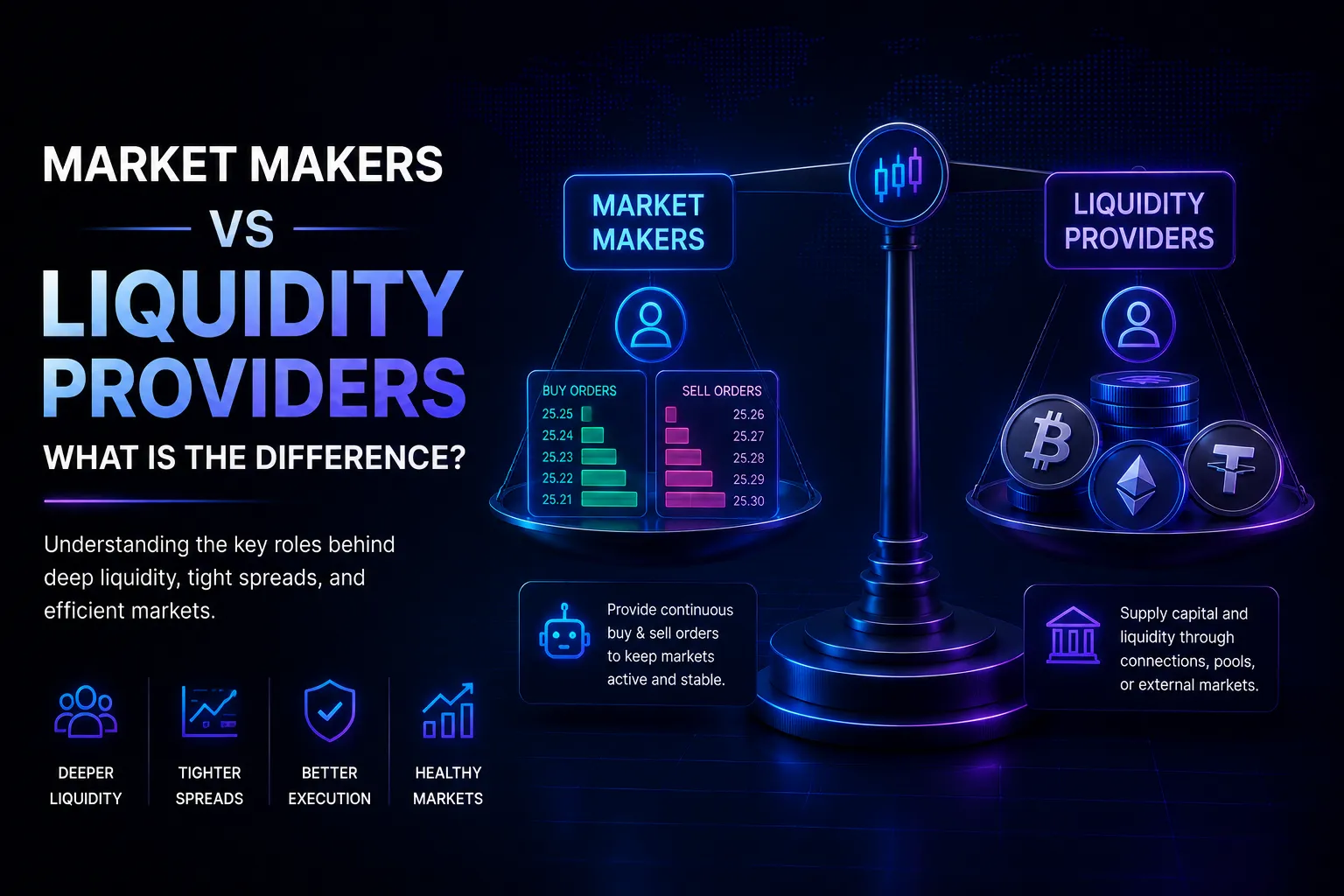
The terms liquidity provider and market maker are often used interchangeably, but they can describe different roles. A liquidity provider may give the exchange access to external prices, order flow, or inventory. A market maker actively maintains orders on both sides of a specific market and adjusts those orders as prices and risks change. A professional market maker earns from spreads, rebates, contractual payments, or a combination of these. In return, the exchange may require minimum quote sizes, maximum spreads, market-availability targets, and performance during volatile periods. Founders should not evaluate a provider only by the total volume it promises. They should examine quote quality, uptime, depth close to the mid-price, execution reliability, inventory capacity, market coverage, reporting, and behaviour during stress. A provider that creates large volumes through repetitive trades but contributes little genuine depth may make the platform look active without improving customer execution.
How Much Liquidity Does an Exchange Need?
There is no universal minimum. Required liquidity depends on the target users, listed assets, average trade size, product type, and competitive environment. A retail exchange serving small transactions may need less depth than an institutional platform. A Bitcoin-to-stablecoin market typically requires more liquidity than a newly listed small-cap token. Futures markets also need deeper and more resilient liquidity because leverage amplifies execution and liquidation risk. Instead of using one arbitrary target, founders should define service-level objectives for each market. For example, the exchange might set a maximum spread, minimum depth within 0.5% of the mid-price, maximum slippage for several order sizes, minimum market-maker uptime, and maximum permitted deviation from selected reference venues. These targets should be monitored continuously and adjusted as customer activity grows.
Liquidity and the Matching Engine
The matching engine does not create liquidity by itself. It organizes and executes the liquidity supplied by market participants. However, poor matching-engine design can damage otherwise healthy liquidity. Delayed order processing, inconsistent priority rules, failed cancellations, stale market data, or incorrect balances increase risk for professional traders. The engine should enforce price-time priority or another clearly documented allocation model. It must support appropriate order types, trading increments, self-trade prevention, market controls, and high-volume order management. For derivatives, liquidity infrastructure must also interact with mark prices, index prices, margin calculations, liquidations, and risk limits. A thin futures book can cause large price movements and unfair liquidations if the platform relies too heavily on its own last traded price.
Liquidity Aggregation
Liquidity aggregation combines prices and available volume from multiple sources into a unified trading environment. An aggregator may select the best bid and ask across several venues, divide an order among providers, or route execution to the source offering the best result. This approach can help a new exchange display tighter spreads and support larger trades. It can also reduce dependence on a single liquidity provider. However, aggregation introduces latency, reconciliation, inventory, and settlement risk. External liquidity may disappear between the moment a price is displayed and the moment an order is routed. The platform needs controls for stale quotes, provider outages, partial fills, symbol mismatches, rejected orders, rate limits, and differences in available balances. Founders must also decide whether customer trades are executed internally, externally, or through a hybrid model.
Internalization and External Execution
An exchange may match customer orders against other customers, route them to external liquidity, or internalize some transactions using its own inventory. Internal matching can reduce external trading costs and keep fee revenue within the platform. External routing can provide better depth during the early stages of the exchange. A hybrid model can choose the most appropriate path based on price, order size, available inventory, market conditions, and counterparty limits. The risk is that internalization can create conflicts of interest if the exchange trades against customers without transparent rules and proper controls. Legal review, execution policies, reporting, and separation of responsibilities are essential.
Liquidity for Newly Listed Tokens
New token markets are particularly difficult because historical volume may be limited and fair price discovery may not yet exist. Before listing a token, the exchange should evaluate circulating supply, token distribution, available markets, expected users, project treasury controls, market-maker arrangements, and concentration among major holders. Launching a market with insufficient liquidity may produce extreme volatility. Even small orders can move the price sharply, making the asset vulnerable to manipulation and damaging both the project and the exchange. Founders should establish minimum launch conditions, including committed inventory, quote obligations, reference pricing, spread limits, and monitoring for wash trading or abnormal order behaviour. Market-making commitments should also have a defined duration. A token may appear liquid during a promotional launch and become almost untradeable when incentives end.
CEX Liquidity vs DEX Liquidity
A decentralized exchange typically obtains liquidity from assets deposited into smart-contract pools rather than from a traditional centralized order book. Automated market makers use formulas to adjust prices as traders change the balance of assets in the pool. Uniswap v3 also introduced concentrated liquidity, which allows liquidity providers to allocate capital within selected price ranges rather than across every possible price. This can improve capital efficiency, but DEX liquidity has different risks. Providers face smart-contract exposure, price-range management, impermanent loss, gas costs, and on-chain execution constraints. A hybrid product may combine a centralized order book with on-chain settlement or external DEX liquidity. Founders should understand that CEX and DEX liquidity cannot always be combined without additional routing, custody, pricing, and risk-management infrastructure.
Common Liquidity Mistakes Founders Make
A common mistake is launching too many markets. Liquidity becomes fragmented across dozens or hundreds of trading pairs, leaving each order book weak. Another mistake is focusing on reported trading volume rather than execution quality. High volume can result from incentives, internal activity, or wash trading and may not represent genuine customer liquidity. Founders may also rely on a single provider without a backup, underestimate the technical requirements of professional traders, or sign agreements without measurable service levels. Unsustainable fee rebates are another risk. Paying large incentives can attract temporary volume, but liquidity may disappear when the programme ends. The exchange should prioritize a smaller number of strong markets, measure real execution quality, diversify its providers, and gradually expand as organic activity develops.
How to Build a Sustainable Liquidity Strategy
The first step is defining the platform’s target customer and core markets. A local retail exchange, an institutional venue, and a derivatives platform will require different liquidity profiles. Next, the operator should select providers, define commercial terms, and establish objective performance requirements. These should cover spreads, depth, uptime, response time, market coverage, and behaviour during volatility. The technology must then support aggregation, monitoring, risk controls, API access, reporting, and automatic provider failover where appropriate. Finally, the exchange must create organic demand. Liquidity providers can support the order book, but they cannot replace genuine users indefinitely. Fiat payments, customer trust, product quality, competitive fees, and relevant markets are what eventually convert supplied liquidity into a functioning marketplace.
How Javizen Supports Crypto Exchange Liquidity
Javizen develops modular exchange infrastructure that can connect matching engines, liquidity providers, market makers, pricing feeds, order books, wallets, risk controls, and administrative monitoring. Depending on the exchange model, the platform can support external liquidity integration, market-making tools, configurable fee tiers, trading-pair management, automated price feeds, spot and derivatives markets, and reporting for liquidity performance. Administrative teams can monitor markets, manage providers, adjust trading parameters, review spreads and depth, and respond to abnormal conditions through a unified control environment. The appropriate liquidity architecture should be defined according to the operator’s target markets, expected volumes, supported products, regulatory structure, and commercial relationships.
Conclusion
Crypto exchange liquidity is one of the most important factors determining whether a new platform can attract and retain traders. Healthy liquidity produces tighter spreads, lower slippage, stronger price discovery, more trading activity, and greater user confidence. Poor liquidity creates the opposite effect, even when the exchange’s interface and technical features appear professional. Founders should define liquidity targets before launch, start with a focused set of markets, work with reliable providers, build infrastructure for professional traders, and monitor execution quality continuously. Liquidity is not a one-time integration. It is an ongoing operational function that connects the matching engine, APIs, market makers, pricing feeds, risk controls, fees, and customer demand. By treating liquidity as a core product and infrastructure requirement, exchange operators can create markets that remain stable, competitive, and commercially sustainable.
Frequently asked questions
What is liquidity in a crypto exchange?
Liquidity is the ability to buy or sell crypto quickly and at a predictable price without causing significant market movement.
Can a new crypto exchange operate without a market maker?
Technically yes, but its order books may remain empty until it attracts enough organic traders. Most new exchanges require market makers or external liquidity during their early stages.
What is a good bid-ask spread?
There is no universal figure. A good spread depends on the asset, volatility, order size, and competing venues. Major markets generally require tighter spreads than newly listed or less actively traded assets.
Does high trading volume always mean high liquidity?
No. Volume does not show how much can be executed near the current price. Founders must also examine spreads, depth, slippage, and market impact.
What is liquidity aggregation?
Liquidity aggregation combines prices and available volume from multiple providers or exchanges to improve execution and reduce dependence on one source.
Does the matching engine provide liquidity?
No. The matching engine matches existing buy and sell orders. Liquidity is supplied by traders, market makers, external providers, or the exchange’s own inventory model.
آخر مقال
 06 Sep, 2026
How to Build a Crypto Options Trading Platform
 05 Sep, 2026
How to Launch a Crypto Prop Trading Platform
 03 Sep, 2026
How to Scale a Crypto Exchange for High Trading Volume
 02 Sep, 2026
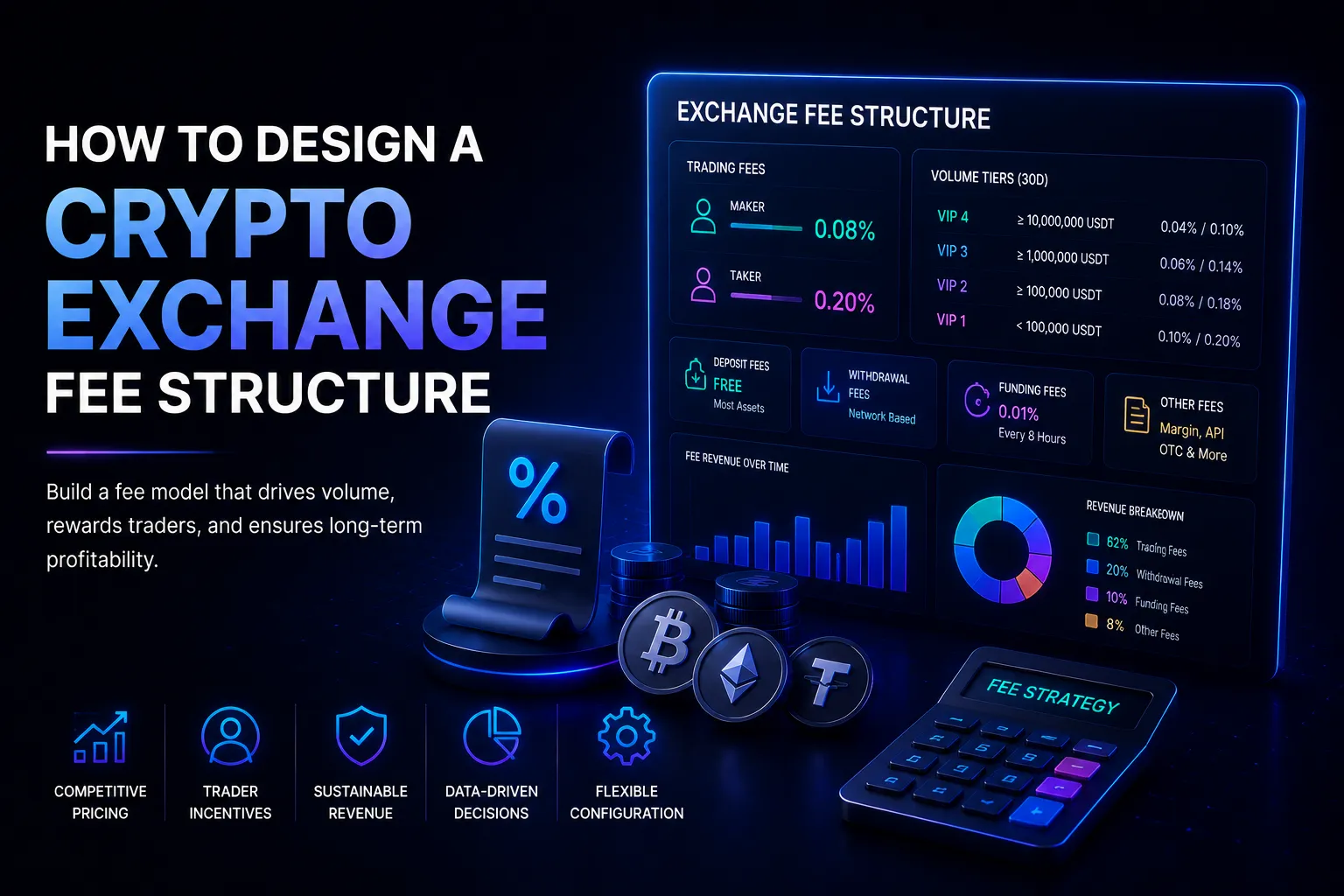
How to Design a Crypto Exchange Fee Structure
 01 Sep, 2026
Market Makers vs Liquidity Providers: What Is the Difference?
Build with Javizen.
Planning an exchange, token or blockchain product? Talk to our team and turn the ideas in this article into a launch-ready platform.