
Custodial Wallets vs Non-Custodial Wallets for Exchanges
What Is a Custodial Crypto Wallet?
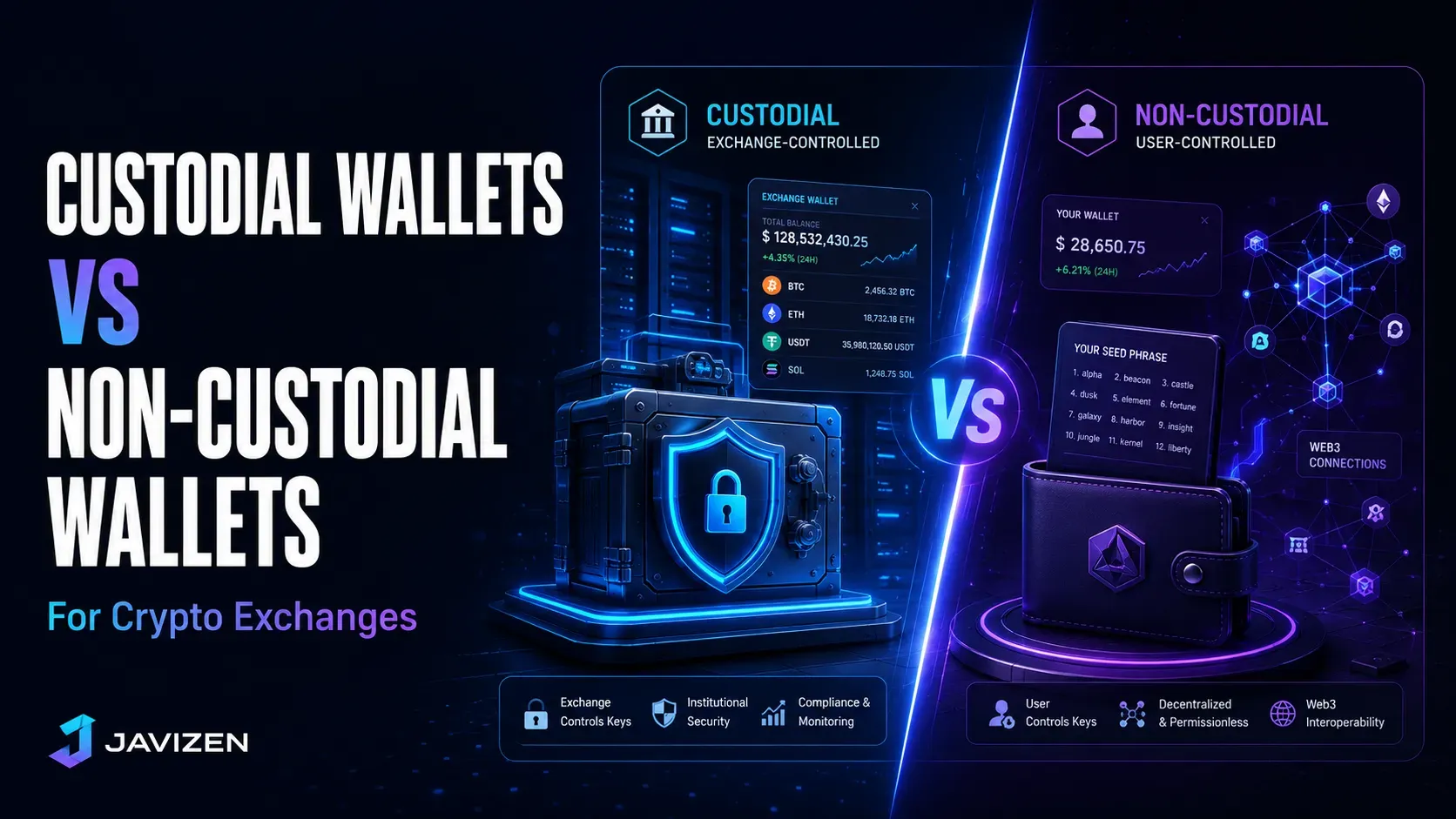
A custodial wallet is a wallet in which a third party controls the private keys required to move the assets. On a centralized exchange, users normally sign in with an email address, password, passkey, or multifactor authentication rather than signing every transaction directly with a blockchain private key. The exchange maintains the wallet infrastructure and records each customer’s balance in its internal ledger. Coinbase defines a custodial wallet as one managed by a centralized entity, such as an exchange, that holds the wallet’s private keys. It also explains that assets held in a Coinbase account are stored or custodied for the customer’s benefit. Custody does not necessarily mean that every customer receives a separate on-chain wallet containing exactly their account balance. Exchanges often combine deposit-address management, omnibus wallets, hot wallets, warm storage, and cold storage with an internal accounting system. This architecture allows thousands of trades to occur without creating a separate blockchain transaction for every execution.
What Is a Non-Custodial Wallet?
A non-custodial wallet, also called a self-custody or self-hosted wallet, gives the user control over the keys used to authorize blockchain transactions. The wallet does not physically store cryptocurrency. The assets remain recorded on the blockchain, while the wallet manages the cryptographic credentials that control them. In a traditional self-custody model, the user is responsible for protecting a private key, seed phrase, hardware device, or another recovery mechanism. If the required credentials are lost and no recovery method exists, the platform cannot normally restore access. Coinbase distinguishes its custodial exchange account from its self-custody wallet by explaining that the exchange manages keys for Coinbase accounts, while users directly control the keys associated with the self-custody product. Modern non-custodial products do not always rely on a single seed phrase. Some use multiparty computation, social login, distributed key shares, or programmable recovery. These systems can improve usability, but the fundamental question remains whether the provider can independently control or move customer assets.
Custodial vs Non-Custodial Wallets: Key Differences
Exchange founders should evaluate the two models across several operational dimensions:
- Control of private keys: The exchange or custodian controls custodial-wallet keys, while users control non-custodial-wallet credentials.
- Account recovery: Custodial platforms can usually restore account access after identity and security checks. Traditional self-custody wallets may not be recoverable if the user loses the required credentials.
- Transaction execution: Custodial exchanges can process internal transfers and trades without waiting for an on-chain transaction. Non-custodial activity generally requires blockchain or smart-contract execution.
- Compliance controls: Custodial exchanges can apply withdrawal holds, sanctions controls, transaction limits, account restrictions, and approval workflows before assets leave the platform.
- User responsibility: Custodial users rely on the platform’s security, while non-custodial users must protect their own keys and approve transactions carefully.
- Trading performance: Custodial systems are generally better suited to high-frequency order-book trading because balance updates occur within the exchange ledger.
- Web3 access: Non-custodial wallets can connect directly to decentralized applications, smart contracts, NFT platforms, and DeFi protocols.
- Counterparty exposure: Custodial users depend on the exchange’s solvency, governance, cybersecurity, and withdrawal policies. Non-custodial users avoid direct custody exposure but remain exposed to phishing, malicious contracts, key theft, and user error.
Neither model removes risk. It changes where the risk is concentrated and who is responsible for managing it.
Why Centralized Exchanges Use Custodial Wallets
Centralized exchanges need to process large numbers of orders quickly. Executing every trade directly on a public blockchain would introduce network fees, confirmation delays, congestion, and limited throughput. A custodial architecture allows the exchange to update balances internally when trades occur. Blockchain transactions are generally required only when customers deposit assets from outside the platform or withdraw them to external addresses. This model also supports unified balances across spot trading, futures, staking, P2P trading, lending, token sales, and other services. Funds can be reserved, released, transferred, or restricted according to the state of each transaction. Custodial infrastructure also provides a more familiar account experience. Customers can reset login credentials, contact support, use multifactor authentication, and recover access after losing a device. For exchange operators, however, custody creates significant responsibility. The platform becomes responsible for protecting customer assets, maintaining accurate ledgers, managing blockchain fees, detecting suspicious withdrawals, and ensuring that authorized transactions are signed safely.
Custodial Wallet Security Architecture
A production exchange should not store all customer assets in one online wallet. Most custodial platforms separate assets across hot, warm, and cold environments. Hot wallets maintain enough liquidity for routine withdrawals. Cold wallets keep larger reserves offline or behind highly restricted signing procedures. Warm storage may sit between these layers for operational rebalancing. Modern custody systems may use hardware security modules, multisignature schemes, or multiparty computation. MPC can split signing authority across several parties or devices so that a complete private key is not assembled in one location. Coinbase describes an institutional non-custodial implementation in which key shares remain split during generation and signing, illustrating how distributed signing can also support self-custody designs. The architecture should also enforce transaction policies. Large withdrawals may require several approvals, while unusual addresses, new devices, or high-risk blockchain exposure may trigger delays or manual review. Strong wallet security combines cryptography with operational controls. Even an advanced signing method can fail if administrators have excessive permissions, backups are poorly managed, or internal processes are not auditable.
Benefits of Custodial Wallets for Exchanges
The greatest advantage of custody is operational efficiency. Customers can trade immediately after funds are credited, move balances between exchange products, and execute transactions without paying a network fee for every internal action. The exchange can aggregate blockchain transactions, manage gas costs, and maintain liquidity across supported networks. Custodial wallets also make it easier to provide customer support. The exchange can lock compromised accounts, reverse incorrect internal transfers where policy permits, and restore login access after verification. From a compliance perspective, custodial platforms can screen deposits and withdrawals, collect Travel Rule information, restrict prohibited transactions, and maintain transaction records. FATF guidance generally treats exchanges, transfer services, and certain hosted-wallet providers as virtual asset service providers when they conduct covered activities for customers. Such businesses may therefore face customer due diligence, record-keeping, monitoring, and reporting obligations depending on the jurisdiction.
Risks of Custodial Wallets
Custodial platforms create concentrated security risk because they control assets belonging to many customers. A successful attack against wallet infrastructure, employee credentials, signing systems, or withdrawal controls may produce substantial losses. The exchange must also protect against insider threats, unauthorized policy changes, and operational mistakes. Customers face counterparty risk as well. They depend on the exchange to maintain sufficient assets, process withdrawals, secure private keys, and operate honestly. Another risk is inaccurate internal accounting. Blockchain balances alone do not reveal how much each customer is owed. The platform must maintain a reliable double-entry ledger and reconcile it continuously with on-chain assets, pending deposits, withdrawals, fees, trading activity, and liabilities. Custody may also increase licensing, reporting, capital, insurance, and audit requirements. Founders should obtain jurisdiction-specific legal advice before deciding how customer assets will be held.
Benefits of Non-Custodial Wallets
Non-custodial wallets give users direct control over their assets. The wallet provider generally cannot freeze funds, block a transaction, or move assets without the user’s authorization. Users can interact directly with supported blockchains and transfer assets without first requesting a withdrawal from an exchange. Self-custody may also reduce the amount of customer assets concentrated in the exchange’s own wallets. This can limit the financial impact of a breach of the exchange’s infrastructure. For Web3-focused platforms, non-custodial architecture allows customers to access decentralized applications, token swaps, lending protocols, NFT markets, and smart contracts from the same wallet. MetaMask describes itself as a self-custodial wallet that provides users with control over their blockchain assets and access to decentralized applications.
Risks of Non-Custodial Wallets
The main disadvantage of self-custody is that user mistakes can be irreversible. Users may lose recovery credentials, approve malicious smart contracts, send assets to the wrong network, expose private keys through phishing, or install fraudulent wallet software. An exchange cannot always recover funds or cancel transactions after they are confirmed on-chain. Customer support therefore has less control over the final outcome. Non-custodial trading may also be slower or more expensive. Each deposit, swap, settlement, or withdrawal may require a blockchain transaction and network fee. Performance depends on the underlying chain and smart contracts rather than only on the exchange’s internal systems. Compliance can also be more complicated. Regulators and platforms may require risk-based controls for transfers involving self-hosted wallets, including address screening, customer information collection, wallet-ownership checks, or enhanced monitoring in certain circumstances. FATF distinguishes hosted-wallet activity from transactions involving unhosted wallets and continues to evaluate the risks and controls associated with these transfers.
Which Wallet Model Is Better for an Exchange?
The best model depends on the product. A high-volume centralized spot or derivatives exchange will generally need custodial infrastructure. It allows fast execution, internal settlement, unified balances, liquidation controls, and efficient management of user funds. A decentralized exchange or Web3 trading application may use a non-custodial model in which users connect their own wallets and authorize transactions through smart contracts. A retail platform may combine both. Customers can hold assets in a custodial exchange account for trading while using an integrated non-custodial wallet for DeFi, NFTs, and direct blockchain access. Founders should choose based on trading speed, customer experience, target market, compliance obligations, asset support, recovery expectations, and operational capability rather than using custody terminology as a marketing decision.
Hybrid Wallet Architecture
A hybrid exchange offers custodial and non-custodial experiences within one ecosystem. For example, users may deposit funds into a custodial account for order-book trading and later transfer assets to a self-custody wallet. The platform may also allow users to connect external wallets for deposits, identity verification, token sales, or Web3 features. Hybrid architecture can broaden the product offering, but the distinction between wallet types must remain clear. Users should always understand who controls the keys, whether transactions are internal or on-chain, which fees apply, and whether account recovery is possible. The platform must also separate the security boundaries of each system. A compromise in the exchange account should not automatically expose a user-controlled wallet, and wallet permissions should not grant unnecessary access to centralized account functions.
Wallet Infrastructure Requirements for Exchange Founders
Before launching wallet services, founders should confirm that the platform supports:
- Secure key generation, backup, rotation, recovery, and signing across supported networks
- Hot, warm, and cold wallet separation with configurable asset thresholds
- Deposit-address creation, blockchain confirmation rules, and chain-reorganization handling
- Withdrawal limits, allowlists, risk scoring, approval workflows, and emergency suspension
- Internal double-entry accounting with continuous on-chain reconciliation
- Network-fee estimation, transaction replacement, nonce management, and failed-transaction recovery
- Role-based permissions, immutable audit logs, and segregation of administrative duties
- Blockchain monitoring, sanctions screening, Travel Rule workflows, and compliance case management
These controls should be designed before substantial customer balances are accepted. Retrofitting a secure custody architecture after launch is considerably more difficult.
How Javizen Supports Exchange Wallet Infrastructure
Javizen develops modular wallet infrastructure for centralized exchanges, trading platforms, token-sale systems, P2P markets, and other blockchain products. A Javizen exchange can integrate deposit-address management, hot and cold wallet workflows, internal user ledgers, withdrawal approval rules, fee management, blockchain monitoring, account limits, and administrative reporting. The wider platform can connect wallet status to KYC/KYB checks, trading permissions, risk scoring, transaction monitoring, and user notifications. Depending on the business model, Javizen can also support external-wallet connections and non-custodial experiences alongside the main custodial exchange infrastructure. The final design should reflect the operator’s legal structure, supported networks, customer segments, liquidity model, transaction volume, and security requirements.
Conclusion
The custodial versus non-custodial wallet decision affects every part of a crypto exchange, including trading performance, security, compliance, customer support, blockchain operations, and user trust. Custodial wallets provide the speed, internal settlement, recovery options, and operational control required by most centralized exchanges. However, they make the operator responsible for protecting customer assets and maintaining accurate records. Non-custodial wallets give users direct control and broader access to Web3 services, but they place greater responsibility on customers and make lost credentials or incorrect transactions more difficult to resolve. For many exchange businesses, the strongest approach is a carefully designed custodial core with transparent withdrawals and optional non-custodial functionality. Whatever model is selected, founders must define key ownership clearly and build security, compliance, recovery, and auditability into the platform from the beginning.
Frequently asked questions
Are exchange wallets custodial?
Most centralized exchange wallets are custodial because the exchange controls the keys and manages transactions for customers. Decentralized exchanges generally allow users to trade through non-custodial wallets.
Is a non-custodial wallet safer?
It removes direct custody exposure to an exchange, but it transfers key-management and transaction risk to the user. Safety depends on the wallet design, recovery method, device security, and user behaviour.
Can a custodial exchange lose customer funds?
Yes. Wallet breaches, insider attacks, signing errors, poor controls, or financial failure can place customer funds at risk. Exchanges need layered security, accurate accounting, and operational safeguards.
Can a non-custodial wallet recover lost keys?
Traditional self-custody wallets usually cannot recover lost keys or seed phrases. Some newer systems provide social recovery, MPC key shares, or account-abstraction recovery mechanisms.
Do non-custodial wallets require KYC?
A wallet application may not always require KYC merely to provide software. However, regulated exchange, brokerage, payment, or transfer services integrated into the wallet may have separate verification requirements.
Can an exchange offer both wallet types?
Yes. Many platforms provide custodial exchange accounts alongside self-custody wallets or external-wallet connectivity. The interface must clearly explain which party controls each wallet.
آخر مقال
 06 Sep, 2026
How to Build a Crypto Options Trading Platform
 05 Sep, 2026
How to Launch a Crypto Prop Trading Platform
 03 Sep, 2026
How to Scale a Crypto Exchange for High Trading Volume
 02 Sep, 2026
How to Design a Crypto Exchange Fee Structure
 01 Sep, 2026
Market Makers vs Liquidity Providers: What Is the Difference?
Build with Javizen.
Planning an exchange, token or blockchain product? Talk to our team and turn the ideas in this article into a launch-ready platform.