
DeFi’s Yield Machine Has a Risk Problem
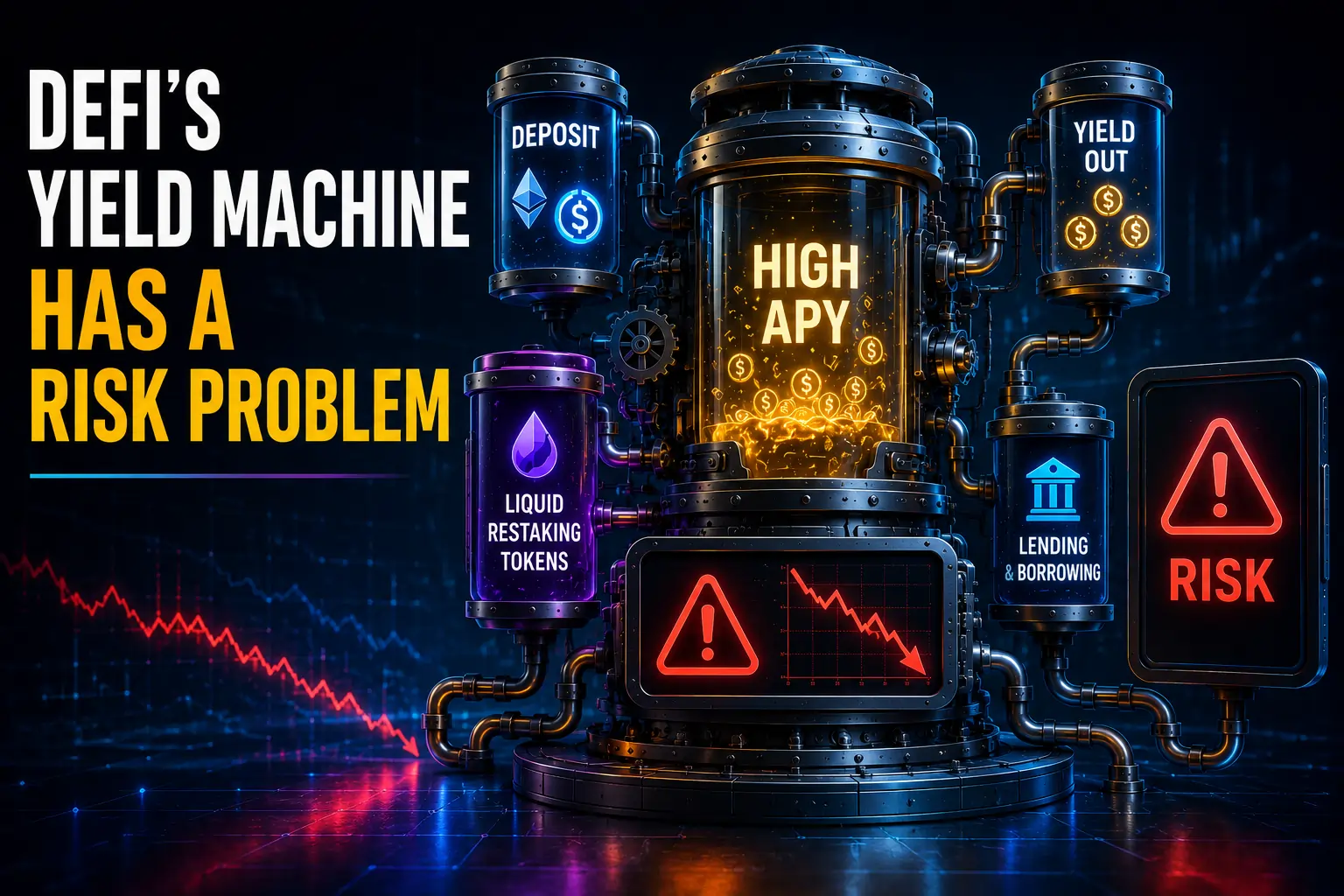
Why Is DeFi Yield Risky?
DeFi yield is risky because returns often come from complex systems that depend on smart contracts, leverage, collateral, liquid staking tokens, bridges, or restaking protocols. A yield opportunity may look simple on the surface, but behind it there may be multiple layers of risk. In simple words, DeFi yield is not free money. It is usually a reward for taking risk. Some risks are obvious, such as token price volatility. Others are hidden, such as smart contract bugs, oracle failures, bridge exploits, liquidation cascades, depegged tokens, and interconnected protocol exposure. The problem is that DeFi has become a yield machine. Users deposit assets into one protocol, receive a liquid token, use that token as collateral somewhere else, borrow against it, restake it, bridge it, or loop it through multiple platforms. This creates attractive returns, but it also creates fragile chains of dependency. When one link breaks, the damage can spread quickly.
Why DeFi Yield Became So Popular
DeFi became popular because it gave users access to financial tools without traditional banks or brokers. Users could lend, borrow, trade, stake, provide liquidity, and earn yield directly through blockchain protocols. For many crypto users, this was revolutionary. Instead of keeping tokens idle in a wallet, they could put them to work. DeFi yield can come from several sources:
- Lending interest
- Trading fees
- Staking rewards
- Liquidity provider fees
- Token incentives
- Restaking rewards
- Points programs
- Borrowing and looping strategies
- Real-world asset yield
The appeal is easy to understand. Users want passive income. Protocols want liquidity. Tokens need incentives. DeFi creates a marketplace where capital moves toward yield. But when yields become the main attraction, risk can be underestimated.
The Hidden Problem With “Passive” DeFi Income
Many beginners think DeFi yield is passive income. In reality, it is often active risk exposure. When you deposit into a DeFi protocol, you may be exposed to more than one risk at the same time. You may be trusting a smart contract, a price oracle, a governance system, a bridge, a validator set, a liquid staking token, a restaking operator, and a lending market. The interface may show a simple APY number, but that number does not explain the full risk structure. For example, a 12% yield may look better than a 4% yield. But if the 12% yield depends on leverage, token incentives, bridge security, and an unstable collateral asset, it may be much riskier than it appears. This is the core issue: DeFi is excellent at displaying yield, but not always good at displaying risk.
Restaking: The New Layer of Yield
Restaking is one of the most important DeFi trends behind the current risk debate. In normal staking, users stake assets to help secure a blockchain and earn rewards. Restaking allows the same staked assets to be used again to secure additional networks, services, or applications. The idea is powerful. Instead of needing separate security for every new protocol, restaking can reuse existing economic security from a major blockchain ecosystem. But this also adds risk. If the same asset is used to secure multiple systems, a failure in one place can affect the restaked position. Users may earn extra yield, but they are also accepting extra exposure. This is why restaking is often described as a “one-to-many” security model. One asset can support many services. But one mistake can also create wider consequences.
Liquid Restaking Tokens: Useful but Complex
Liquid restaking tokens, or LRTs, make restaking easier to use in DeFi. When users restake assets, they may receive a liquid token that represents their restaked position. That token can then be used in other DeFi protocols, such as lending markets, liquidity pools, or yield platforms. This unlocks capital efficiency. A user can earn restaking rewards while still using the liquid token elsewhere. But it also creates layered risk. An LRT may depend on:
- The underlying staked asset
- The staking protocol
- The restaking protocol
- The validator or operator
- The AVS or service being secured
- The smart contract issuing the LRT
- The bridge if the token moves across chains
- The DeFi protocol accepting it as collateral
- The market liquidity of the token
That is a lot of dependency for one “yield” product. If any part fails, the LRT may lose value, depeg, become illiquid, or create bad debt in lending markets.
The Kelp DAO Lesson: How Risk Spreads
Recent DeFi incidents have shown how quickly risks can spread when liquid restaking tokens are used across multiple protocols. When a liquid restaking token is widely accepted as collateral, a problem with that token can affect lending markets, liquidity pools, borrowers, lenders, and other protocols. Even if a major lending protocol is not directly hacked, it can still face stress if the collateral inside its markets becomes questionable. This is one of the biggest problems with modern DeFi: protocols are connected. A bridge exploit is not only a bridge problem. A depegged LRT is not only an LRT problem. A collateral failure is not only a borrower problem. In DeFi, one asset can sit inside many systems at once. This interconnectedness can make DeFi efficient during normal times and fragile during stress.
Why High APY Can Be a Warning Sign
A high APY is not automatically bad, but it should always raise questions. In finance, higher return usually means higher risk. DeFi is no different. A protocol may offer high yield because it is paying token incentives. That yield may disappear when incentives end. Another protocol may offer high yield because it needs liquidity urgently. Another may be using leverage or complex strategies. Another may depend on new tokens, points, or speculative rewards. Before chasing high APY, users should ask:
- Where does the yield come from?
- Is it paid from real revenue or token emissions?
- Is leverage involved?
- Is the strategy using bridges?
- Is the asset used as collateral elsewhere?
- Is the protocol audited?
- Is the token liquid enough to exit?
- Could the yield collapse if market conditions change?
If the yield source is unclear, the risk is probably higher than it looks.
The Main Risks Behind DeFi Yield
1. Smart Contract Risk
DeFi protocols run on code. If the code has a bug, attackers may exploit it. Even audited protocols can fail.
2. Bridge Risk
Bridges are often used to move assets across blockchains. They are also one of the most attacked parts of crypto infrastructure.
3. Oracle Risk
Many DeFi platforms rely on price oracles. If an oracle gives incorrect or manipulated prices, liquidations and bad debt can follow.
4. Liquidation Risk
When users borrow against collateral, falling collateral value can trigger liquidation. In volatile markets, liquidations can cascade quickly.
5. Depeg Risk
Liquid staking tokens, restaking tokens, stablecoins, and wrapped assets can trade below their expected value during stress.
6. Liquidity Risk
A token may look valuable on paper but be hard to sell during panic. Low liquidity can make losses worse.
7. Governance Risk
Some protocols can change rules through governance. Poor decisions, malicious governance, or centralization can affect users.
8. Slashing Risk
In staking and restaking, validators or operators may be penalized for failures or misbehavior. Users may indirectly bear that loss.
9. Composability Risk
DeFi protocols are often connected like building blocks. This is useful, but it also means one failure can spread across the system.
Why Composability Is Both DeFi’s Strength and Weakness
DeFi is often called “money Legos” because protocols can connect with each other. A token from one protocol can be used inside another. A lending market can accept a liquid staking token. A yield optimizer can route funds across multiple strategies. A stablecoin can be used in pools, farms, and collateral systems. This creates innovation and efficiency. But it also creates contagion risk. When everything connects, risk travels faster. If one token depegs, protocols using that token as collateral may suffer. If one bridge fails, assets on multiple chains may be affected. If one lending market liquidates positions, other markets may see pressure. Composability makes DeFi powerful. It also makes DeFi harder to understand.
How Beginners Can Evaluate DeFi Yield
Beginners should not judge a DeFi opportunity by APY alone. A safer approach is to evaluate the full risk profile. Start with the protocol. Is it established? Has it been audited? Does it have a history of incidents? Is the team transparent? Is there real revenue? Then study the asset. Is it ETH, a stablecoin, an LST, an LRT, a wrapped token, or a small governance token? How liquid is it? Can it depeg? Next, examine the strategy. Is it simple lending? Liquidity provision? Restaking? Leveraged looping? Cross-chain farming? The more steps involved, the more risks you may be taking. Finally, ask what happens in a bad scenario. If the token drops 20%, if the bridge pauses, if liquidity disappears, or if the oracle fails, can you exit? If you cannot understand the downside, you should not chase the upside.
Is DeFi Yield Still Worth It?
DeFi yield is not automatically bad. It can be useful when users understand the risks. Lending stablecoins, staking ETH, providing liquidity, or using established protocols can all have legitimate use cases. DeFi can create open financial markets, improve capital efficiency, and give users more control. The problem is not yield itself. The problem is yield without risk awareness. A 4% yield from a transparent source may be better than a 20% yield from a fragile strategy. A lower return with clear risk may be healthier than a higher return built on leverage, emissions, and hidden dependencies. Good DeFi users think like risk managers, not just yield hunters.
What DeFi Protocols Should Improve
DeFi protocols need better risk communication. Instead of only showing APY, platforms should show:
- Yield source
- Smart contract risk
- Bridge exposure
- Collateral risk
- Oracle dependency
- Liquidity depth
- Slashing exposure
- Historical depeg data
- Leverage level
- Exit conditions
Users should not need to read dozens of documents to understand basic risks. As DeFi matures, risk dashboards may become as important as yield dashboards. The next generation of DeFi platforms may compete not only on APY, but on transparency and safety.
Final Thoughts
DeFi’s yield machine is powerful, but it has a risk problem. The same systems that make DeFi attractive also make it fragile. Liquid staking, restaking, bridges, lending markets, collateral loops, and composable protocols can create higher returns, but they also create deeper dependencies. For beginners, the most important lesson is simple: APY is not the full story. Before entering any DeFi strategy, understand where the yield comes from, what can break, how liquid the asset is, and what happens during market stress. DeFi is not going away. It will likely become more sophisticated, more connected, and more important. But if it wants mainstream adoption, it must become better at explaining risk. The future of DeFi will not belong only to the protocols with the highest yields. It will belong to the protocols that make risk visible before users learn about it the hard way.
Frequently asked questions
Why is DeFi yield risky?
DeFi yield is risky because it can depend on smart contracts, bridges, leverage, collateral, liquid staking tokens, restaking protocols, and market liquidity.
What is restaking risk?
Restaking risk comes from using the same staked asset to secure additional services or protocols. This can create extra yield, but also extra exposure.
What are liquid restaking tokens?
Liquid restaking tokens are tokens that represent restaked assets. They can be used in DeFi, but they add risks such as depeg risk, bridge risk, and protocol dependency.
Is high APY in DeFi safe?
Not always. High APY often means higher risk, token incentives, leverage, low liquidity, or unsustainable rewards.
What is DeFi composability risk?
Composability risk happens when many DeFi protocols are connected. A failure in one protocol or asset can affect others.
Can DeFi protocols lose user funds?
Yes. Funds can be lost through hacks, smart contract bugs, bad collateral, liquidations, oracle failures, bridge exploits, or governance issues.
Is DeFi yield still useful?
Yes, DeFi yield can be useful when users understand the risks and choose transparent, sustainable strategies.
Latest Post
 06 Sep, 2026
How to Build a Crypto Options Trading Platform
 05 Sep, 2026
How to Launch a Crypto Prop Trading Platform
 03 Sep, 2026
How to Scale a Crypto Exchange for High Trading Volume
 02 Sep, 2026
How to Design a Crypto Exchange Fee Structure
 01 Sep, 2026
Market Makers vs Liquidity Providers: What Is the Difference?
Build with Javizen.
Planning an exchange, token or blockchain product? Talk to our team and turn the ideas in this article into a launch-ready platform.