
Crypto Exchange Architecture: A Complete Guide for Founders
What Is Crypto Exchange Architecture?
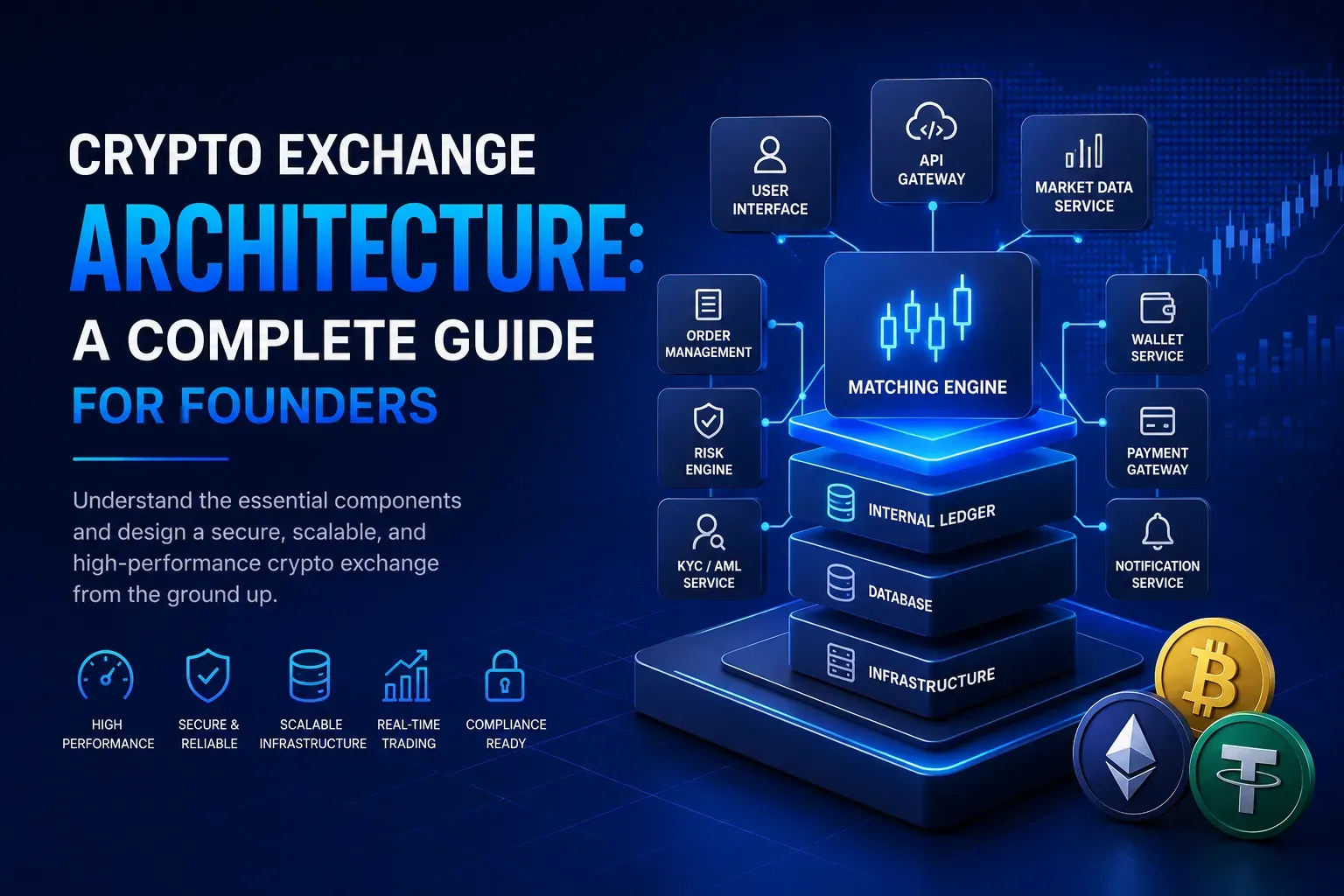
Crypto exchange architecture describes how the platform’s software, data, infrastructure, and external integrations work together. From the user’s perspective, an exchange may appear to be a single website or mobile application. Behind that interface, several specialized systems handle authentication, balances, orders, trades, deposits, withdrawals, prices, risk checks, compliance reviews, and notifications. The architecture must coordinate these systems without losing financial data or allowing conflicting actions. For example, funds reserved for an open order must not also be available for withdrawal. A completed trade must update both counterparties accurately. A blockchain deposit should not be credited before the required confirmation conditions are met. This is why an exchange should be treated as financial infrastructure rather than a conventional e-commerce application.
Start with the Exchange Model
Architecture should follow the business model, not the other way around. A custodial centralized exchange normally maintains customer balances through an internal ledger and settles blockchain transactions only for deposits and withdrawals. A decentralized exchange relies more heavily on smart contracts and user-controlled wallets. A derivatives platform additionally requires margin calculations, mark prices, liquidations, insurance mechanisms, and position-risk controls. Founders should also define whether the platform will support fiat payments, spot trading, futures, staking, P2P transactions, institutional accounts, liquidity aggregation, or token-sale services. These decisions affect the databases, wallet structure, APIs, security boundaries, regulatory workflows, and operational team required for the platform.
Core Components of a Crypto Exchange
A complete centralized exchange architecture generally includes:
- User and identity service: Registration, authentication, multifactor security, customer profiles, devices, sessions, KYC/KYB status, and account restrictions.
- API gateway: A controlled entry point for web, mobile, institutional, and third-party API requests, with authentication, rate limiting, routing, and request validation.
- Order management system: Validates orders, checks balances, reserves funds, tracks order states, and communicates with the matching engine.
- Matching engine: Matches compatible buy and sell orders according to defined priority rules and produces trade events.
- Internal ledger: Records customer liabilities, available balances, reserved balances, fees, transfers, deposits, withdrawals, and adjustments.
- Wallet infrastructure: Manages blockchain addresses, confirmations, signing policies, hot and cold storage, network fees, and withdrawals.
- Market data service: Distributes order books, trades, tickers, candles, and price updates through REST and WebSocket interfaces.
- Admin and compliance systems: Provide KYC review, transaction monitoring, wallet controls, fee management, market configuration, reports, alerts, and immutable audit history.
These components should have clear responsibilities. When one service is responsible for too many unrelated operations, a failure or security compromise can affect a much larger part of the exchange.
The Matching Engine
The matching engine is the core of an order-book exchange. It receives valid orders, compares buy and sell prices, executes compatible orders, and publishes trade results. It may follow price-time priority, where better-priced orders execute first and orders at the same price are processed according to arrival time. The engine should remain deterministic. Given the same ordered sequence of commands, it should produce the same results. This makes replay, auditing, and recovery easier. Latency is important, particularly for professional traders and market makers. AWS notes that network proximity between components matters for latency-sensitive financial workloads, including automated trading systems. Coinbase International Exchange has also described using cloud-native infrastructure and a low-latency database architecture for near-real-time transaction access. The engine should avoid unnecessary network calls during matching. Identity checks, reporting, emails, blockchain queries, and analytics should not sit directly in the order-execution path.
Order Management and Balance Reservation
The order management system sits between clients and the matching engine. Before an order is accepted, it should verify that the account is active, the market is available, the quantity and price meet market rules, and sufficient funds exist. When a user places a sell order, the relevant asset should move from available balance to reserved balance. For a buy order, the required quote currency should be reserved. This prevents users from spending or withdrawing the same funds twice. After execution, cancellation, or expiration, the system updates the reserved and available amounts according to the final order state. These balance movements must be recorded through the ledger rather than by directly editing a balance field.
The Internal Ledger
The internal ledger is often more important than the visible trading interface. It records how much the exchange owes each customer. A custodial exchange cannot determine individual customer balances merely by looking at its blockchain wallets because assets are commonly pooled across omnibus, hot, warm, and cold wallets. A double-entry approach provides stronger accounting integrity. Every financial movement creates balanced entries. A trade debits one asset and credits another, while fees are transferred to the appropriate exchange account. The ledger should distinguish between available, reserved, pending, locked, and total balances. It should also preserve an immutable financial history rather than overwriting previous records. Blockchain holdings, bank balances, customer liabilities, pending withdrawals, fees, and operational accounts should be reconciled regularly. A mismatch should create an immediate investigation event.
Wallet and Blockchain Architecture
Wallet infrastructure connects the exchange’s internal accounting system to public blockchains. The deposit service generates or assigns addresses, monitors supported networks, detects incoming transactions, waits for the required confirmations, and credits the correct ledger account. The withdrawal service validates customer requests, applies risk and security rules, estimates network fees, creates signing requests, broadcasts transactions, and tracks final status. Customer assets should not all remain in internet-connected wallets. A common model uses hot wallets for routine operations and more restricted storage for larger reserves. Signing systems should be separated from the main application and admin panel. Private keys should never be displayed to administrators. The platform should submit policy-controlled signing requests through secure infrastructure. Blockchain access can be provided through self-hosted nodes, managed node services, or several redundant providers. AWS Managed Blockchain, for example, offers managed access to public blockchain nodes, illustrating one option for reducing direct node-management work.
APIs and Market Data
Exchange APIs serve retail applications, institutional clients, market makers, mobile apps, and internal services. REST APIs are suitable for account actions, historical data, and order submission. WebSocket connections are commonly used for rapidly changing market data such as order books, trades, and tickers. Public market-data traffic should be separated from authenticated account operations. This prevents a surge in public requests from affecting orders, balances, or withdrawals. The API layer should implement strict authentication, object-level authorization, rate limits, request validation, idempotency, and monitoring. OWASP’s API Security Top 10 identifies broken object-level authorization, broken authentication, unrestricted resource consumption, and unrestricted access to sensitive business flows as major API risks. Institutional users may also require FIX connectivity, dedicated limits, API-key permissions, IP restrictions, and high-frequency order-management support.
Event-Driven Architecture
Event-Driven Architecture Many exchange processes do not need to run synchronously. After a trade completes, the platform may need to update charts, calculate fees, publish market data, generate reports, notify users, update risk models, and send information to compliance systems. An event-streaming platform can distribute these events to independent consumers. Apache Kafka describes event streaming as a way to read, write, store, and process events across multiple machines and is commonly used for high-performance data pipelines and mission-critical applications. This architecture reduces direct dependencies between services. The matching engine can publish a trade event without waiting for every downstream system to finish. However, event-driven systems require careful handling of duplicate events, ordering, retries, idempotency, and failed consumers.
Database and Cache Strategy
One database technology is rarely ideal for every exchange workload. The ledger and critical account records normally require a transactional database with strong consistency. Market data and analytics may use time-series, columnar, or specialized storage. Searchable logs and compliance cases may require separate indexes. Redis or a similar in-memory platform may support sessions, temporary rate-limit counters, frequently accessed configuration, and cached market data. Redis documentation explains that clustering can distribute data across nodes and that replication and automatic promotion can improve availability. A cache should not become the only source of truth for balances, trades, withdrawals, or compliance decisions. Cached data may be lost, delayed, or stale. The authoritative data store and recovery process should always be clear.
Security Architecture
Exchange security should use several independent layers. Public services, internal services, databases, wallet systems, and administrative tools should operate within separate security zones. Access should be denied by default and granted only when necessary. Administrative roles should follow least privilege, and high-risk actions should require additional approval. Secrets should be managed through dedicated systems rather than application code or configuration files. Security logs should capture authentication activity, permission changes, withdrawal approvals, balance adjustments, market changes, API-key creation, and data exports. The exchange should also implement encryption, dependency scanning, vulnerability testing, DDoS protection, backups, disaster recovery, and incident-response procedures. The current OWASP Top 10 identifies major web-application risks, while its API guidance covers risks specific to service interfaces. Both should inform the exchange’s security testing programme.
Scalability and High Availability
Not every component needs the same scaling model. Market-data services may require broad horizontal scaling because many users consume the same information. The matching engine may benefit more from strict ordering, predictable latency, and controlled partitioning by market. User services, reporting, notifications, and compliance workloads can scale independently. Critical databases should use replication, tested backups, and failover procedures. Redis documentation similarly distinguishes replication, clustering, and persistence as separate mechanisms for availability, scaling, and durability. High availability should cover infrastructure failures, software crashes, provider outages, and operational mistakes. Failover that exists only in architecture diagrams is not sufficient; it must be tested.
Architecture Mistakes Founders Should Avoid
Common failures include building the entire exchange as one application, storing balances as editable values without an auditable ledger, placing slow external integrations in the trading path, and treating a cache as a financial database. Another mistake is allowing the admin panel to communicate directly with wallet keys or production databases. Sensitive actions should pass through controlled services, permissions, policies, and audit logs. Founders also frequently underestimate reconciliation, blockchain edge cases, market-data load, and the needs of professional liquidity providers. Launching too many products at once can make the architecture difficult to test and operate. Spot, futures, P2P, staking, lending, and token sales introduce different financial states and risks. A focused modular foundation is usually safer than a large platform with tightly coupled features.
Architecture Checklist for Founders
Before launch, founders should verify that the exchange can:
- Maintain an immutable and reconcilable ledger for all customer balances
- Reserve funds correctly across orders, withdrawals, and other products
- Isolate the matching engine from slow external services
- Separate public APIs, authenticated APIs, admin systems, and wallet infrastructure
- Process deposits, confirmations, withdrawals, failures, and chain reorganizations safely
- Recover from service, database, infrastructure, and third-party provider failures
- Enforce role-based permissions, dual approvals, and complete audit logging
- Monitor latency, liquidity, balances, blockchain health, errors, security, and financial mismatches
This is the article’s second and final list. Architecture reviews should include engineering, security, finance, compliance, wallet operations, and market operations because each team depends on different parts of the system.
How Javizen Supports Crypto Exchange Architecture
Javizen develops modular infrastructure for centralized exchanges, P2P platforms, futures, options, token sales, wallets, and other blockchain products. The architecture can connect user management, KYC/KYB, matching-engine services, internal ledgers, liquidity providers, custodial wallets, market data, fees, reporting, notifications, and administrative controls. Because different exchange businesses have different requirements, components can be configured according to the target market, jurisdiction, custody model, supported assets, and expected transaction volume. This modular approach also allows operators to begin with a focused spot-exchange architecture and later add futures, staking, P2P, institutional services, or other products without rebuilding the entire platform.
Frequently Asked Questions
Conclusion
Crypto exchange architecture must coordinate trading, accounting, custody, compliance, security, and operations without sacrificing financial accuracy. The strongest design separates the low-latency trading path from slower business processes, uses an immutable internal ledger, protects wallet signing infrastructure, and connects services through controlled APIs and events. Founders should not evaluate architecture only by speed or the number of supported users. Recoverability, reconciliation, access control, auditability, and operational visibility are equally important. A modular architecture allows the exchange to launch with a focused product and add new services as the business grows. When the technical structure matches the exchange model from the beginning, the platform is easier to secure, operate, scale, and adapt to regulatory requirements.
Frequently asked questions
What is the most important part of crypto exchange architecture?
The internal ledger is one of the most important components because it records customer balances and financial movements. The matching engine, wallet infrastructure, and security controls are also critical.
Should a crypto exchange use microservices?
Microservices can improve isolation and independent scaling, but they also introduce operational complexity. A modular architecture with clear service boundaries is more important than using a particular label.
Can Redis store exchange balances?
Redis may support caching and temporary operational data, but authoritative customer balances should generally remain in a durable transactional ledger.
Why should the matching engine be isolated?
Isolation protects order execution from slow APIs, blockchain providers, reporting tasks, and other services that could increase latency or cause failures.
Does a crypto exchange need blockchain nodes?
It needs reliable blockchain access. This may come from self-hosted nodes, managed providers, or a redundant combination of both.
Can one architecture support spot and futures trading?
Yes, but futures require additional components for positions, collateral, mark prices, margin, liquidation, funding, and risk management.
Latest Post
 06 Sep, 2026
How to Build a Crypto Options Trading Platform
 05 Sep, 2026
How to Launch a Crypto Prop Trading Platform
 03 Sep, 2026
How to Scale a Crypto Exchange for High Trading Volume
 02 Sep, 2026
How to Design a Crypto Exchange Fee Structure
 01 Sep, 2026
Market Makers vs Liquidity Providers: What Is the Difference?
Build with Javizen.
Planning an exchange, token or blockchain product? Talk to our team and turn the ideas in this article into a launch-ready platform.