
Has Bitcoin's Four-Year Cycle Finally Broken?
Recent Research & Real‑Time Market Analysis (2025–2026 Update)
Bitcoin’s historic four‑year cycle — driven by its programmed halving events — has long been considered one of the most reliable frameworks for predicting price behavior in crypto markets. However, mounting evidence from analysts, institutional research, and real‑time data is shaking this narrative. As of mid‑2026, analysts and academic research are debating whether the traditional Bitcoin price cycle is broken, evolving, or simply changing shape.
| In this comprehensive analysis, we’ll explore: |
|---|
| What the four‑year cycle was supposed to be |
| Why the 2024–2026 cycle deviates from historical norms |
| Latest research and institutional insights |
| What this means for traders and long‑term investors |
| Where Bitcoin may be headed next |
What Is the Bitcoin Four‑Year Cycle? (Halving Theory Recap)
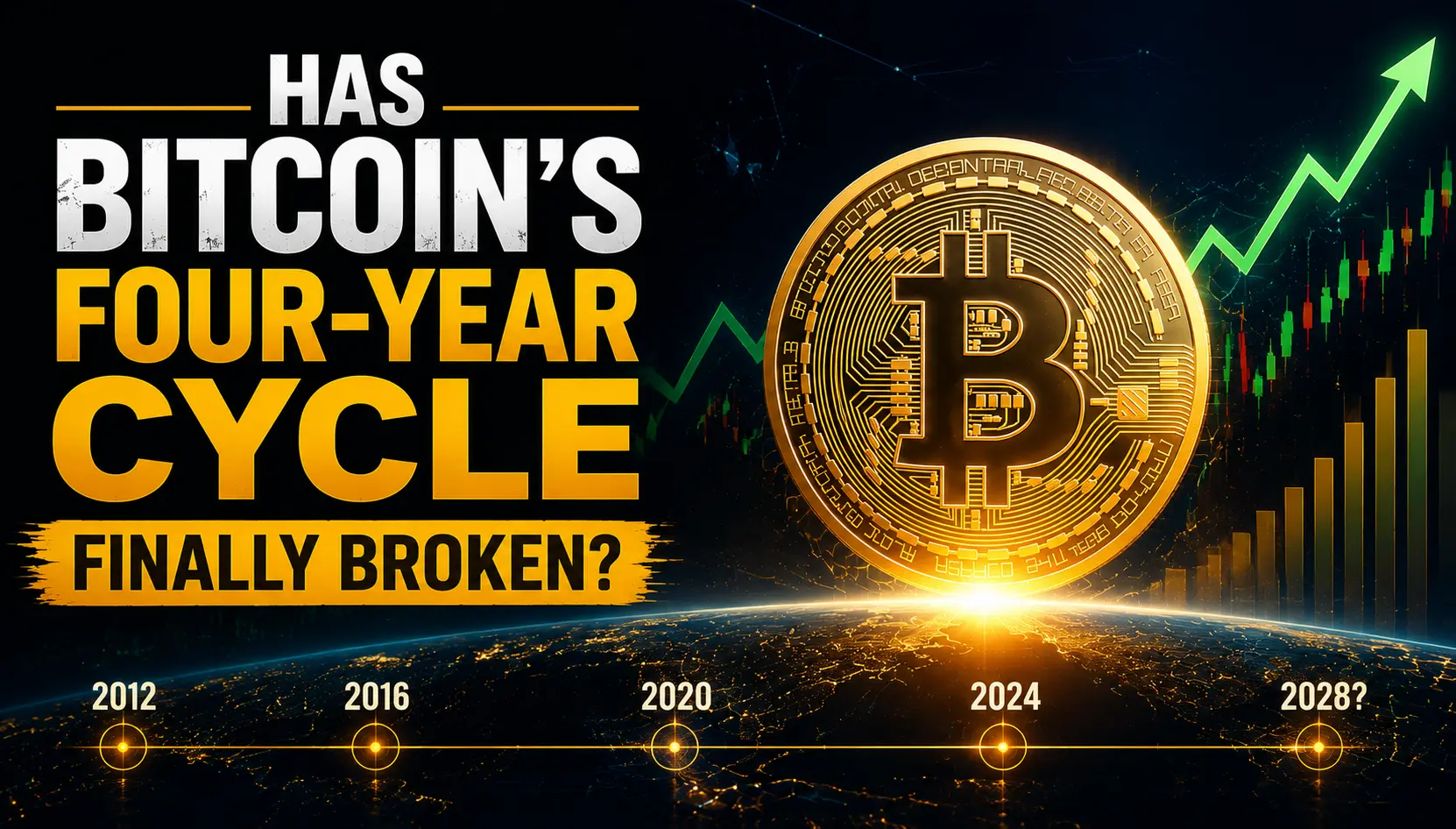
Bitcoin’s four‑year cycle emerges from its halving events, which cut miner rewards by half roughly every ~210,000 blocks. This reduces new BTC issuance, theoretically increasing scarcity. Historically: 1. 2012 Halving → Bitcoin later rallied over 7,000% 2. 2016 Halving → Post‑halving gains ~291% 3. 2020 Halving → Post‑halving gains ~541% These cycles would typically unfold over ~12–18 months after the halving, culminating in a peak, followed by a bear market before the next halving reset. Because these repeatable patterns helped traders plan entries and exits, the four‑year cycle grew into a widely accepted investment framework — sometimes called the “Bitcoin calendar cycle.”
Why Analysts Are Questioning the Four‑Year Cycle in 2025–2026
1. The 2024 Halving Didn’t Trigger the Expected Bull Run
Despite the April 2024 halving, Bitcoin failed to deliver a historic rally of past magnitudes. While previous cycles saw exponential post‑halving growth, the 2024–2025 cycle offered:
- A modest post‑halving gain (~31% over the first year)
- A price peak before the halving — a first in Bitcoin history
- A flattened correction, not a swift parabolic blow‑off
This deviation is a strong sign that the classic halving → scarcity → retail FOMO → parabolic rise model may be weakening.
2. Institutional Capital Is Now the Dominant Buyer
Analysts point to a structural shift in demand drivers. Instead of retail traders piling in after a halving, institutional inflows — led by spot Bitcoin ETFs and corporate treasuries — have replaced retail as the marginal buyer. ETF inflows in 2025‑2026 frequently dwarfed the daily new BTC miner supply — fundamentally altering market dynamics. The result?
- Reduced volatility
- Muting of traditional blow‑off tops
- A more programmatic, orderly accumulation period
This change challenges the assumption that halvings alone can generate parabolic rallies.
3. Volatility Has Compressed Dramatically
Volatility — a hallmark of earlier Bitcoin cycles — has contracted significantly. Recent research and market analysis show that price swings and key on‑chain top signals (like MVRV Z‑Score and Puell Multiple) have not reached levels typical of past cycle peaks. Lower volatility suggests a maturing market, possibly due to:
- Bigger, deeper pools of liquidity
- More long‑term holders
- Greater participation by institutional players
All of which can dampen panic buying and selling — meaning cycles may no longer have the same amplitude they once did.
Spark
4. Macro and Regulatory Forces Matter More Today
Bitcoin is no longer an isolated digital asset emerging from retail speculation — it’s now tied into:
- Global monetary policy cycles
- Interest‑rate expectations
- Regulatory frameworks in the U.S., EU, and Asia
- Institutional investment mandates
This macro overlay weakens the pure halving‑alone thesis and introduces new timing variables that can stretch or compress typical cycle timelines.
Morgan Stanley
Institutional Views: Dead, Evolving, or Transformed?
Some Experts Say the Cycle Is Dead
Market commentators from crypto research firms and hedge fund strategists have explicitly stated that the four‑year cycle may be finished as a reliable model. According to one analysis, closing 2025 in negative territory for the first time after a halving challenges the foundational assumption of predictable post‑halving rallies.
Others Say It’s Evolving but Not Gone
Not all researchers agree. Institutional analysts like those at Fidelity argue that the cycle is still playing out but in a different shape — slower moves, muted volatility, and sideways market phases that make the post‑halving behavior look weaker, but not obsolete.
A New Institutional Regime
According to a recent institutional research thesis, Bitcoin’s cycle mechanics haven’t vanished — they’ve transitioned from retail‑driven dynamics to institutional capital flows. In this view:
- Halving still matters at the supply level
- But the price discovery mechanism now depends on ETF flows, corporate balance sheets, and sovereign reserve strategies
- Retail investors no longer set the price direction
This institutional dominance keeps price trends steadier but removes the explosive patterns that defined earlier cycles.
Academic Research Adds Depth to the Debate
Recent peer‑reviewed studies (e.g., Ribeirão Preto University research) examine how cumulative returns and volatility behave around halving events. These studies show that while halving still exerts some influence, the overall relationship is weakening as markets mature and external forces matter more. Another academic effort using causal analysis found evidence that the 2024 halving did have a short‑term positive impact on price, though far smaller than expected — again highlighting that halving is no longer the sole dominant force.
Implications for Investors and Traders
Whether the cycle is broken or transformed, the practical implications are meaningful.
1. Don’t Rely on Halving Dates Alone
Traditional buy‑the‑dip after a halving campaigns may not work as historically reliable timing strategies any more.
2. Focus on On‑Chain, Macro, and ETF Flows
Metrics like ETF inflows, miner activity, and institutional allocation may provide better lead indicators than halving countdown clocks.
3. Prepare for Extended and Flattened Cycles
If institutional dominance continues, cycles may span beyond four years in duration — with shallower peaks and longer accumulation periods.
4. Embrace a Risk‑Managed Strategy
Risk management, diversification, and logical entry/exit criteria become even more vital when old cycle dates lose predictive power.
Where Might Bitcoin Go Next?
Bullish Scenario – Institutional Maturation
Bitcoin may still reach new all‑time highs in 2027 or 2028, but in a smoother, less volatile fashion compared to earlier cycles. Long‑term holders could benefit from ongoing accumulation without brutal selloffs.
Neutral Scenario – Cycle Extension
Bitcoin could still follow its four‑year rhythm, but with shifted timing — meaning cycle lows might occur later than expected, while peaks align more with macro triggers than strict halving dates.
Bearish Scenario – Macro Pressure Dominates
If macro stress intensifies — e.g., rising rates or regulatory headwinds — Bitcoin could experience deeper corrections, further challenging the case for a strict halving cycle.
Conclusion: Broken, Changing, or Transitional?
The question “Has Bitcoin’s four‑year cycle finally broken?” doesn’t have a simple yes/no answer — but the strongest consensus from recent research and market behavior is:
The traditional halving‑driven four‑year cycle has materially changed — it may not be dead, but its mechanics are no longer the sole or even the strongest driver of price.
Institutional capital flows, macroeconomic conditions, and deeper market liquidity now exert powerful influence over Bitcoin’s trajectory. The halving still matters at a fundamental level, but cycles appear to be evolving into a new paradigm that merges halving effects with broader market forces. For investors, this means shifting from strictly calendar‑based strategies to more holistic approaches that account for institutional behavior, liquidity flows, volatility, and macro conditions — all of which are shaping Bitcoin’s future more decisively than ever before.
Frequently asked questions
What is Bitcoin’s four-year cycle?
Bitcoin’s four-year cycle refers to the pattern of price behavior historically linked to its halving events. Every ~210,000 blocks, the reward for miners is halved, reducing new supply and historically influencing post-halving price rallies.
What factors could be affecting the cycle?
+ Increased institutional participation + Macro-economic conditions like inflation and interest rates + Regulatory developments across global markets + Higher market maturity and liquidity These factors can dampen the parabolic swings traditionally associated with the cycle.
What is the future of Bitcoin’s four-year cycle?
The cycle may continue but in an altered form. Longer accumulation phases, muted rallies, and stronger influence from institutions and macroeconomic conditions suggest the traditional four-year timing may be less predictive but still useful for contextual analysis.
Latest Post
 06 Sep, 2026
How to Build a Crypto Options Trading Platform
 05 Sep, 2026
How to Launch a Crypto Prop Trading Platform
 03 Sep, 2026
How to Scale a Crypto Exchange for High Trading Volume
 02 Sep, 2026
How to Design a Crypto Exchange Fee Structure
 01 Sep, 2026
Market Makers vs Liquidity Providers: What Is the Difference?
Build with Javizen.
Planning an exchange, token or blockchain product? Talk to our team and turn the ideas in this article into a launch-ready platform.