
What Is DePIN? The Crypto Trend Connecting Blockchain to Real-World Infrastructure
What Is DePIN?
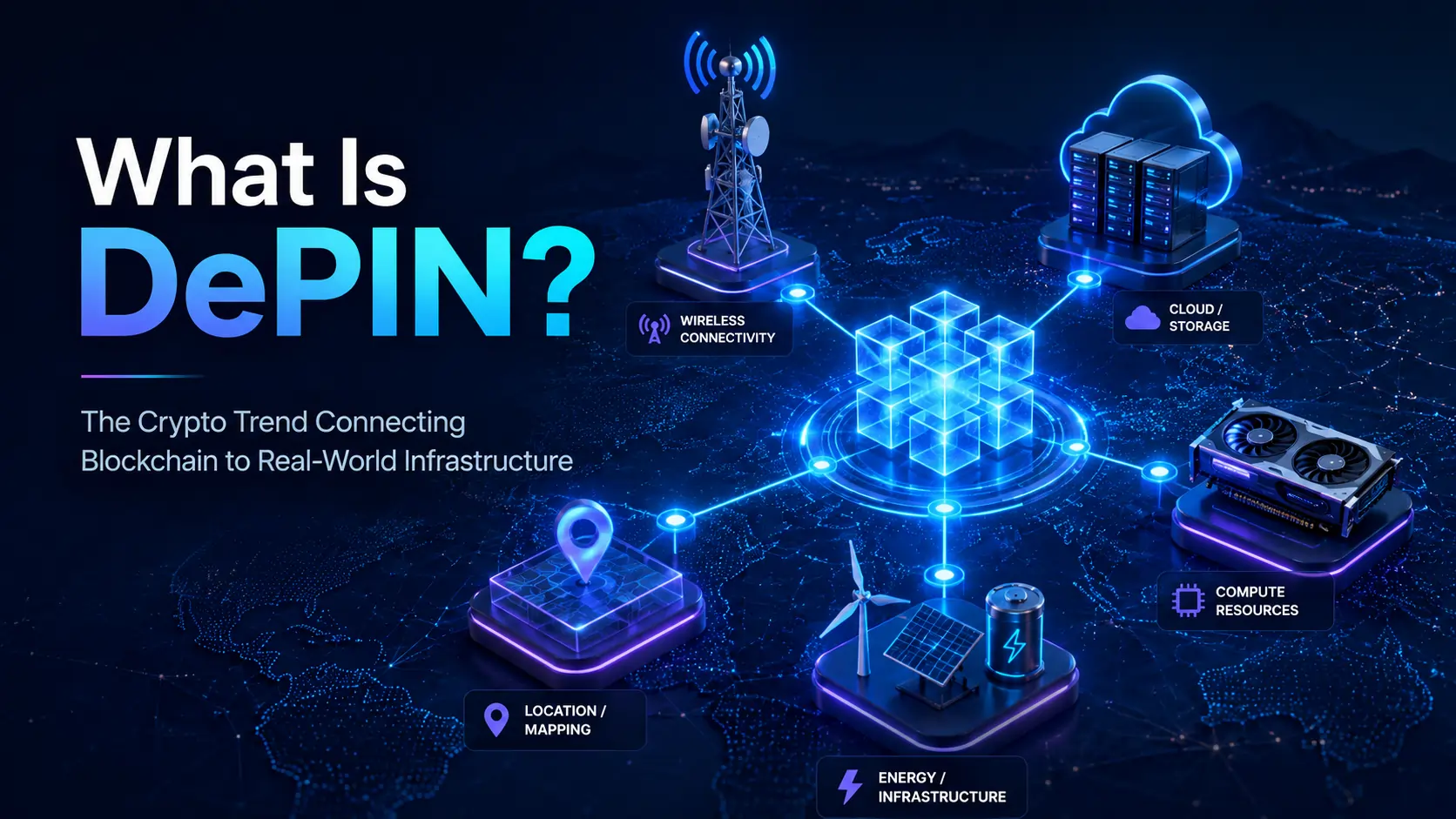
DePIN stands for Decentralized Physical Infrastructure Networks. It refers to blockchain-powered networks where people contribute real-world resources, such as internet connectivity, storage, computing power, sensors, mapping data, or energy infrastructure, and receive token rewards in return. In simple words, DePIN uses crypto incentives to build and operate real-world infrastructure without relying only on large centralized companies. Instead of one company owning all the hardware, a DePIN network can allow thousands of individuals or businesses to contribute devices, data, bandwidth, storage, or computing power. The blockchain helps coordinate rewards, track contributions, verify activity, and create an open marketplace for infrastructure services. DePIN is important because it connects crypto to something practical: real-world infrastructure.
Why DePIN Matters in Crypto
For many beginners, crypto still feels abstract. Bitcoin is digital money. DeFi is online finance. NFTs are digital collectibles. But DePIN is different because it connects blockchain to physical systems and real-world services. DePIN tries to answer a big question: Can blockchain help build infrastructure in the real world? Traditional infrastructure is usually built by governments, telecom companies, cloud providers, energy companies, logistics firms, or large corporations. These systems can be expensive, centralized, slow to expand, and difficult for ordinary users to participate in. DePIN offers a different model. It uses token incentives to encourage people to contribute resources to a shared network. If the network becomes useful, contributors may earn rewards, users may access cheaper or more open services, and the ecosystem may grow without needing one central company to build everything alone. This is why DePIN is often described as one of the strongest real-world use cases for crypto.
How Does DePIN Work?
A DePIN network usually has three main parts: contributors, users, and blockchain-based incentives. Contributors provide physical or digital infrastructure. This could be a wireless hotspot, storage space, GPU power, vehicle data, environmental sensor, mapping device, or energy resource. Users consume the service. For example, a user may need decentralized storage, wireless coverage, compute power, location data, or sensor information. The blockchain tracks and rewards contributions. Smart contracts and token systems can help distribute rewards based on useful activity, network demand, and verified service quality. A simple DePIN model works like this: 1. A person installs or connects a device. 2. The device provides a useful service to the network. 3. The network verifies the contribution. 4. The contributor earns token rewards. 5. Users pay for access to the infrastructure or service. 6. The network grows as more contributors join. The goal is to create a self-reinforcing system: more contributors create better infrastructure, better infrastructure attracts more users, and more users create stronger demand.
Simple Example of DePIN
Imagine a decentralized wireless network. Instead of one telecom company building all towers and charging users, thousands of people install small wireless devices in their homes, offices, shops, or public spaces. These devices provide coverage for nearby users or connected machines. When a device provides useful coverage, the owner earns token rewards. Users or businesses can then access the network for connectivity. This is the basic DePIN idea: infrastructure is built from the bottom up by many participants, not only from the top down by one central company. The same concept can apply to cloud storage, GPU computing, mapping, weather sensors, mobility data, energy grids, and other infrastructure services.
Main Types of DePIN Projects
DePIN is not one single category. It includes several different infrastructure sectors.
1. Wireless Networks
Some DePIN projects focus on decentralized wireless coverage. Participants install hotspots or network devices and earn rewards for providing useful connectivity.
2. Decentralized Storage
Storage DePIN projects allow users to rent unused storage space from distributed providers instead of relying only on centralized cloud storage companies.
3. Compute and GPU Networks
Compute DePIN projects connect people who need processing power with providers who have unused computing or GPU resources. This is especially relevant as AI increases demand for compute.
4. Sensor Networks
Some networks use physical sensors to collect real-world data, such as weather, air quality, traffic, noise, location, or environmental information.
5. Mapping and Mobility Data
Some DePIN projects reward users for contributing mapping, traffic, or mobility data. This can help create decentralized alternatives to centralized mapping platforms.
6. Energy Infrastructure
Energy-related DePIN projects may connect distributed energy resources, battery systems, charging stations, or grid-related data.
The common theme is simple: users contribute real-world resources and receive blockchain-based incentives.
Why DePIN Is Becoming Popular
DePIN is becoming popular because it has a clearer link to real demand than many speculative crypto narratives. Many crypto projects depend mainly on token trading. DePIN projects, at least in theory, aim to create real services that people or businesses actually use. Several trends are making DePIN more relevant:
- Rising demand for cloud computing and AI infrastructure
- Growing need for decentralized storage
- Expansion of connected devices and IoT
- Higher cost of centralized infrastructure
- Demand for open data networks
- Interest in real-world crypto use cases
- Growth of tokenized incentive models
DePIN also fits the larger movement toward user-owned networks. Instead of only using platforms owned by large companies, participants can help build and benefit from the network.
Benefits of DePIN
1. Real-World Utility
DePIN connects blockchain to practical services such as connectivity, data, storage, and computing.
2. Lower Infrastructure Costs
A decentralized network may grow by using resources from many participants instead of requiring one company to fund all infrastructure upfront.
3. Community Participation
Users can become contributors, not just customers. This can create stronger network ownership and engagement.
4. Token Incentives
Tokens can reward people for providing useful infrastructure and help bootstrap early network growth.
5. Decentralization
Instead of relying on one provider, DePIN networks can distribute infrastructure across many independent participants.
6. Open Marketplaces
DePIN can create marketplaces where users buy services from distributed providers, potentially increasing competition and efficiency.
Risks and Challenges of DePIN
DePIN is promising, but it is not risk-free. The first risk is token speculation. Some DePIN projects may attract investors before proving real demand. A token can rise because of hype even if the network has few paying users. The second risk is weak economics. If rewards are too high and real revenue is too low, the token model may not be sustainable. The third risk is verification. DePIN networks must prove that contributors are providing real services, not fake activity. This is called proof of physical work or proof of useful work. The fourth risk is hardware cost. Some networks require users to buy devices. If rewards fall, contributors may not recover their investment. The fifth risk is reliability. Real infrastructure needs strong uptime, coverage, performance, and support. Decentralized networks must compete with professional centralized providers. The sixth risk is regulation. Wireless, energy, mapping, and data networks may face local legal requirements. The seventh risk is user demand. A DePIN project is only valuable if people actually use the infrastructure.
DePIN vs Traditional Infrastructure
Traditional infrastructure is usually built by a central company or government. The organization owns the assets, controls access, sets prices, and manages operations. DePIN uses a more distributed model. Many participants provide resources, while blockchain coordinates incentives and settlement. Here is the simple difference:
| Feature | Traditional Infrastructure | DePIN |
|---|---|---|
| Ownership | Centralized | Distributed |
| Funding | Company or government capital | Community and token incentives |
| Access | Controlled by provider | Potentially more open |
| Rewards | Company captures revenue | Contributors may earn tokens |
| Transparency | Private systems | More on-chain visibility |
| Growth Model | Top-down expansion | Bottom-up participation |
This does not mean DePIN will replace all traditional infrastructure. In many cases, it may complement existing systems.
DePIN and AI: Why Compute Networks Matter
One of the most important DePIN trends is decentralized compute. AI applications need huge amounts of computing power, especially GPUs. Large cloud providers control much of this infrastructure, and compute can be expensive. DePIN compute networks try to create alternative marketplaces where people or companies can provide unused computing resources. Developers, AI startups, or applications may then rent that compute through a decentralized system. This is one reason DePIN is often connected to the AI crypto narrative. If AI demand continues to grow, decentralized compute could become one of the strongest DePIN use cases. However, competing with major cloud providers is difficult. DePIN compute networks must prove they can offer reliability, speed, security, and competitive pricing.
Is DePIN a Real Use Case or Hype?
DePIN has real use-case potential, but not every DePIN project is strong. The real use case appears when a network provides a service that people actually need: storage, connectivity, compute, data, mapping, or energy coordination. The hype appears when a project focuses only on token rewards without real users, real revenue, or useful infrastructure. A good DePIN project should answer these questions:
- What real-world service does it provide?
- Who pays for that service?
- How are contributions verified?
- Is the token model sustainable?
- Is the hardware useful and reliable?
- Does the network have real demand?
- Can it compete with centralized alternatives?
If the answers are unclear, the project may be more narrative than substance.
Is DePIN Good for Beginners?
DePIN is a great topic for beginners to learn because it shows how crypto can move beyond trading and speculation. However, beginners should be careful before buying DePIN tokens or hardware devices. A project may sound exciting but still have weak demand, poor economics, or technical problems. For beginners, the best approach is to understand the category first. Learn how the network works, what service it provides, who uses it, and whether rewards come from real revenue or mainly token emissions. DePIN is not just about earning tokens. It is about building infrastructure that people actually use.
Final Thoughts
DePIN is one of the most important crypto trends because it connects blockchain to real-world infrastructure. It uses token incentives, decentralized networks, and blockchain coordination to help build systems for storage, compute, connectivity, sensors, mapping, and energy. The promise is powerful: instead of infrastructure being controlled only by large centralized companies, communities can help build and operate networks themselves. But DePIN is still early. The best projects must prove real demand, sustainable economics, accurate verification, and strong performance. Without those, DePIN can become just another crypto hype cycle. For beginners, the key lesson is simple: DePIN is not valuable because it has a token. It is valuable only if the network provides useful infrastructure. If crypto is going to become part of the real world, DePIN may be one of the clearest paths to get there.
Frequently asked questions
What does DePIN mean?
DePIN stands for Decentralized Physical Infrastructure Networks. It refers to blockchain-powered networks that coordinate real-world infrastructure through token incentives.
What is DePIN in simple words?
DePIN uses crypto rewards to encourage people to provide real-world resources such as storage, internet coverage, computing power, sensors, or energy infrastructure.
How does DePIN work?
DePIN networks reward contributors for providing useful infrastructure. Blockchain technology helps track contributions, verify activity, and distribute token rewards.
What are examples of DePIN use cases?
Examples include decentralized wireless networks, cloud storage, GPU compute, mapping data, weather sensors, energy networks, and mobility data.
Can people earn from DePIN?
Yes, some DePIN networks reward users who contribute hardware, data, bandwidth, storage, or computing power. However, rewards are not guaranteed and depend on network demand and token economics.
Is DePIN just hype?
Some DePIN projects may be hype-driven, but the category has real potential when networks provide useful infrastructure with real users and sustainable revenue.
Latest Post
 06 Sep, 2026
How to Build a Crypto Options Trading Platform
 05 Sep, 2026
How to Launch a Crypto Prop Trading Platform
 03 Sep, 2026
How to Scale a Crypto Exchange for High Trading Volume
 02 Sep, 2026
How to Design a Crypto Exchange Fee Structure
 01 Sep, 2026
Market Makers vs Liquidity Providers: What Is the Difference?
Build with Javizen.
Planning an exchange, token or blockchain product? Talk to our team and turn the ideas in this article into a launch-ready platform.