
AI and Crypto: Real Use Cases or Just Hype?
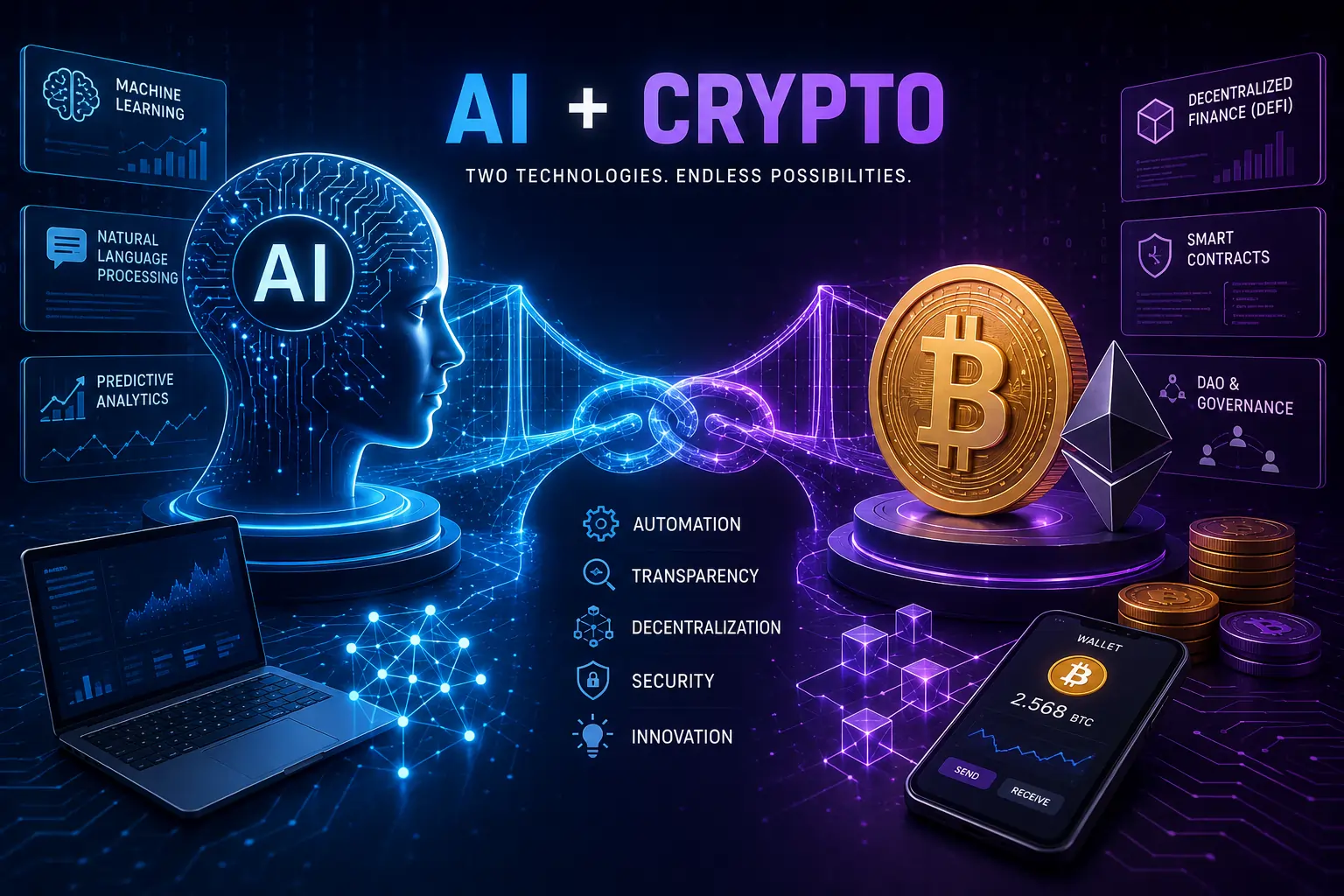
Is AI and Crypto a Real Trend or Just Hype?
AI and crypto are both real technologies, and their combination has real use cases. However, not every AI crypto project is valuable. Some projects use the “AI” label mainly for marketing, while others are building practical tools for automation, payments, data ownership, decentralized computing, trading, and blockchain security. In simple words, AI can help crypto become smarter, and crypto can help AI become more open, verifiable, and financially independent. But beginners should be careful: AI crypto is one of the most hyped areas of the market, and hype often attracts weak projects, scams, and unrealistic promises. The real value appears when AI solves actual blockchain problems or when blockchain gives AI agents tools to transact, verify data, and operate transparently.
Why AI and Crypto Are Being Connected
Artificial intelligence and cryptocurrency are two of the biggest technology trends of the modern digital economy. AI is changing how people analyze information, automate tasks, create content, and interact with software. Crypto is changing how people transfer value, own digital assets, use decentralized applications, and build open financial systems. At first, these two industries may seem separate. AI is about intelligence and automation. Crypto is about ownership, value transfer, and decentralized networks. But when combined, they can create new types of applications. AI can analyze large amounts of blockchain data, detect fraud, automate trading strategies, improve user experience, and help people understand complex DeFi systems. Crypto can give AI agents wallets, payments, ownership, identity, and access to permissionless financial networks. This is why “AI and crypto” has become one of the most discussed narratives in Web3.
What Does AI Mean in Crypto?
AI in crypto usually means using artificial intelligence inside blockchain-related products, platforms, or protocols. This can include:
- AI trading tools
- AI-powered crypto research
- AI agents that interact with DeFi
- AI tools for blockchain security
- Decentralized AI infrastructure
- AI-generated NFT or gaming content
- Data marketplaces for AI training
- Smart contract analysis
- Automated portfolio management
- On-chain identity and reputation systems
Some use cases are practical today. Others are still experimental. The important question is not whether a project mentions AI, but whether AI actually improves the product.
Real Use Case 1: AI Agents in Crypto
AI agents are one of the most important areas where AI and crypto overlap. An AI agent is software that can make decisions and perform tasks with some level of autonomy. In crypto, an AI agent may be able to monitor market data, check wallet balances, compare DeFi yields, execute trades, rebalance a portfolio, or interact with smart contracts. For example, instead of manually searching different DeFi platforms, a user may tell an AI agent: “Find the best stablecoin yield with low risk.” The agent could compare options, explain risks, and eventually execute the transaction if the user approves. This can make crypto easier for beginners because DeFi is often complicated. Users must understand wallets, gas fees, liquidity pools, bridges, approvals, smart contracts, and risks. AI agents can simplify this experience. However, autonomous financial agents are risky. If an agent makes a bad decision, interacts with a malicious contract, or follows incorrect data, users can lose money. That is why AI agents need strong security, clear permissions, transaction simulations, and human approval for important actions.
Real Use Case 2: Better Crypto Trading and Market Analysis
Crypto markets move quickly. Prices, news, social sentiment, liquidity, wallet activity, and macroeconomic factors can all affect the market. AI can help traders and analysts process this information faster. AI tools can summarize market news, detect unusual trading activity, analyze sentiment, identify on-chain patterns, and generate risk alerts. For example, AI may help answer questions like:
- Is trading volume increasing unusually?
- Are large wallets moving assets to exchanges?
- Is social media hype rising around a token?
- Has liquidity dropped in a DeFi pool?
- Are there signs of manipulation?
This does not mean AI can predict prices perfectly. No tool can guarantee profitable trades. But AI can help users organize information and make more informed decisions. The danger is that many platforms market AI trading as a guaranteed profit machine. Beginners should avoid any AI crypto tool that promises fixed returns, risk-free trading, or “100% accurate signals.”
Real Use Case 3: Blockchain Security and Scam Detection
Security is one of the strongest practical use cases for AI in crypto. Blockchain transactions are public, which means AI systems can analyze patterns across wallets, smart contracts, and transaction histories. This can help detect suspicious behavior, phishing attempts, rug pulls, money laundering patterns, or smart contract vulnerabilities. AI can also help users understand risky wallet approvals. For example, before signing a transaction, an AI-powered wallet could warn: “This contract may be able to move all your tokens.” This is extremely useful because many beginners lose funds by clicking fake links, connecting to malicious websites, or approving dangerous transactions. AI can also help developers review smart contracts and identify possible bugs. However, AI should not replace professional audits. It can assist security teams, but it can also miss issues or produce incorrect results.
Real Use Case 4: Decentralized AI Infrastructure
Today, many AI systems depend on centralized companies, private data centers, and closed models. Crypto projects are exploring decentralized alternatives. Decentralized AI infrastructure may include:
- Decentralized computing networks
- Token-based AI model marketplaces
- Data marketplaces for AI training
- Decentralized storage
- Open AI model ownership
- Incentives for people who provide computing resources
The idea is to make AI infrastructure more open and less dependent on a few large technology companies. For example, people with unused GPU power may contribute computing resources to a decentralized network and earn tokens. Developers may use that network to run AI tasks. Data providers may share verified datasets and receive rewards. This is a promising area, but it is also technically complex. Not every decentralized AI project can compete with large cloud companies. The best projects need real users, real demand, strong infrastructure, and sustainable economics.
Real Use Case 5: AI Payments and Machine-to-Machine Transactions
AI agents may eventually need to pay for services without human involvement. For example, an AI assistant might buy data, pay for computing power, access APIs, renew subscriptions, or pay another agent for a completed task. Traditional banking systems are not designed for autonomous software agents. Crypto wallets and stablecoins can provide a more flexible payment layer. An AI agent with a crypto wallet could send small payments instantly, operate across borders, and interact with blockchain-based services without waiting for banks or payment processors. This does not mean AI agents should have unlimited control over funds. They need spending limits, permission systems, risk controls, and human oversight. But crypto gives AI a financial layer that is open, programmable, and available 24/7.
Real Use Case 6: Data Ownership and Content Provenance
AI depends heavily on data. This creates questions about ownership, copyright, authenticity, and proof of origin. Blockchain can help create records of who created a piece of content, when it was created, and how it was licensed. This can be useful for artists, writers, developers, musicians, and data providers. For example, blockchain-based systems could help verify whether content is original, whether an AI model has permission to use certain data, or whether a creator should receive payment when their work is used. This area is still developing, but it may become more important as AI-generated content grows.
Where the Hype Comes From
The hype around AI and crypto comes from three main factors. First, both industries are exciting and fast-moving. When two major trends combine, investors pay attention. Second, AI is a powerful marketing term. Some projects add AI to their branding even when the product has little real intelligence. Third, crypto markets often reward narratives. If traders believe AI crypto is the next big trend, tokens in that category may rise quickly, even before the projects prove real adoption. This creates opportunity, but also risk. A project can have a strong narrative and weak fundamentals at the same time.
How to Judge an AI Crypto Project
Before trusting or investing in an AI crypto project, beginners should ask practical questions:
- What problem does the project solve?
- Does it actually need blockchain?
- Does it actually use AI?
- Is there a working product?
- Who are the users?
- How does the token create value?
- Is the team transparent?
- Are smart contracts audited?
- Are the AI claims realistic?
- Is the project relying only on hype?
A real project should have more than buzzwords. It should show product usage, technical clarity, security awareness, and a reason for the token to exist.
AI and Crypto Risks
AI and crypto also create new risks. AI can generate fake investment content, deepfake videos, scam messages, fake support agents, and phishing websites. This makes crypto scams more convincing. AI trading bots can make poor decisions or fail during volatile markets. AI agents can interact with dangerous smart contracts if permissions are not controlled. Decentralized AI tokens can become speculative bubbles if valuations rise faster than real adoption. Beginners should treat AI crypto as a high-risk sector. It may produce important innovation, but it can also attract hype-driven projects.
Final Verdict: Real Use Cases or Just Hype?
AI and crypto are not just hype. There are real use cases in AI agents, DeFi automation, blockchain security, decentralized computing, machine payments, data ownership, and market analysis. However, the sector is also full of hype. Many AI crypto projects are early, experimental, or overvalued. Some may never deliver real products. The best way to understand AI and crypto is to separate the technology from the marketing. AI can improve crypto products. Crypto can give AI agents open financial infrastructure. But a token is not valuable just because it has AI in its name. For beginners, the safest approach is to learn the use cases first, study projects carefully, and avoid anything promising guaranteed profits. AI and crypto may become one of the most important intersections in technology, but the winners will be the projects that solve real problems, not the ones with the loudest hype.
Frequently asked questions
What is AI in crypto?
AI in crypto means using artificial intelligence in blockchain-related products, such as trading tools, AI agents, security systems, DeFi automation, and decentralized AI infrastructure.
Is AI crypto real or hype?
It is both. AI and crypto have real use cases, but many projects also use AI as a marketing buzzword without strong technology or adoption.
What are AI agents in crypto?
AI agents are software systems that can analyze data and perform blockchain actions, such as trading, rebalancing portfolios, or interacting with DeFi protocols.
Can AI predict crypto prices?
AI can analyze data and identify patterns, but it cannot predict crypto prices with certainty. Any tool promising guaranteed profits should be treated with caution.
Latest Post
 06 Sep, 2026
How to Build a Crypto Options Trading Platform
 05 Sep, 2026
How to Launch a Crypto Prop Trading Platform
 03 Sep, 2026
How to Scale a Crypto Exchange for High Trading Volume
 02 Sep, 2026
How to Design a Crypto Exchange Fee Structure
 01 Sep, 2026
Market Makers vs Liquidity Providers: What Is the Difference?
Build with Javizen.
Planning an exchange, token or blockchain product? Talk to our team and turn the ideas in this article into a launch-ready platform.