
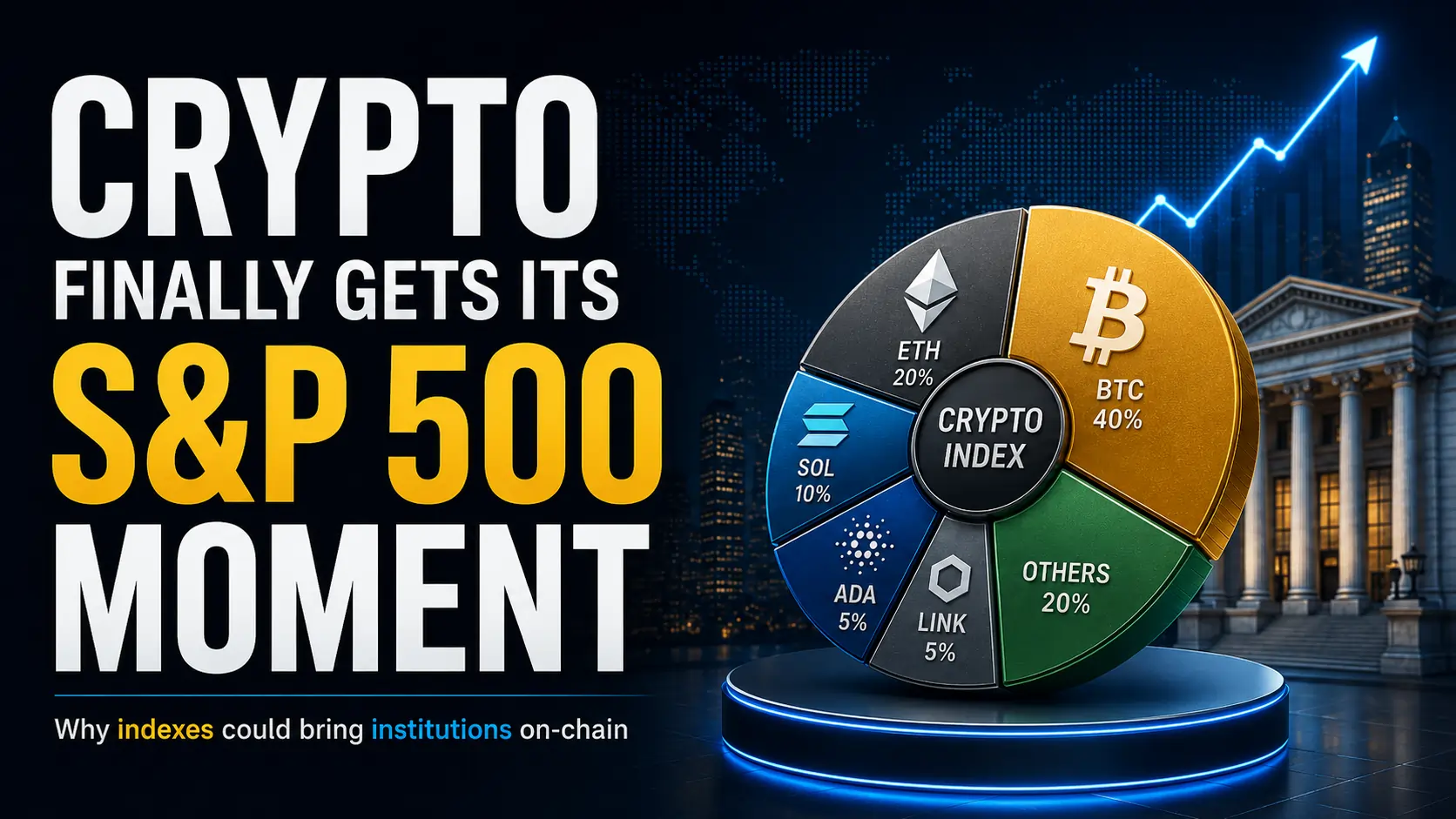
Crypto Finally Gets Its S&P 500 Moment: Why Indexes Could Bring Institutions On-Chain
What Is Crypto’s “S&P 500 Moment”?
Crypto’s “S&P 500 moment” refers to the point where digital assets start becoming easier to measure, compare, and invest in through trusted indexes. In traditional finance, the S&P 500 is not just a list of stocks. It is a benchmark, a market signal, a portfolio tool, and the foundation for many investment products. It helps investors understand the broad U.S. stock market without analyzing every company one by one. Crypto may now be moving toward a similar stage. Instead of institutions only asking, “Should we buy Bitcoin?” they may start asking, “What is the right benchmark for the digital asset market?” That shift matters because indexes can turn crypto from a collection of scattered tokens into a more structured asset class.
Why Crypto Needs Indexes
The crypto market is difficult to understand. There are thousands of tokens, dozens of sectors, many blockchains, different risk profiles, and constant market narratives. One month, AI tokens are trending. Another month, real-world assets lead the market. Then Layer 2s, DeFi, stablecoins, meme coins, gaming, privacy, or Bitcoin ecosystem assets take attention. For retail traders, this can be exciting. For institutions, it can be overwhelming. Institutions need structure. They need benchmarks, categories, data standards, risk models, liquidity screens, and clear portfolio construction tools. That is where crypto indexes become important. A crypto index can help answer questions like:
- What is the broad crypto market doing?
- Which assets are leading?
- Which sectors are outperforming?
- How diversified is a portfolio?
- Is a fund beating its benchmark?
- How much exposure should go to Bitcoin, Ethereum, or altcoins?
- Which assets are liquid enough for institutional products?
Without indexes, crypto feels like a noisy market. With indexes, it starts to look like an investable asset class.
What Is a Crypto Index?
A crypto index is a basket of digital assets designed to track part of the crypto market. For example, one index may track the largest crypto assets by market capitalization. Another may track DeFi tokens. Another may focus on smart contract platforms, Bitcoin ecosystem assets, stablecoin infrastructure, or real-world asset tokens. A crypto index can be built using rules such as:
- Market capitalization
- Liquidity
- Exchange availability
- Custody support
- Sector classification
- Rebalancing schedule
- Weight limits
- Eligibility requirements
- Risk controls
The goal is to create a transparent method for measuring a specific part of the market. In simple words, a crypto index gives investors a cleaner way to follow crypto performance without choosing every asset manually.
Why the S&P 500 Comparison Matters
The S&P 500 became powerful because it created a shared reference point. Investors, fund managers, advisors, analysts, and financial media can all talk about “the market” using the same benchmark. If a portfolio manager says they outperformed the S&P 500, people understand the comparison. Crypto lacks that kind of universal benchmark. Bitcoin is often treated as the main market signal, but Bitcoin is not the whole crypto market. Ethereum is important, but it does not represent every sector. Total market cap is useful, but it does not always show investable quality, liquidity, or risk-adjusted exposure. A strong crypto index can become a more useful benchmark. It can help investors see digital assets as a market, not just a collection of coins.
Why Institutions Care About Benchmarks
Institutional investors rarely invest without benchmarks. A pension fund, hedge fund, asset manager, family office, or wealth advisor needs to compare performance against something. They need to know whether a strategy is adding value or simply taking more risk. Benchmarks help with:
- Portfolio allocation
- Risk management
- Performance measurement
- Product creation
- Compliance reporting
- Market research
- Investor communication
If a crypto fund holds 20 digital assets, how should performance be judged? Against Bitcoin? Against Ethereum? Against the total market? Against a sector index? A trusted index solves this problem. It gives institutions a professional reference point. That makes crypto easier to discuss in investment committees, fund documents, research reports, and client portfolios.
From Single-Coin Bets to Portfolio Exposure
For years, institutional crypto exposure was mostly about Bitcoin. Then Ethereum gained more attention. Later, spot ETFs, tokenized assets, stablecoins, and DeFi started creating broader interest. But buying one asset is different from investing in an asset class. A single-coin strategy depends heavily on one network. A broader index approach gives exposure to multiple assets, sectors, and market themes. This is similar to traditional markets. An investor can buy Apple stock, but they can also buy an S&P 500 product for diversified exposure. One is a company bet. The other is market exposure. Crypto indexes could allow investors to move from “Which coin should I buy?” to “How should I allocate to digital assets?” That is a more mature question.
How Crypto Indexes Could Bring Institutions On-Chain
Crypto indexes can help institutions enter the market in several ways.
1. Clearer Market Structure
Indexes organize the market into understandable segments. This makes crypto easier to research, explain, and allocate.
2. Better Diversification
Instead of concentrating only on Bitcoin or Ethereum, investors can gain exposure to a basket of assets.
3. Risk Management
Indexes can include liquidity screens, weighting rules, rebalancing, and sector controls. This can reduce some risks of random token selection.
4. Product Creation
Indexes can support funds, structured products, derivatives, ETFs, certificates, tokenized portfolios, and institutional dashboards.
5. Performance Benchmarks
Fund managers need benchmarks to show whether they are outperforming or underperforming the market.
6. On-Chain Portfolio Tools
As more financial products move on-chain, indexes could become the foundation for tokenized index products, automated portfolios, and DeFi-based asset management.
What Would an On-Chain Index Look Like?
An on-chain crypto index could work like a tokenized portfolio. Instead of buying every asset separately, a user may hold one token that represents exposure to a basket of digital assets. For example, a tokenized index could track major crypto assets, DeFi tokens, Layer 2 ecosystems, RWA tokens, or AI crypto projects. The index could rebalance automatically based on transparent rules. Smart contracts could handle portfolio composition, settlement, and reporting. Users could hold the index token in a wallet, trade it on exchanges, or use it in DeFi. This is where crypto indexes become more than market data. They become programmable financial products. In traditional finance, index funds changed investing by making diversified exposure easier. In crypto, tokenized indexes could do something similar, but with 24/7 trading, wallet access, and on-chain settlement.
Why Indexes Are Good for Beginners Too
Crypto indexes are not only useful for institutions. They can also help beginners. New users often struggle with token selection. They may buy assets based on hype, social media, or short-term price movements. This creates risk. An index-based approach can teach beginners to think in terms of diversification, sectors, risk, and long-term exposure. Instead of chasing one trending token, a beginner can ask:
- What part of the crypto market do I want exposure to?
- Am I too concentrated in one asset?
- Does this index include liquid and established assets?
- How often does it rebalance?
- What risks does it avoid?
- What risks does it still carry?
This makes crypto education more professional. Indexes do not remove risk, but they can reduce random decision-making.
The Risks of Crypto Indexes
Crypto indexes are useful, but they are not risk-free. The first risk is market risk. If the crypto market falls, an index can fall too. The second risk is methodology risk. An index is only as good as its rules. Poor asset selection or weak weighting methods can create bad exposure. The third risk is liquidity risk. Some assets may look important but be hard to trade in large size. The fourth risk is concentration risk. Even a “diversified” crypto index may still be heavily weighted toward Bitcoin and Ethereum. The fifth risk is product risk. If an index is turned into a fund or tokenized product, users must understand custody, fees, issuer risk, smart contract risk, and redemption rules. The sixth risk is narrative risk. Crypto sectors change quickly. A trend-based index may become outdated if the market moves on. So indexes help organize crypto, but they do not make crypto safe by default.
Why This Could Matter for Exchanges
Crypto indexes could become important for exchanges because they create new products and better user experiences. An exchange could offer:
- Index-based spot baskets
- Crypto index funds
- Tokenized index products
- Sector performance dashboards
- Portfolio benchmark tools
- Index futures
- Index-based structured products
- Copy portfolios based on index themes
- RWA or DeFi sector baskets
This can turn an exchange from a place where users pick coins manually into a platform where users choose market strategies. That is a big shift. Instead of only listing more tokens, exchanges may compete by offering smarter ways to access the market.
Could Crypto Indexes Become the Next Big Institutional Product?
Yes, but only if they are transparent, liquid, regulated where necessary, and trusted. Institutions do not only need returns. They need infrastructure. They need reliable pricing, custody, compliance, reporting, and benchmarks. Crypto indexes can provide part of that infrastructure. They can help digital assets move from speculation to allocation. They can help advisors explain crypto exposure to clients. They can help fund managers create diversified products. They can help exchanges build more professional trading tools. The S&P 500 did not become important because it made stocks risk-free. It became important because it gave the market a shared language. Crypto needs that shared language. Indexes may provide it.
Final Thoughts
Crypto may finally be getting its S&P 500 moment. After years of token hype, narrative cycles, and single-asset speculation, the market is starting to build the tools that institutions understand: benchmarks, indexes, baskets, risk models, and investable products. This does not mean crypto will become traditional finance overnight. It also does not mean indexes will remove volatility or risk. But it does mean digital assets are becoming easier to measure and easier to package. For institutions, indexes can make crypto more investable. For exchanges, they can unlock new products. For beginners, they can make the market easier to understand. The future of crypto may not be about picking one winning coin. It may be about building smarter access to the entire digital asset economy.
Frequently asked questions
What is a crypto index?
A crypto index is a basket of digital assets designed to track the performance of a specific part of the crypto market.
Is there an S&P 500 for crypto?
There is no single universal S&P 500 equivalent for crypto yet, but several providers offer broad crypto market indexes and sector benchmarks.
Why do institutions need crypto indexes?
Institutions need indexes for benchmarking, risk management, portfolio allocation, reporting, and product creation.
Are crypto index funds safer than buying single coins?
Crypto index funds may offer diversification, but they are still exposed to crypto market risk, liquidity risk, and product structure risk.
What is the CoinDesk 20 Index?
The CoinDesk 20 is a digital asset index designed to track major crypto assets and serve as a benchmark for the broader crypto market.
How can indexes bring institutions on-chain?
Indexes can support tokenized portfolios, index funds, derivatives, structured products, and on-chain asset management tools.
Can beginners use crypto indexes?
Yes, beginners can use indexes to better understand market sectors and diversification, but they should still understand the risks.
Do crypto indexes remove volatility?
No. Indexes can help organize and diversify exposure, but they do not remove crypto volatility.
Latest Post
 06 Sep, 2026
How to Build a Crypto Options Trading Platform
 05 Sep, 2026
How to Launch a Crypto Prop Trading Platform
 03 Sep, 2026
How to Scale a Crypto Exchange for High Trading Volume
 02 Sep, 2026
How to Design a Crypto Exchange Fee Structure
 01 Sep, 2026
Market Makers vs Liquidity Providers: What Is the Difference?
Build with Javizen.
Planning an exchange, token or blockchain product? Talk to our team and turn the ideas in this article into a launch-ready platform.