
Bitcoin Is Busy Again — But Not Because of Payments
Why Is Bitcoin Busy Again?
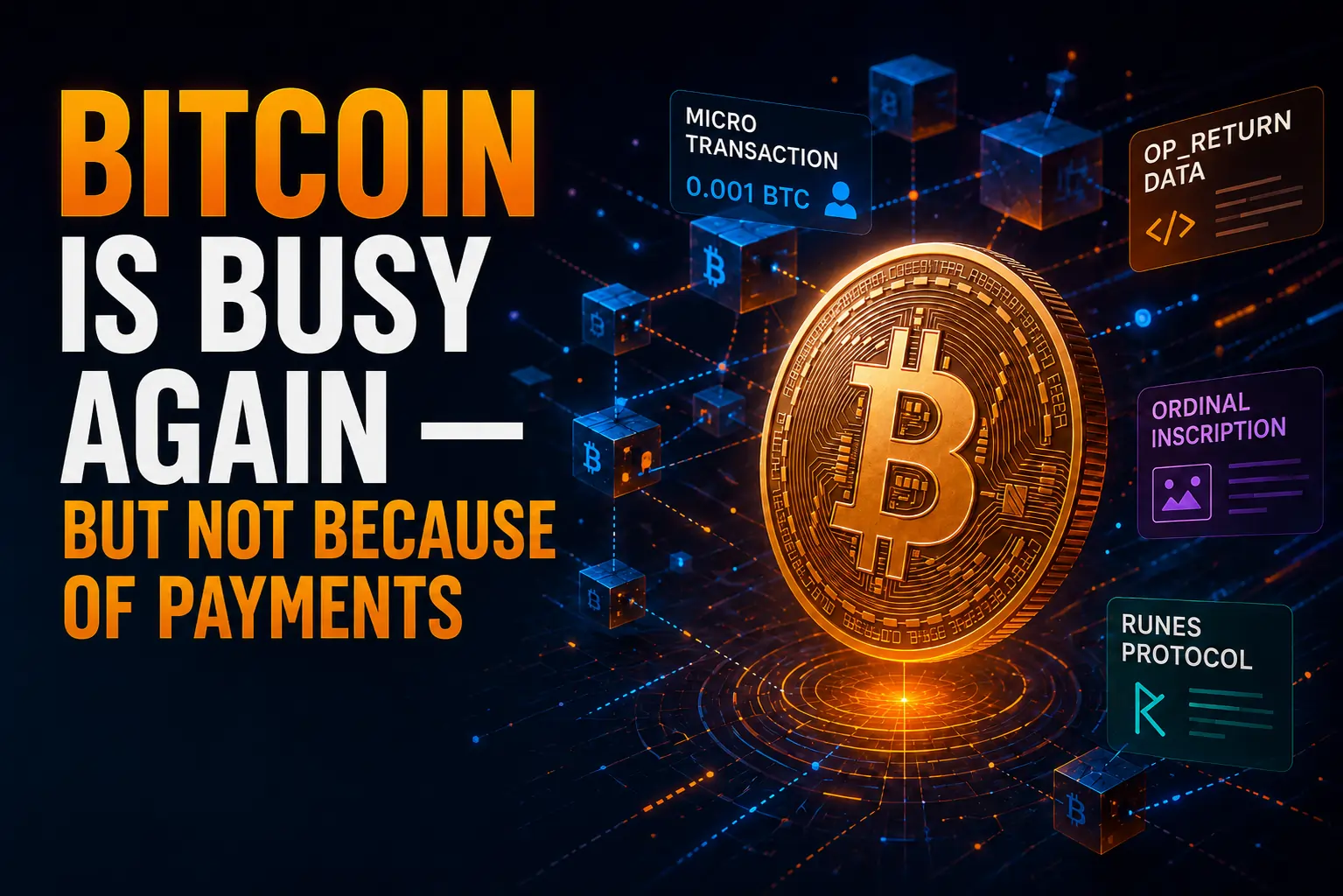
Bitcoin network activity is rising again because of a surge in small transactions and data-related activity, not because people are suddenly using Bitcoin mainly for everyday payments. In simple words, Bitcoin is busy because more users and protocols are using the blockchain as a data layer. This includes activity from Ordinals, Runes, BRC-20-style tokens, timestamping services, and OP_RETURN-based transactions. This is important because high Bitcoin activity does not always mean the same thing. Sometimes it means more people are moving large amounts of BTC. Sometimes it means traders are reacting to price volatility. And sometimes, like now, it means the network is being used for many small, low-value transactions connected to data, inscriptions, or token protocols. Bitcoin is still the world’s most important crypto asset. But the way people use its blockchain is changing.
The New Bitcoin Activity Wave
For years, many people described Bitcoin mainly as digital gold. It was seen as a store of value, a long-term asset, and a hedge against monetary uncertainty. But Bitcoin’s blockchain is now being used for more than simple BTC transfers. Recent network activity shows that smaller transactions are taking up a larger share of daily Bitcoin usage. These are not necessarily coffee payments or merchant transactions. Many are protocol-driven interactions created by applications built on top of Bitcoin. That difference matters. If Bitcoin activity rises because people are paying each other with BTC, that suggests payment adoption. If activity rises because protocols are storing data or issuing token-like assets, that suggests a different type of demand: demand for Bitcoin blockspace. Bitcoin blockspace is limited. Every block can only include a certain amount of transaction data. When more users compete for that space, fees can rise, the mempool can grow, and transaction settlement can become more expensive. So the real story is not only that Bitcoin is busy. The story is what kind of activity is making it busy.
What Are Bitcoin Microtransactions?
Bitcoin microtransactions are very small BTC transactions. In current market discussions, analysts often refer to transactions below 0.01 BTC or even below 0.001 BTC as small-value activity. These transactions may look like payments at first glance, but many of them are not traditional payments. Some are created by protocols that use Bitcoin to record data, mint assets, update token balances, or interact with inscription-based systems. This can make transaction counts rise even if the total economic value being transferred is relatively small. That is why transaction count alone can be misleading. A network can process many transactions, but that does not always mean large amounts of value are moving. For example, 100,000 small data-related transactions may increase network activity more than a few large institutional transfers. But the economic meaning is very different. This is why analysts now separate activity-driven usage from value-driven usage.
Why Payments Are Not the Main Driver
Bitcoin was originally introduced as a peer-to-peer electronic cash system. Over time, however, its main narrative shifted toward store of value. High fees, slow confirmation times during congestion, and volatility made everyday on-chain payments less practical for many users. Bitcoin payments still exist. Some users send BTC directly. Some use the Lightning Network for faster and cheaper payments. Some businesses accept Bitcoin. But the recent rise in base-layer activity is not mainly about everyday spending. Instead, much of the current activity appears to be driven by Bitcoin-native protocols and data use cases. That means Bitcoin is being used less like a simple payment rail and more like a settlement and data layer. This is a major shift in how the network is understood. Bitcoin is not only moving coins. It is increasingly being used to store, reference, or settle digital information.
What Is OP_RETURN?
OP_RETURN is a Bitcoin script function that allows users to include small pieces of data in a transaction. In simple words, OP_RETURN lets users write data to the Bitcoin blockchain in a way that does not create spendable outputs. This matters because Bitcoin is not designed like Ethereum. It does not have the same smart contract environment. But OP_RETURN gives users a way to attach data to Bitcoin transactions. Over time, many protocols have used OP_RETURN or similar transaction structures to create new use cases. These include data timestamping, token metadata, inscriptions, and Bitcoin-based asset systems. The debate is simple: Supporters say OP_RETURN and data-based activity create new demand for Bitcoin blockspace and prove that Bitcoin can support more than payments. Critics say these transactions fill blocks with low-value data, increase fees, and make Bitcoin less useful for ordinary financial transfers. Both sides agree on one thing: OP_RETURN changes how Bitcoin blockspace is used.
Ordinals, Runes, and Bitcoin as a Data Layer
Ordinals brought major attention to the idea of putting digital artifacts directly on Bitcoin. They made it possible to inscribe data onto individual satoshis, creating Bitcoin-native collectibles and metadata-based assets. Runes continued this trend by offering another way to issue fungible assets on Bitcoin. BRC-20-style experiments also showed that users were interested in token-like systems built around Bitcoin’s security and cultural importance. These protocols created a new type of Bitcoin demand. Instead of using Bitcoin only to transfer BTC, users began using Bitcoin to create and track digital assets. This is why Bitcoin is being described more often as a data layer. The phrase does not mean Bitcoin has become Ethereum. It means some users are treating Bitcoin blockspace as valuable digital real estate. They want their data, assets, or protocol updates recorded on the most secure and recognized blockchain.
Why This Matters for Fees
When Bitcoin becomes busier, fees can rise. Bitcoin fees are based on competition for blockspace. If many users want their transactions confirmed quickly, they must pay higher fees to miners. When data protocols generate many small transactions, they compete with ordinary BTC transfers. This can create higher fees for everyone, including users who simply want to move Bitcoin from one wallet to another. For miners, this can be positive. Higher transaction fees increase miner revenue, which becomes more important as Bitcoin block rewards continue to decline over time. For users, it can be frustrating. A simple transfer may become more expensive during congestion. This creates one of Bitcoin’s biggest long-term debates: should the base layer prioritize financial settlement, or should any valid transaction be accepted as long as users pay the fee? Bitcoin’s design generally supports the second view. If a transaction follows consensus rules and pays enough fees, it can compete for blockspace. But socially, the debate remains intense.
Is High Bitcoin Activity Good or Bad?
High Bitcoin activity can be good, bad, or neutral depending on what is driving it. It is good because it shows demand for the network. More activity can mean Bitcoin blockspace is valuable. It can also support miner revenue and encourage innovation. It can be bad if activity creates congestion without meaningful economic value. If blocks fill with low-value data transactions, users making important transfers may face higher fees. It can be neutral if the network is simply reflecting market demand. Bitcoin does not judge whether a transaction is a payment, inscription, token update, or timestamp. The fee market decides what gets included. The important point is that users should not assume all activity means the same thing. A busy Bitcoin network does not automatically mean more payment adoption. It may mean more demand for on-chain data.
Bitcoin as Money vs Bitcoin as Infrastructure
Bitcoin now has two competing identities. The first identity is Bitcoin as money: a decentralized asset used for saving, transferring value, and resisting censorship. The second identity is Bitcoin as infrastructure: a secure settlement layer that can support data, token protocols, inscriptions, timestamping, and other applications. These identities can coexist, but they create tension. If Bitcoin is mainly money, users may want low fees and clean financial transactions. If Bitcoin is infrastructure, users may accept higher fees because blockspace becomes a scarce resource for many types of activity. The future may depend on how the community balances these roles. Bitcoin does not need to become a general-purpose smart contract platform to be useful as infrastructure. But if more protocols build on Bitcoin, the network’s fee market and user experience will continue to change.
What This Means for Beginners
For beginners, the key lesson is simple: Bitcoin network activity is not just about price or payments. When you see headlines saying Bitcoin activity is near record highs, ask:
- Are people sending more BTC?
- Are institutions moving large value?
- Are miners earning more fees?
- Are inscriptions or token protocols driving activity?
- Are small transactions dominating the network?
- Is the mempool congested?
- Are fees rising?
These questions help you understand what is really happening. A higher transaction count can be bullish for network usage, but it does not always mean Bitcoin is becoming a payment app. It may mean Bitcoin is being used as a scarce settlement layer for new types of digital activity.
What This Means for Exchanges and Wallets
Exchanges and wallets need to pay attention to this trend. If Bitcoin fees rise because of data-related activity, platforms must improve fee estimation, withdrawal batching, transaction timing, and user education. Wallets may need to explain why fees are higher during congestion. Exchanges may need to optimize withdrawals to avoid overpaying. Payment providers may need to route small payments through Lightning or other scaling solutions instead of the base layer. This is especially important for beginners. Many users do not understand why a Bitcoin withdrawal fee changes from one day to another. Better UX can reduce confusion and frustration. If Bitcoin becomes a more active data and settlement layer, infrastructure providers must adapt.
Could This Make Lightning More Important?
Yes. If the Bitcoin base layer becomes more expensive during busy periods, Lightning and other scaling solutions may become more important for small payments. The base layer may increasingly be used for settlement, high-value transfers, and data-heavy activity. Lightning can handle faster and cheaper payment flows off-chain. This creates a layered model:
- Bitcoin base layer for security and settlement
- Lightning for fast payments
- Sidechains and Layer 2s for experiments
- Data protocols for inscriptions, tokens, and timestamping
This does not mean one model wins completely. It means Bitcoin usage may become more specialized.
Final Thoughts
Bitcoin is busy again, but not mainly because people are using it for everyday payments. The latest activity wave is driven by microtransactions, OP_RETURN usage, Ordinals, Runes, BRC-20-style assets, and data-based protocols. This shows that Bitcoin blockspace is becoming valuable for more than simple BTC transfers. That is both exciting and controversial. Supporters see innovation, miner revenue, and new demand for Bitcoin’s security. Critics see congestion, higher fees, and distraction from Bitcoin’s monetary purpose. For users, the most important takeaway is clear: Bitcoin activity needs context. A rising transaction count does not always mean rising payment adoption. Sometimes it means the blockchain is becoming a battlefield for scarce blockspace. Bitcoin may still be digital gold. But increasingly, it is also becoming digital real estate. And everyone wants a piece of the block.
Frequently asked questions
Why is Bitcoin network activity increasing?
Bitcoin activity is increasing because small transactions and data-related protocols such as Ordinals, Runes, BRC-20-style assets, and OP_RETURN-based services are using more blockspace.
Are people using Bitcoin more for payments?
Not necessarily. Recent activity appears to be driven more by microtransactions and data protocols than by everyday payments.
What are Bitcoin microtransactions?
Bitcoin microtransactions are very small BTC transactions, often below 0.01 BTC or 0.001 BTC. Many are linked to protocol-driven activity rather than traditional payments.
What is OP_RETURN in Bitcoin?
OP_RETURN is a Bitcoin script function that allows users to include data in a transaction without creating a spendable output.
Why does OP_RETURN matter?
OP_RETURN matters because it allows data-based protocols to use Bitcoin as a data layer, increasing transaction activity and blockspace demand.
What are Ordinals and Runes?
Ordinals and Runes are Bitcoin-based protocols that use the blockchain for inscriptions, digital assets, or token-like activity.
Can microtransactions increase Bitcoin fees?
Yes. If many small transactions compete for blockspace, they can increase congestion and push fees higher.
Latest Post
 06 Sep, 2026
How to Build a Crypto Options Trading Platform
 05 Sep, 2026
How to Launch a Crypto Prop Trading Platform
 03 Sep, 2026
How to Scale a Crypto Exchange for High Trading Volume
 02 Sep, 2026
How to Design a Crypto Exchange Fee Structure
 01 Sep, 2026
Market Makers vs Liquidity Providers: What Is the Difference?
Build with Javizen.
Planning an exchange, token or blockchain product? Talk to our team and turn the ideas in this article into a launch-ready platform.