
The Layer 2 Shakeout: Why Not Every Blockchain Needs to Exist
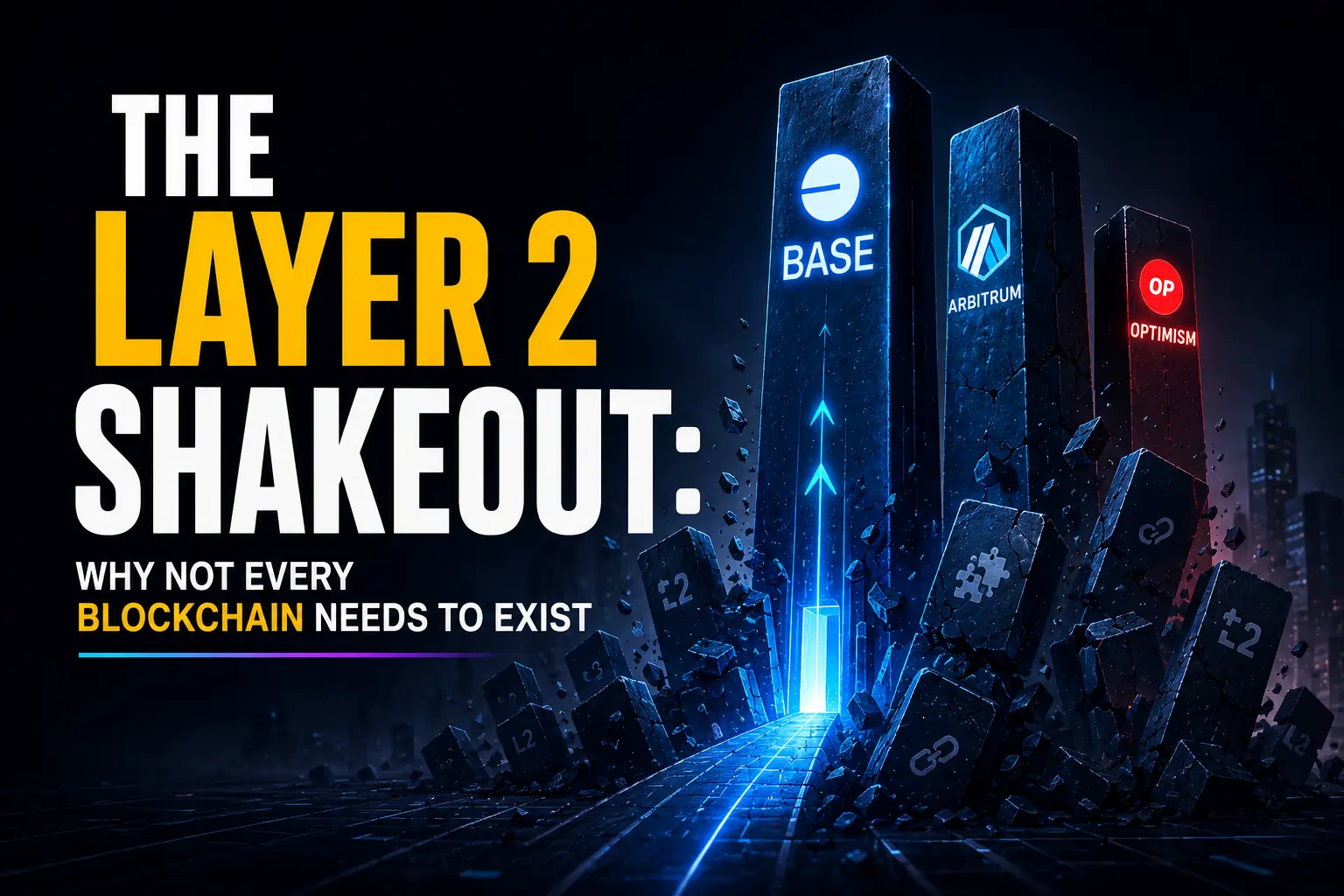
What Is the Layer 2 Shakeout?
The Layer 2 shakeout is the growing competition and consolidation happening among Ethereum Layer 2 networks. After years of new rollups and scaling chains launching, users, liquidity, developers, and applications are now concentrating around fewer major networks. In simple words, the market is starting to ask a hard question: Do we really need this many Layer 2 blockchains? Layer 2s were created to make Ethereum faster and cheaper. They still matter. But not every Layer 2 has enough users, liquidity, apps, or a clear purpose to survive long term. The next phase of Layer 2 growth may not be about launching more chains. It may be about proving why each chain deserves to exist.
Why Layer 2 Networks Became Popular
Ethereum is one of the most important smart contract blockchains in the world. It powers DeFi, NFTs, stablecoins, DAOs, tokenized assets, and thousands of applications. But Ethereum has historically had a scaling problem. When the network becomes busy, transaction fees can rise and confirmation times can feel slow. This made Ethereum expensive for everyday users. Layer 2 networks were created to solve this problem. A Layer 2 is a blockchain or scaling system built on top of Ethereum. It processes transactions more cheaply and efficiently, then settles or posts data back to Ethereum. This allows users to benefit from lower fees while still connecting to Ethereum’s security and ecosystem. Popular Layer 2 networks include Base, Arbitrum, Optimism, zkSync, Starknet, Linea, Scroll, Mantle, and others. At first, the idea was simple: Ethereum needs more blockspace, and Layer 2s can provide it. But now the problem has changed. There may be plenty of blockspace. The question is whether there are enough real users for all these chains.
From Scaling Problem to Differentiation Problem
In the early Layer 2 era, being cheaper than Ethereum was enough. If an L2 could offer faster transactions and lower fees, it had a clear value proposition. Today, that is no longer enough. Many Layer 2s are cheap. Many support Ethereum-compatible apps. Many offer bridges, swaps, NFTs, DeFi, and wallets. From a user’s point of view, they can start to feel similar. This creates a differentiation problem. If ten chains all say, “We are fast, cheap, and EVM-compatible,” users will ask: why should I choose this one? For a Layer 2 to matter, it needs more than low fees. It needs a reason to exist. That reason may be liquidity, users, applications, ecosystem partnerships, developer tools, institutional adoption, payments, gaming, AI, RWA, or a specific community. Generic scaling is no longer enough.
Why Base and Arbitrum Are Winning Attention
The current Layer 2 market shows that activity tends to concentrate around a few strong networks. Base has gained attention because it is backed by Coinbase, one of the largest crypto exchanges. That gives it distribution, brand trust, fiat on-ramps, and access to millions of potential users. Arbitrum has built a strong DeFi ecosystem and remains one of the most important rollup networks for liquidity, applications, and developers. Optimism also matters because of its OP Stack ecosystem, which allows other chains to build using its technology and participate in a larger network vision. These networks are not winning only because they are cheap. They are winning because they have ecosystems. A blockchain without an ecosystem is just empty infrastructure.
The Problem With Too Many Chains
Too many Layer 2 networks can create several problems. The first problem is liquidity fragmentation. If assets and users are spread across too many chains, each chain may have weaker liquidity. This makes trading worse, increases slippage, and makes DeFi less efficient. The second problem is user confusion. Beginners already struggle with wallets, bridges, gas fees, and networks. Adding dozens of similar Layer 2s makes the experience more complicated. The third problem is developer fatigue. Developers do not want to deploy and maintain apps across every chain unless there is real demand. The fourth problem is bridge risk. Moving assets between chains can introduce extra complexity and security risks. The fifth problem is weak network effects. Blockchains are valuable when people, apps, liquidity, and developers gather in the same place. Too many small networks can weaken those effects. The sixth problem is “ghost chain” risk. Some chains may have impressive marketing, but very little real usage. A blockchain exists technically when blocks are produced. But economically, it exists only when users care.
What Makes a Layer 2 Valuable?
A Layer 2 is valuable when it solves a real problem for real users. Important signs of a strong Layer 2 include:
- Active users
- Real transaction volume
- Deep liquidity
- Strong developer activity
- Useful applications
- Reliable infrastructure
- Clear security model
- Easy onboarding
- Strong ecosystem partnerships
- Sustainable fees or revenue
- A reason to choose it over competitors
The best Layer 2s will not only be fast and cheap. They will be useful. For example, a payments-focused L2 should make stablecoin transfers easy, cheap, and reliable. A gaming-focused L2 should provide tools for game studios. A DeFi-focused L2 should have liquidity, lending markets, DEXs, and risk management. An institutional L2 should offer compliance, security, and settlement quality. The future may belong to specialized chains, not generic chains.
The Rise of App-Specific and Purpose-Built Chains
One important trend is the rise of app-specific and purpose-built Layer 2 networks. Instead of launching a general-purpose chain and hoping users arrive, some teams are building chains for specific use cases. Examples of possible specialization include:
- Stablecoin payments
- Cross-border remittances
- Gaming
- Social apps
- Real-world assets
- Institutional settlement
- AI agents
- DeFi liquidity
- Consumer apps
- Enterprise blockchain systems
This makes sense because different use cases need different infrastructure. A payments chain may prioritize low fees and fast settlement. A gaming chain may prioritize speed and user experience. An institutional RWA chain may prioritize compliance and privacy. The Layer 2 market may move from “one chain for everything” to “the right chain for the right use case.”
Why Ethereum Still Benefits From Layer 2s
The Layer 2 shakeout does not mean Layer 2s are failing. It means the market is maturing. Ethereum still benefits from strong Layer 2 networks because they help scale activity, reduce costs, and bring more applications into the ecosystem. Layer 2s can also serve as innovation zones. They can experiment with new governance models, fee structures, developer tools, and app ecosystems while still connecting back to Ethereum. The issue is not whether Layer 2s matter. They do. The issue is whether every Layer 2 matters. A smaller number of stronger Layer 2s may be healthier than dozens of weak networks competing for the same users.
The User Experience Problem
For normal users, Layer 2 fragmentation is confusing. A user may ask:
- Which network should I use?
- Why is my USDC on Base different from USDC on Arbitrum?
- Do I need ETH for gas on every chain?
- How do I bridge assets safely?
- Why is liquidity better on one chain than another?
- What happens if I send funds to the wrong network?
These questions create friction. Crypto onboarding is already difficult, and too many chains make it harder. In the long term, wallets and apps may hide some of this complexity. Users may not need to know which chain they are using. The app may route transactions automatically based on cost, liquidity, and safety. But until that experience becomes common, Layer 2 fragmentation remains a barrier for beginners.
Security and Decentralization Still Matter
Not all Layer 2s have the same security assumptions. Some are more mature. Some are more centralized. Some rely heavily on sequencers, upgrade keys, bridges, or governance controls. Some have stronger fraud proofs or validity proofs than others. Some are still moving toward full decentralization. This matters because users often think all Layer 2s inherit Ethereum security equally. That is not always true in practice. A strong Layer 2 should be transparent about its risks:
- Who runs the sequencer?
- Can the chain be paused?
- Who controls upgrades?
- How does the bridge work?
- What proof system is used?
- How decentralized is the network?
- What happens during an outage?
As the market matures, users and developers may become more selective. Cheap fees alone will not be enough if the security model is weak.
Are Smaller Layer 2s Dead?
Not necessarily. A smaller Layer 2 can survive if it has a clear niche. It does not need to beat Base or Arbitrum at everything. It needs to be the best option for a specific audience or use case. For example, a smaller chain may win by focusing on gaming, privacy, payments, RWA, enterprise settlement, or regional stablecoin adoption. The problem is not being small. The problem is being generic. A small chain with a strong purpose can survive. A generic chain with no users will struggle.
What the Shakeout Means for Builders
For developers and startups, the Layer 2 shakeout changes the decision-making process. In the past, a project might deploy on many chains just to maximize exposure. Today, builders need to ask where their users actually are. Important questions include:
- Where is the liquidity?
- Which chain has the right users?
- Which ecosystem supports our product?
- Which network has reliable infrastructure?
- Which chain has the best developer tools?
- Which chain gives us distribution?
- Which security model matches our risk profile?
Choosing a chain is now a product strategy decision, not just a technical decision.
What the Shakeout Means for Investors
For investors, the Layer 2 shakeout is a reminder that not every blockchain token will capture value. A chain can have strong technology but weak adoption. It can have a large token valuation but low real usage. It can have incentives that attract temporary liquidity but no long-term users. Investors should look beyond hype and ask:
- Are people actually using the chain?
- Are developers building there?
- Is liquidity growing naturally?
- Does the chain have a clear niche?
- Is the token needed?
- Are fees or revenue sustainable?
- Can the chain survive without incentives?
In the next phase of the market, usage may matter more than announcements.
Final Thoughts
The Layer 2 shakeout is not a sign that Ethereum scaling failed. It is a sign that the market is becoming more realistic. Layer 2s solved a real problem: Ethereum needed cheaper and faster transaction capacity. But now that many networks offer cheap blockspace, the question has changed. The winners will be the chains with users, liquidity, developers, security, and a clear reason to exist. The losers will be generic chains that cannot explain why anyone should choose them. Not every blockchain needs to exist. And that may be good for crypto. A smaller number of stronger, more useful, and more specialized networks could make the entire ecosystem easier to use, safer to build on, and more valuable in the long run.
Frequently asked questions
What is an Ethereum Layer 2?
An Ethereum Layer 2 is a scaling network built on top of Ethereum that processes transactions more cheaply and efficiently while connecting back to Ethereum.
Why are there so many Layer 2 blockchains?
Many Layer 2s launched to solve Ethereum’s fee and scaling problems. But as the market matured, many chains began competing for the same users and liquidity.
Why are some Layer 2s struggling?
Some Layer 2s are struggling because they lack users, liquidity, developer activity, differentiation, or a clear use case.
What is liquidity fragmentation?
Liquidity fragmentation happens when assets and users are spread across too many chains, making markets less efficient and harder to trade.
What makes a Layer 2 worth using?
A Layer 2 is worth using when it has real users, strong liquidity, useful apps, reliable infrastructure, good security, and a clear purpose.
Latest Post
 06 Sep, 2026
How to Build a Crypto Options Trading Platform
 05 Sep, 2026
How to Launch a Crypto Prop Trading Platform
 03 Sep, 2026
How to Scale a Crypto Exchange for High Trading Volume
 02 Sep, 2026
How to Design a Crypto Exchange Fee Structure
 01 Sep, 2026
Market Makers vs Liquidity Providers: What Is the Difference?
Build with Javizen.
Planning an exchange, token or blockchain product? Talk to our team and turn the ideas in this article into a launch-ready platform.