
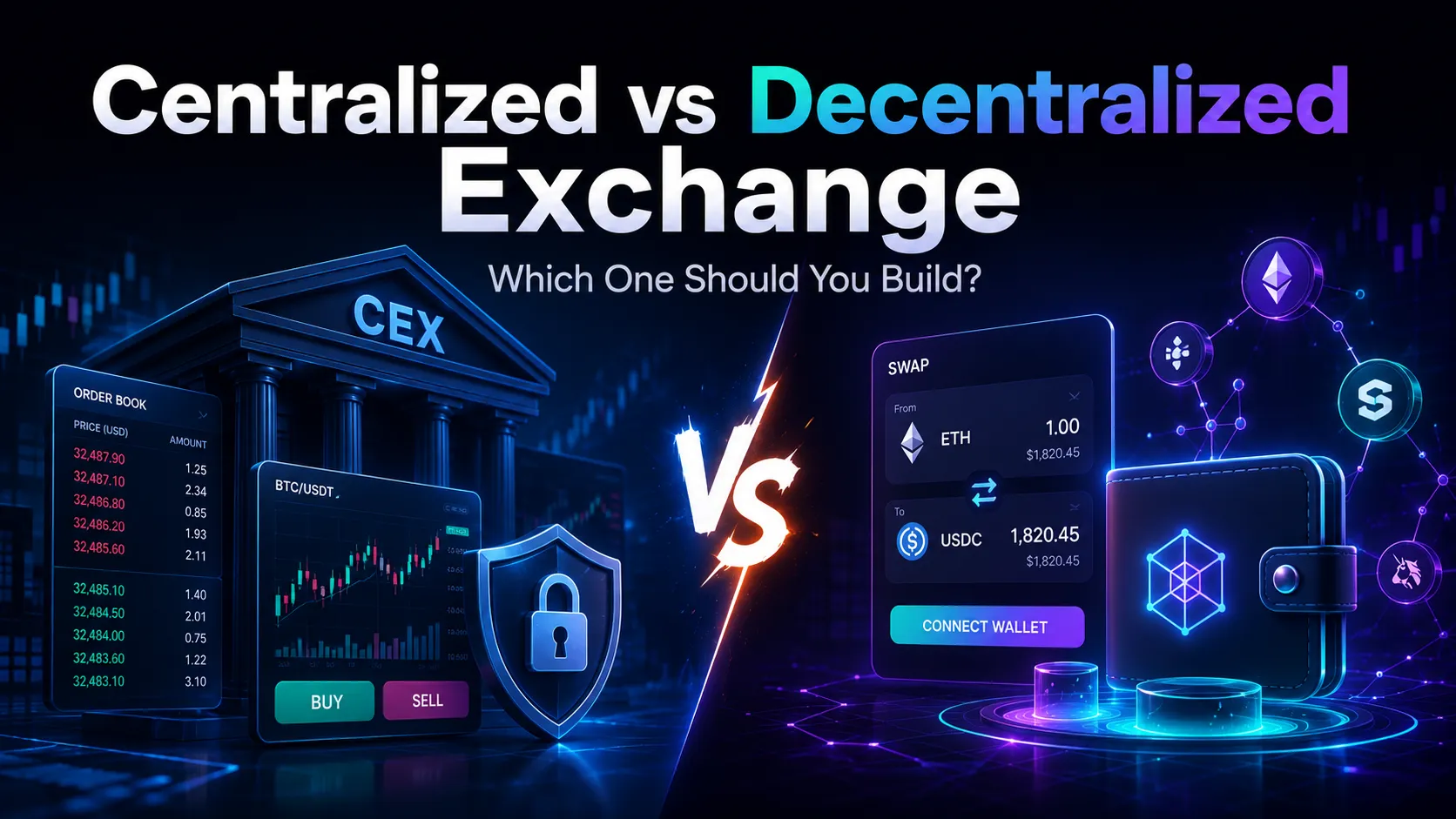
Centralized vs Decentralized Exchange: Which One Should You Build?
Quick Answer
If you want to build a crypto exchange with fiat support, KYC, admin control, order books, customer support, advanced trading modules, and a clear business model, a centralized exchange is usually the better choice. If your goal is to build a trustless, non-custodial, on-chain trading protocol where users keep control of their wallets, a decentralized exchange may be the right option. For many serious crypto businesses, the best answer is not purely CEX or DEX. It is a hybrid model: centralized infrastructure for usability, compliance, liquidity, and business operations, combined with decentralized features such as Web3 wallet login, on-chain settlement, tokenized assets, or DeFi liquidity integrations.
What Is a Centralized Exchange?
A centralized exchange, or CEX, is a crypto trading platform operated by a company. Users create accounts, pass KYC if required, deposit crypto or fiat, and trade through an internal matching engine.
Examples of CEX-style features include:
- Spot trading
- Futures trading
- P2P trading
- Fiat deposit and withdrawal
- KYC and AML checks
- Admin panel
- User wallet management
- Internal ledger
- Trading fee system
- Referral and affiliate system
- Market maker tools
- Customer support and ticketing
A CEX gives the operator more control over the product, trading experience, risk management, liquidity, fees, and user support. For founders building a real crypto business, this control is often important. You are not just launching a smart contract. You are building a financial product with users, operations, revenue, compliance needs, and long-term maintenance.
What Is a Decentralized Exchange?
A decentralized exchange, or DEX, allows users to trade crypto assets directly from their own wallets. Instead of depositing funds into a company-controlled account, users connect wallets such as MetaMask or Trust Wallet and interact with smart contracts.
DEXs usually use one of these models:
- Automated Market Maker, or AMM
- On-chain order book
- Hybrid off-chain order book with on-chain settlement
- Cross-chain swap protocol
- Aggregator model
A DEX is attractive because users keep custody of their assets. It also fits the original Web3 idea of open, permissionless finance. However, building a DEX is not automatically easier than building a CEX. You still need smart contract development, audits, liquidity strategy, front-end UX, token listing logic, analytics, routing, security monitoring, and chain-level infrastructure.
Centralized vs Decentralized Exchange: Main Differences
| Factor | Centralized Exchange | Decentralized Exchange |
|---|---|---|
| Custody | Platform controls user balances | Users control their own wallets |
| Trading engine | Easier for beginners | Smart contracts or on-chain liquidity pools |
| User experience | Easier for beginners | More complex for non-technical users |
| Liquidity | Easier to manage with market makers | Depends on liquidity pools or external routing |
| Compliance | Easier to apply KYC/AML | More difficult and jurisdiction-dependent |
| Revenue | Trading fees, listing fees, spreads, subscriptions | Swap fees, protocol fees, token incentives |
| Security risk | Custodial wallet, server, database, admin risks | Smart contract, bridge, oracle, MEV risks |
| Speed | Usually faster and cheaper | Depends on blockchain speed and gas fees |
| Scalability | Controlled by backend architecture | Limited by chain/network infrastructure |
| Best for | Commercial exchange businesses | DeFi protocols and Web3-native products |
DeFi protocols and Web3-native products
You should build a centralized exchange if your goal is to launch a complete trading business.
A CEX is usually the better option when you need:
1. Fiat On-Ramp and Off-Ramp
Most mainstream users still want to buy crypto with local currency. If your platform needs bank transfers, payment gateways, local fiat markets, OTC desks, or stablecoin settlement, a centralized model is usually more practical.
2. KYC, AML, and Compliance Control
Centralized platforms can build structured KYC flows, user risk levels, withdrawal limits, suspicious activity monitoring, and admin review systems. This matters because crypto regulation is becoming more formal in many regions. For example, the EU’s MiCA framework introduces rules around transparency, disclosure, authorization, and supervision for crypto-asset services. In the U.S., FinCEN has also treated certain virtual currency exchangers and administrators as money services businesses when they accept and transmit convertible virtual currency. This does not mean every exchange has the same legal obligations, but it does mean compliance planning should be part of the infrastructure from day one.
3. Better User Experience
A CEX can feel like a normal fintech product. Users can reset passwords, contact support, use 2FA, view order history, receive notifications, and manage balances from a simple dashboard. This is important if your audience includes beginners, local traders, retail users, or businesses that do not want to manage private keys.
4. Advanced Trading Features
If you want to offer professional trading tools, a CEX gives you more flexibility.
You can build:
- Spot order booksv
- Futures trading
- Margin trading
- Options trading
- Stop-limit orders
- Copy trading
- Trading competitions
- VIP fee tiers
- Market maker accounts
- Admin-controlled listings
A decentralized architecture can support some of these features, but the technical complexity is much higher.
5. Stronger Business Control
With a centralized exchange, you can control the full commercial model: trading fees, listing fees, withdrawal fees, referral rewards, campaigns, user segments, liquidity providers, and market operations. That makes CEX infrastructure better for companies that want to build a serious exchange brand, not just a protocol.
When Should You Build a Decentralized Exchange?
A DEX may be the better option if your product is designed for Web3-native users and on-chain liquidity.
You should consider building a DEX if you need:
1. Non-Custodial Trading
If your users want to trade without depositing funds into your platform, DEX architecture is the right fit. Users keep control of their assets and sign transactions from their wallets. This can reduce custody responsibility, but it does not remove all security responsibility. Smart contracts, front-end attacks, oracle issues, and bridge risks still matter.
2. Token Ecosystem Growth
DEXs are often useful for token projects. If you are launching a new token, DeFi ecosystem, DAO, or Layer 2 network, a DEX can help create open liquidity around your assets.
3. Permissionless Market Creation
In a DEX, new pools and trading pairs can often be created faster than in a centralized exchange. This is useful for long-tail assets, community tokens, and early-stage Web3 markets.
4. On-Chain Transparency
DEX activity is visible on-chain. Traders, analysts, and protocols can verify liquidity, trades, and pool activity directly through blockchain explorers and analytics tools.
5. DeFi Composability
A DEX can connect with lending protocols, yield platforms, aggregators, bridges, tokenized real-world assets, and other DeFi products. This composability is one of the biggest strengths of decentralized finance.
Security: CEX Risk vs DEX Risk
Security: CEX Risk vs DEX Risk
A CEX must protect:
- Hot wallets
- Cold wallets
- Private keys
- User accounts
- Admin access
- Internal ledger
- APIs
- Trading engine
- Databases
- Withdrawal systems
A DEX must protect:
- Smart contracts
- Liquidity pools
- Oracles
- Bridges
- Front-end interfaces
- Governance contracts
- MEV exposure
- Contract upgrade logic
Crypto security remains a major issue across the industry. Chainalysis reported $2.2 billion stolen from crypto platforms in 2024, and its 2025 mid-year update reported more than $2.17 billion stolen in crypto by mid-2025. So the question is not: “Which model is risk-free?” The real question is: “Which risks can your team manage better?” If your team is strong in backend security, custody operations, and exchange infrastructure, a CEX may be easier to control. If your team is strong in smart contract engineering and DeFi security, a DEX may be more natural.
Liquidity: The Hardest Part of Every Exchange
Many founders focus on the technology first, but liquidity is often the real challenge. A centralized exchange needs order book liquidity. Without enough buy and sell orders, users see wide spreads and poor execution. A decentralized exchange needs pool liquidity. Without enough liquidity locked in pools, users face high slippage.
For a CEX, liquidity can come from:
- Market makers
- Internal liquidity management
- External exchange integrations
- Aggregated liquidity providers
- OTC partners
For a DEX, liquidity can come from:
- Liquidity mining
- Token incentives
- DeFi partnerships
- Aggregators
- Cross-chain routing
If you are building a commercial exchange for a specific country, niche market, or user base, a centralized exchange with managed liquidity is usually more predictable.
Which One Is Better for Monetization?
A CEX usually has more monetization options.
Centralized exchange revenue can include:
- Maker/taker trading fees
- Withdrawal fees
- Listing fees
- Launchpad fees
- Futures funding/spread revenue
- VIP subscriptions
- Staking commission
- P2P merchant fees
- API access
- White-label partnerships
DEX revenue is usually based on:
- Swap fees
- Protocol fees
- Token incentives
- Treasury-controlled liquidity
- Governance token value
- Aggregator fees
A DEX can become very powerful at scale, but monetization is often more dependent on token design, community growth, and liquidity incentives. For most businesses that want a direct revenue model, a CEX is easier to plan.
Should You Build a Hybrid Exchange?
For many companies, the best model is hybrid.
A hybrid exchange can combine the strengths of both sides:
- KYC and admin control
- Internal matching engine
- Web3 wallet connection
- On-chain deposits and withdrawals
- DeFi liquidity access
- Token launchpad
- Proof-of-reserves features
- Non-custodial modules for selected assets
This model is especially useful for businesses that want to serve both regular users and Web3-native traders. For example, a platform could start as a centralized exchange with spot trading, wallets, KYC, admin panel, and liquidity management. Later, it can add DeFi swap routing, P2P trading, token sale modules, futures, options, or Web3 wallet features. This is often more practical than trying to build everything at once.
Final Recommendation: Which One Should You Build?
Build a centralized exchange if you want:
- A real exchange business
- Fiat support
- KYC and compliance workflows
- Admin control
- Better beginner UX
- Order book trading
- Futures, P2P, staking, launchpad, or advanced modules
- Predictable monetization
Build a decentralized exchange if you want:
- A Web3-native protocol
- Non-custodial trading
- On-chain transparency
- Token ecosystem liquidity
- DeFi integrations
- Permissionless market creation
Build a hybrid exchange if you want the best of both worlds: the usability and business control of a CEX, with selected decentralized features where they create real value.
How Javizen Helps You Build the Right Exchange
Javizen provides crypto and blockchain infrastructure for companies that want to launch professional exchange platforms faster and with less technical risk. Instead of starting from zero, Javizen helps you build with ready-made and customizable modules such as:
- Centralized crypto exchange script
- Trading engine
- Wallet infrastructure
- Admin panel
- KYC and security modules
- P2P trading module
- Futures trading module
- Options trading module
- Launchpad and token sale platform
- Crypto payment gateway
- Web3 and blockchain integrations
Whether you want to launch a CEX, DEX-related product, or hybrid crypto platform, the most important step is choosing the right architecture before development begins. A strong exchange is not just a website. It is a complete financial infrastructure with trading, wallets, security, liquidity, operations, compliance, and growth systems working together.
Frequently asked questions
Is a centralized exchange better than a decentralized exchange?
Not always. A centralized exchange is better for usability, liquidity control, fiat support, compliance, and business operations. A decentralized exchange is better for non-custodial trading, on-chain transparency, and DeFi-native use cases.
Is it cheaper to build a CEX or DEX?
A simple DEX can be cheaper at the beginning, especially if it is only a basic AMM. However, a secure, audited, scalable DEX can become expensive. A CEX usually requires more backend infrastructure, but it offers more business control and monetization options.
Can I build both CEX and DEX features in one platform?
Yes. Many modern crypto businesses use a hybrid model. They combine centralized accounts, KYC, admin tools, and order books with Web3 wallet connection, on-chain settlement, or DeFi liquidity routing.
Which exchange model is better for startups?
For most startups that want to build a revenue-generating crypto trading business, a centralized or hybrid exchange is usually the better starting point. A DEX is better when the startup is building a DeFi protocol or token ecosystem.
What is the most important thing before building an exchange?
The most important step is choosing the right architecture. Your decision should be based on your target users, legal environment, liquidity plan, trading features, custody model, revenue strategy, and long-term product roadmap.
Latest Post
 06 Sep, 2026
How to Build a Crypto Options Trading Platform
 05 Sep, 2026
How to Launch a Crypto Prop Trading Platform
 03 Sep, 2026
How to Scale a Crypto Exchange for High Trading Volume
 02 Sep, 2026
How to Design a Crypto Exchange Fee Structure
 01 Sep, 2026
Market Makers vs Liquidity Providers: What Is the Difference?
Build with Javizen.
Planning an exchange, token or blockchain product? Talk to our team and turn the ideas in this article into a launch-ready platform.