
Crypto Exchange Security Checklist
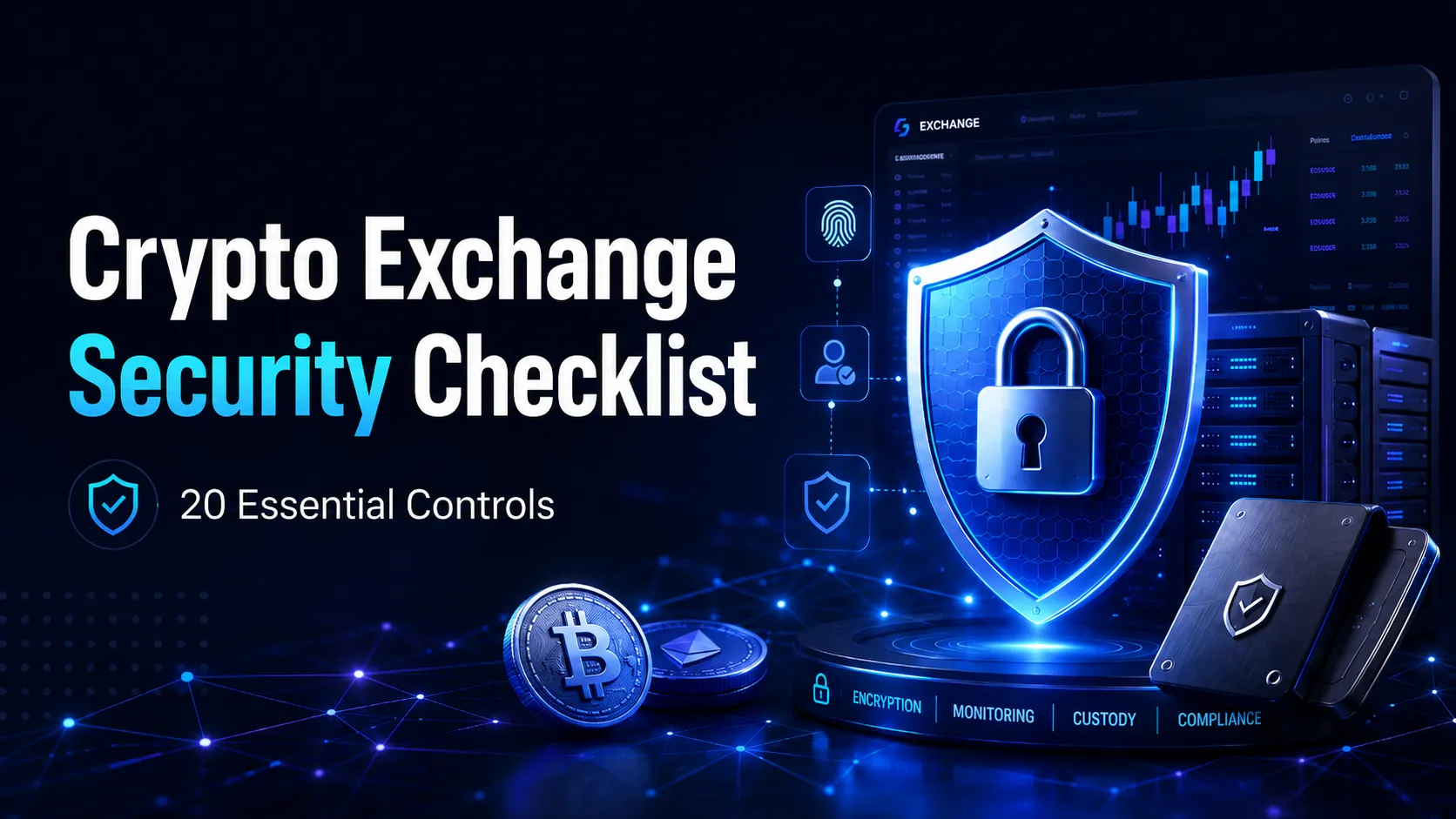
Quick Answer: How Do You Secure a Crypto Exchange?
A secure crypto exchange requires multiple layers of protection:
- Separate hot, warm, and cold wallets
- Protect private keys throughout their lifecycle
- Require multiple approvals for high-risk transactions
- Enforce phishing-resistant authentication
- Restrict administrator privileges
- Monitor withdrawals using a risk engine
- Secure every API endpoint
- Protect the internal ledger and matching engine
- Segment production infrastructure
- Monitor logs and suspicious activity continuously
- Test the platform before and after launch
- Maintain incident-response and recovery procedures
Security should address governance, prevention, detection, response, and recovery. The NIST Cybersecurity Framework 2.0 organizes cybersecurity risk management around six functions: Govern, Identify, Protect, Detect, Respond, and Recover.
Why Crypto Exchange Security Requires a Layered Approach
Many exchange operators focus primarily on wallet security. Wallet protection is essential, but it is only one part of the system.
An attacker may target:
- Customer accounts
- Administrator credentials
- Withdrawal APIs
- Private keys
- Cloud infrastructure
- Source-code repositories
- Third-party dependencies
- Liquidity-provider integrations
- KYC information
- Internal accounting systems
- Employees and support agents
A platform can have secure cold storage and still lose funds through an administrator account, incorrect balance logic, compromised API key, or manipulated withdrawal process. For this reason, exchanges should combine general cybersecurity frameworks with crypto-specific standards. The CryptoCurrency Security Standard, or CCSS, focuses on protecting cryptocurrency systems and key-management processes. Its current Version 9.0 is intended to complement broader information-security standards rather than replace them.
1. Establish Security Governance and Responsibility
Start by defining who is responsible for each security-sensitive activity.
Document who can:
- Access production infrastructure
- Create or rotate wallet keys
- Approve treasury transactions
- Change withdrawal limits
- Modify user balances
- Deploy production code
- Review security alerts
- Pause withdrawals
- Communicate during an incident
Apply separation of duties. One employee should not be able to initiate, approve, and complete a high-value wallet transfer without independent oversight. Review employee access regularly and revoke it immediately when someone changes roles or leaves the company.
2. Separate Hot, Warm, and Cold Wallets
Do not keep all customer assets in an internet-connected wallet. A safer wallet architecture usually includes: Hot wallets: Used for routine deposits and withdrawals. They should contain only the amount needed for short-term operations. Warm wallets: An intermediate treasury layer with stronger approval requirements and limited connectivity. Cold wallets: Offline or highly isolated wallets used to store the majority of long-term reserves. Transfers between wallet layers should follow predefined thresholds, approval rules, destination allowlists, and transaction-monitoring policies. Cold storage must also have tested backup and recovery procedures. An inaccessible wallet can be as damaging operationally as a compromised one.
3. Protect Private Keys Across Their Entire Lifecycle
Private keys must be secured during generation, storage, backup, signing, recovery, rotation, and destruction.
Never store production keys in:
- Application source code
- Public repositories
- Developer laptops
- Plain-text environment files
- Shared cloud drives
- Messaging applications
- Unencrypted database fields
Use dedicated key-management infrastructure such as hardware security modules, secure signing environments, multi-signature wallets, or multi-party computation where appropriate. NIST defines key management as protecting cryptographic keys throughout their complete lifecycle, including generation, storage, use, establishment, and destruction.
4. Eliminate Single Points of Transaction Approval
No single credential, device, employee, or application server should be able to transfer a significant amount of customer funds.
Require multiple approvals for:
- Large withdrawals
- Cold-wallet transfers
- Treasury rebalancing
- New trusted addresses
- Changes to signing policies
- Emergency fund movements
- Key-recovery operations
Approval thresholds should depend on transaction value, asset type, destination address, user risk, and operational context. Routine low-risk withdrawals may be automated. High-value or unusual transfers should require manual review by multiple authorized individuals using separate accounts or devices.
5. Require Strong Authentication
Offer strong multi-factor authentication to users and require it for sensitive actions.
Preferred options include:
- Passkeys
- FIDO2 hardware security keys
- Authenticator applications
- Device-bound authentication
- Secure recovery codes
SMS codes may be offered as a fallback, but they should not be treated as the strongest authentication method. NIST’s current digital identity guidance requires phishing-resistant options in higher-assurance environments and identifies WebAuthn and FIDO2 as examples of authentication that can resist verifier-impersonation attacks.
Require step-up authentication when a user:
- Changes a password or email address
- Disables MFA
- Adds a withdrawal address
- Creates an API key
- Changes recovery settings
- Requests an unusually large withdrawal
6. Apply Stricter Controls to Administrator Accounts
Administrative accounts can control wallets, users, limits, markets, configuration, and financial records. They need stronger protection than normal customer accounts.
Use:
- Phishing-resistant MFA
- Separate privileged accounts
- Short session durations
- IP or network restrictions
- Approved-device policies
- Just-in-time access
- Detailed administrator logs
- Approval workflows for critical changes
Follow the principle of least privilege. Support agents should not automatically have permission to adjust balances, access wallet infrastructure, export KYC records, or change withdrawal policies. Zero-trust architecture removes implicit trust based only on network location and requires access decisions to focus on users, devices, services, and protected resources.
7. Build a Withdrawal Risk Engine
Correct credentials alone should not be enough to approve every withdrawal.
A withdrawal risk engine should evaluate:
- New devices
- New IP addresses or countries
- Recent password or MFA changes
- Newly added destination addresses
- Abnormal withdrawal values
- Rapid movement of the entire balance
- Multiple failed authentication attempts
- Suspicious API activity
- Unusual user behavior
- High-risk blockchain addresses
Depending on the risk score, the system can approve, delay, reject, or send the withdrawal for manual review. Address allowlisting, configurable withdrawal limits, and cooling-off periods after security changes can further reduce account-takeover risk.
8. Secure Every API Endpoint
Exchange APIs connect web and mobile applications, trading bots, liquidity providers, blockchains, payment systems, and internal services. Every API request must be checked for both authentication and authorization. A valid token must never give a user access to another customer’s orders, balances, transactions, or identity data.
Implement:
- Object-level authorization
- Function-level authorization
- Request validation
- Rate limiting
- Token expiration
- Replay protection
- API-key permission scopes
- Optional IP allowlisting
- Signed trading requests
- Withdrawal permission disabled by default
The OWASP API Security Top 10 highlights broken object-level authorization, broken authentication, unrestricted resource consumption, security misconfiguration, and abuse of sensitive business flows as major API risks.
9. Protect the Ledger, Matching Engine, and Order System
Blockchain wallet balances are not the same as the exchange’s internal accounting records.
Test the internal ledger, matching engine, fee system, and order-management services for:
- Negative balances
- Duplicate execution
- Race conditions
- Double withdrawal requests
- Replay attacks
- Precision and rounding errors
- Incorrect fee calculations
- Unauthorized balance adjustments
- Failed transaction rollbacks
- Extreme market-order conditions
Financial operations should be idempotent, traceable, and reconcilable. Regularly reconcile customer liabilities against internal wallet records and on-chain assets. Any unexplained difference should trigger investigation.
10. Segment Production Infrastructure
Separate public-facing services from critical financial systems. The marketing website, customer dashboard, admin panel, matching engine, database, wallet-signing service, and monitoring platform should not all operate within one unrestricted network.
Use:
- Private networks
- Firewalls and restrictive security groups
- Web application firewalls
- DDoS protection
- Hardened server images
- Restricted administrative access
- Centralized secret management
- Encrypted backups
- Separate production and development environments
A compromise of the public website should not provide a direct path to private keys or the production ledger.
11. Use a Secure Software Development Lifecycle
Security testing should begin during architecture and continue throughout development and operation.
The development process should include:
- Threat modeling
- Peer code review
- Static security testing
- Dynamic application testing
- Secret scanning
- Dependency scanning
- Infrastructure-as-code review
- Container scanning
- Pre-production penetration testing
- Controlled deployment pipelines
OWASP ASVS 5.0 provides testable requirements for verifying application and web-service security, while the NIST Secure Software Development Framework describes practices that can be integrated into the development lifecycle.
12. Protect the Software Supply Chain
Crypto platforms depend on frameworks, packages, containers, blockchain libraries, node software, and third-party APIs.
Maintain an inventory of these components and:
- Pin approved dependency versions
- Remove unused packages
- Monitor vulnerable components
- Generate a software bill of materials
- Verify package integrity
- Restrict who can modify build pipelines
- Sign or verify deployment artifacts
- Rotate exposed development secrets
OWASP recommends tracking both direct and transitive dependencies through an SBOM to improve vulnerability management and incident response.
13. Centralize Logging and Real-Time Monitoring
Record all security-sensitive events, including:
- Login attempts
- MFA changes
- Password resets
- API-key creation
- Withdrawal requests
- Wallet transfers
- Administrator actions
- Balance adjustments
- Permission changes
- Production deployments
- Server access
- Configuration changes
Logs should be centralized, time-synchronized, protected against tampering, and connected to meaningful alerts. Alerts should be prioritized. A large cold-wallet transaction requires a different response from an ordinary failed login.
14. Test Backups and Disaster Recovery
Backups are useful only when they can be restored. Back up critical databases, configurations, audit records, wallet metadata, and required recovery materials according to documented procedures.
Test:
- Database restoration
- Service recovery
- Infrastructure recreation
- Key-recovery processesv
- Failover systems
- Communication procedures
- Recovery time objectives
Store backups separately from the primary environment so that one compromise cannot destroy both production data and recovery copies.
15. Prepare an Incident-Response Plan
Create specific response procedures for:
- Private-key compromise
- Hot-wallet theft
- Account takeover
- Database exposure
- Malicious administrator activity
- API abuse
- DDoS attacks
- Unauthorized deployments
- Blockchain disruption
- Liquidity-provider failure
The plan should define who can pause withdrawals, isolate services, rotate credentials, move funds, preserve evidence, contact partners, notify users, and authorize recovery. NIST’s current incident-response guidance integrates preparation, detection, response, and recovery with the broader cybersecurity risk-management process.
Final Crypto Exchange Security Checklist
Before accepting customer deposits, confirm that:
- Wallets are separated into operational and reserve layers.
- Private keys are stored outside application code and ordinary databases.
- Large transfers require multiple approvals.
- Users can enable strong MFA.
- Administrators must use phishing-resistant authentication.
- Withdrawal limits and risk scoring are operational.
- API keys use restricted permission scopes.
- Ledger and order edge cases have been tested.
- Production services are properly segmented.
- Dependencies and secrets are continuously scanned.
- Logs and real-time security alerts are active.
- Independent penetration testing has been completed.
- Backups have been successfully restored in a test.
- Emergency withdrawal controls have been rehearsed.
- Incident roles and communication procedures are documented.
Building Secure Crypto Exchange Infrastructure with Javizen
Javizen develops secure, scalable, and customizable crypto and blockchain infrastructure for exchange operators, fintech companies, and Web3 businesses. The Javizen CEX Crypto Exchange Script provides a production-grade exchange foundation with a matching engine, liquidity connectivity, custodial wallets with cold-storage support, KYC workflows, payment integrations, and a complete administration panel. The platform can also be extended with P2P, futures, options, and prop trading modules. However, secure exchange deployment involves more than installing software. Wallet policies, server configuration, operational procedures, administrator access, monitoring, compliance requirements, and incident plans must all be adapted to the operator’s business model.
Conclusion
Crypto exchange security is not a one-time feature or certification. It is a continuous process that combines secure architecture, operational discipline, real-time monitoring, independent testing, and prepared incident response. Before accepting real funds, exchange operators should test every critical control under realistic failure and attack scenarios. Adding another trading feature may improve the product. Preventing one unauthorized withdrawal may protect the entire business.
Frequently asked questions
What is the most important security feature of a crypto exchange?
There is no single feature that can secure an entire exchange. Secure key management, wallet isolation, strong authentication, withdrawal controls, API security, monitoring, and incident response must work together.
How much cryptocurrency should be kept in a hot wallet?
A hot wallet should contain only the liquidity required for expected short-term withdrawals. The exact amount depends on withdrawal volume, replenishment speed, supported assets, and the operator’s risk tolerance.
Is two-factor authentication enough?
No. MFA should be combined with device monitoring, withdrawal-risk analysis, session controls, address allowlisting, and secure account-recovery procedures.
Is a white-label crypto exchange secure?
A white-label platform can be secure when its architecture, source code, deployment, wallet infrastructure, access controls, and operational procedures are professionally tested and maintained.
How often should an exchange conduct penetration testing?
An independent security test should be completed before launch and repeated after major changes to wallets, authentication, APIs, infrastructure, or financial logic. Continuous vulnerability scanning should operate between formal assessments.
Latest Post
 06 Sep, 2026
How to Build a Crypto Options Trading Platform
 05 Sep, 2026
How to Launch a Crypto Prop Trading Platform
 03 Sep, 2026
How to Scale a Crypto Exchange for High Trading Volume
 02 Sep, 2026
How to Design a Crypto Exchange Fee Structure
 01 Sep, 2026
Market Makers vs Liquidity Providers: What Is the Difference?
Build with Javizen.
Planning an exchange, token or blockchain product? Talk to our team and turn the ideas in this article into a launch-ready platform.