

Javizen's RWA Tokenization Platform enables businesses to register real-world assets, issue and manage compliance-aware digital tokens, onboard investors, and run controlled offerings from one modular system. It combines blockchain infrastructure, identity verification, payments, pricing, treasury operations, reporting, and auditability, with future-ready support for DEX and CEX integrations.
- Future updates included
- 6 months author support
- Fully open source
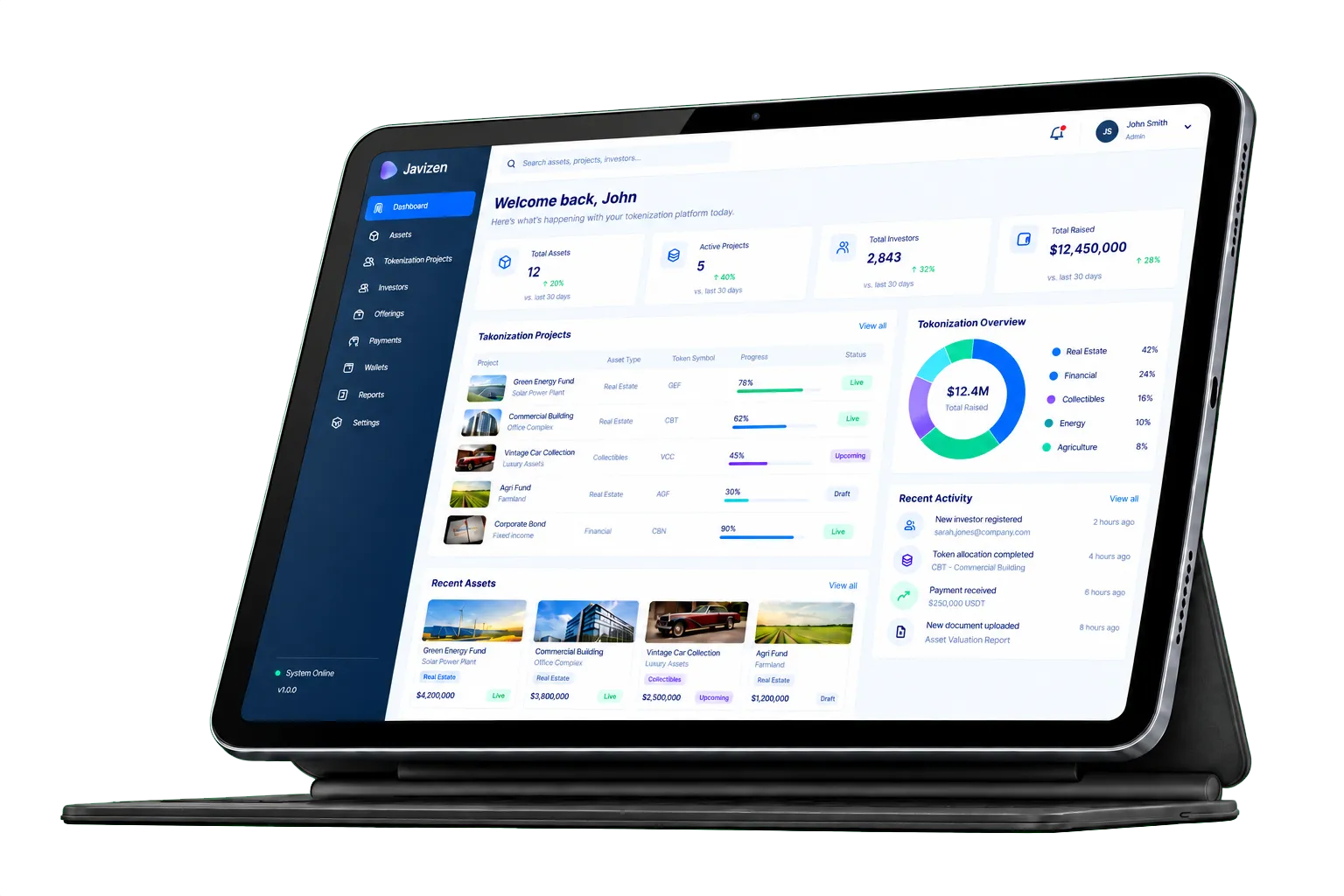
One modular system for the whole asset lifecycle
Javizen's Real-World Asset Tokenization Platform provides the technical foundation for turning physical and financial assets into securely managed digital tokens. Designed as a multi-project, compliance-aware platform, it supports the full asset lifecycle: asset registration, document management, investor onboarding, token issuance, controlled offerings, allocation, payments, vesting, claims, refunds, reporting, and ongoing administration.
Each tokenization project can define its own asset structure, investor eligibility rules, offering rounds, pricing method, supply controls, transfer restrictions, payment options, and holder rights. KYC and KYB screening, country restrictions, consent records, multi-factor authentication, role-based access, and approval workflows help operators apply the policies required for their chosen markets and asset models.
The platform uses EVM-compatible smart contracts and standard token architecture, with controlled minting, burning, pausing, access permissions, vesting, treasury operations, compliance controls, and oracle-based pricing. Sensitive actions can require multisignature approval, timelocks, dual control, and complete audit records. Asset documents, ownership evidence, valuation reports, and proof-of-reserve references can be maintained alongside immutable on-chain transaction data.
For investors, the platform provides a clear journey from registration and verification to participation, payment, token allocation, portfolio monitoring, and eligible claims. Administrators receive dedicated tools for project publishing, investor management, offering configuration, approvals, treasury oversight, reconciliations, notifications, reports, and security monitoring.
A modular backend, documented APIs, webhooks, payment and wallet adapters, price feeds, and blockchain indexers make the solution easier to integrate with external services and existing business infrastructure. The initial deployment can launch as a focused tokenization and offering platform for one selected asset, then expand across additional projects, networks, payment methods, liquidity services, and secondary-market connections. DEX readiness can be included, while CEX listing remains a separate commercial and regulatory workstream.
Key Features from day one
End-to-End Asset Lifecycle
Manage assets, offerings, allocations, claims, refunds, and reporting centrally and securely.
Compliance-Aware Investor Onboarding
Apply KYC, KYB, eligibility, jurisdiction, consent, and approval controls consistently.
Secure Smart Contract Infrastructure
Issue configurable tokens with supply, transfer, vesting, and treasury controls.
Flexible Integrations and Market Readiness
Connect wallets, payments, pricing feeds, APIs, webhooks, DEXs, and CEXs.
Everything your tokenization platform needs
Asset registration & documents
- Asset registrationEach project defines its own asset structure, registered on the platform before anything is issued.
- Document managementAsset documents, ownership evidence and valuation reports are held with the asset rather than in an inbox.
- Proof-of-reserve referencesKept alongside immutable on-chain transaction data, so the off-chain claim and the on-chain record sit together.
- Multi-project by designOne deployment carries several tokenization projects, each with its own asset model and rules.
Investor onboarding & eligibility
- KYC and KYB screeningIndividual and business investors are screened before they can participate.
- Eligibility and jurisdiction rulesInvestor eligibility and country restrictions are set per project, not globally.
- Consent recordsConsents are recorded as part of the onboarding trail rather than assumed.
- Access controlMulti-factor authentication, role-based access and approval workflows cover both investors and operators.
Token issuance & smart contracts
- EVM-compatible contractsStandard token architecture on EVM-compatible networks.
- Controlled supplyMinting, burning and pausing are permissioned operations, not open ones.
- Transfer restrictionsCompliance controls and holder rights are enforced by the contracts themselves.
- VestingVesting schedules live in the contract layer rather than in a spreadsheet.
- Oracle-based pricingPrices come from oracle feeds rather than being typed in by hand.
Offerings & allocation
- Offering roundsEach project defines its own rounds, pricing method and supply controls.
- Controlled participationWho can take part in a round follows the eligibility rules you set for it.
- AllocationToken allocation follows the payment and the rules of the round it belongs to.
- Claims and refundsEligible claims and refunds are processed inside the platform, with a record of each.
Payments & treasury
- Payment optionsPayment methods are configured per project rather than fixed for the whole platform.
- Treasury operationsTreasury actions run through the same permissions and approvals as everything else.
- Idempotent processingFinancial processing is idempotent, so a retry cannot charge or allocate twice.
- Blockchain reconciliationOn-chain and off-chain records are reconciled rather than assumed to agree.
Controls & auditability
- Multisignature approvalSensitive actions can be made to require more than one signature.
- TimelocksA delay can be placed in front of the operations that should not be instant.
- Dual controlTwo-person control for the actions where one person should not be enough.
- Complete audit recordsEvery sensitive action leaves a record that can be read back later.
The investor journey
- Registration and verificationA clear path from sign-up to a verified, eligible investor.
- Participation and paymentInvestors join an offering and pay through the method the project allows.
- Portfolio monitoringHoldings, allocations and vesting position in one place.
- Eligible claimsInvestors see what they are entitled to claim, and claim it from the same screen.
Integration layer
- Modular backendBuilt to be extended at the edges rather than forked.
- Documented APIs and webhooksExternal systems integrate against a documented surface, not a reverse-engineered one.
- Payment and wallet adaptersAdapters connect the platform to wallets and payment providers.
- Price feeds and indexersBlockchain indexers and price feeds keep the platform in step with the chain.
Operations & environments
- Encrypted storage and backupsSensitive data is encrypted at rest and backed up on a schedule.
- Monitoring and incident alertsProblems arrive as alerts rather than as support tickets from investors.
- Recovery runbooksWritten procedures for the situations that need a procedure.
- Separate environmentsDevelopment, testing, staging and production are kept apart.
Issue the token,then give it somewhere to trade.
The tokenization platform runs on its own. If you also want to raise against the token or give holders a market for it, these are the Javizen products that connect to it.
 Token Sale
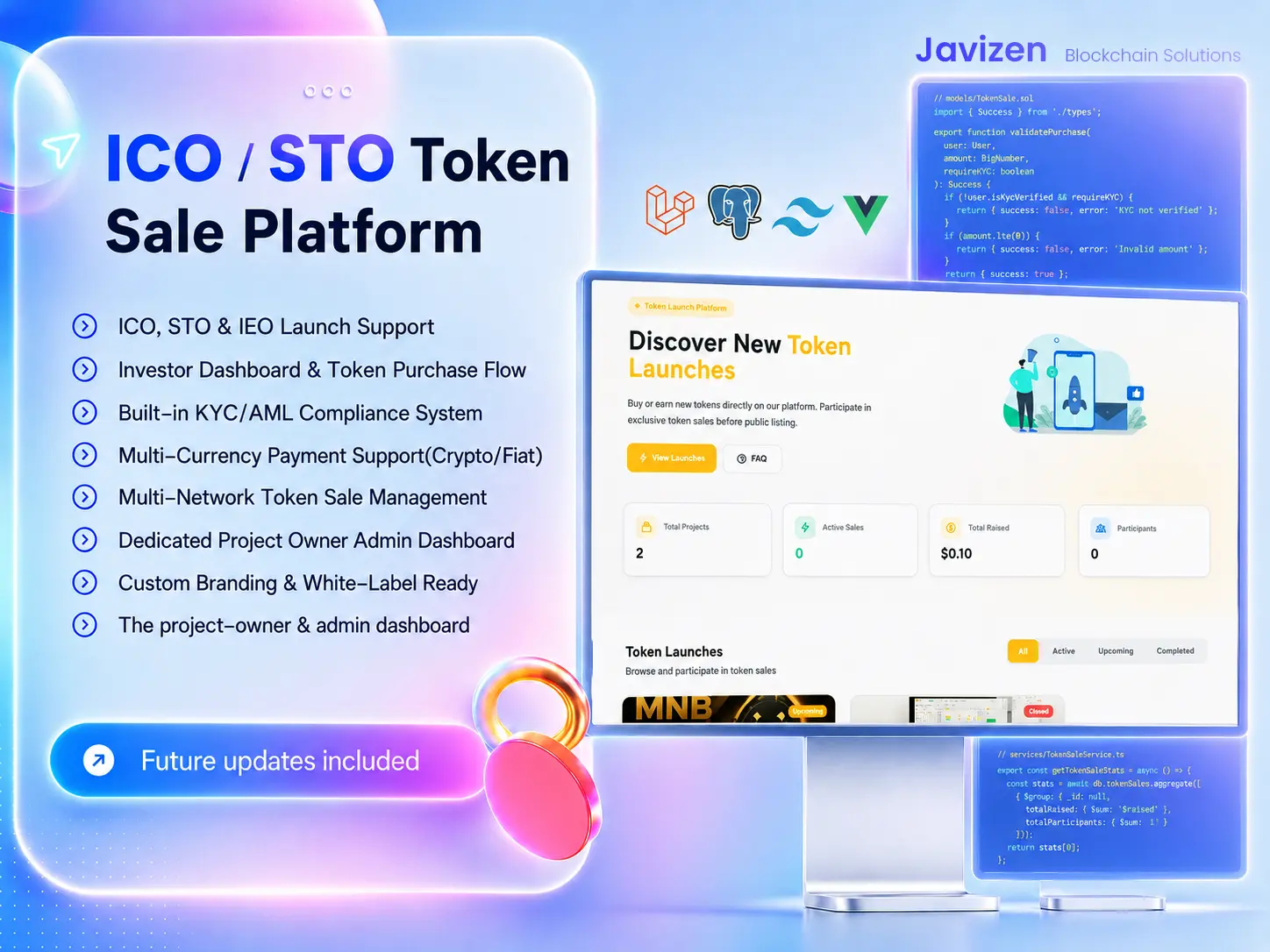
ICO / STO Token Sale Platform
Run public, private or staged token offerings with dashboards, referral systems and admin panels — connectable to your CEX/DEX.
Explore module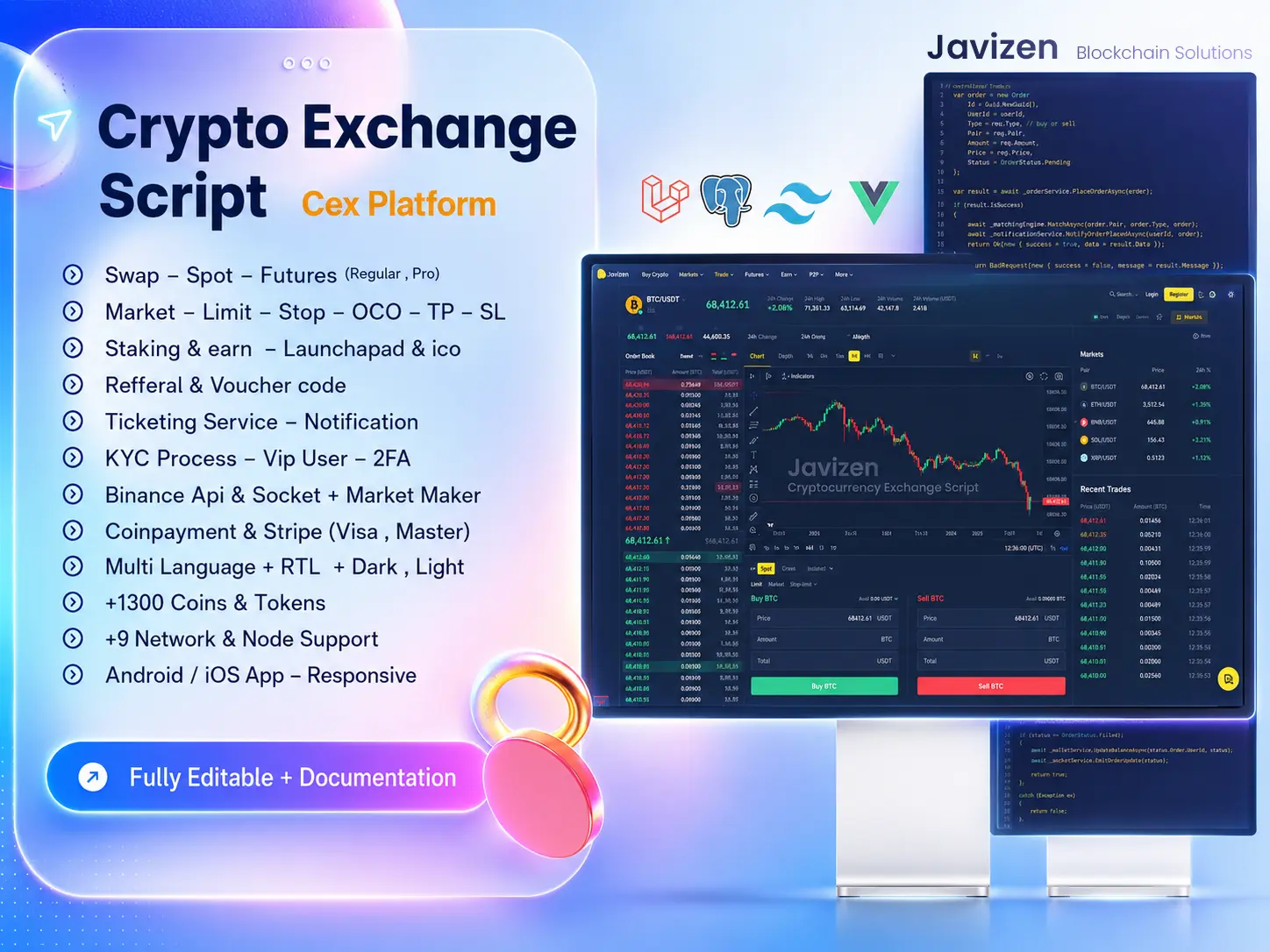 Crypto Exchange Infrastructure
Javizen CEX Full Suite
Complete crypto exchange infrastructure with full source ownership — Spot, Futures, Options, P2P and Prop Trading, wallets, KYC, APIs and complete operator tools. $24,900, deployment included.
Explore module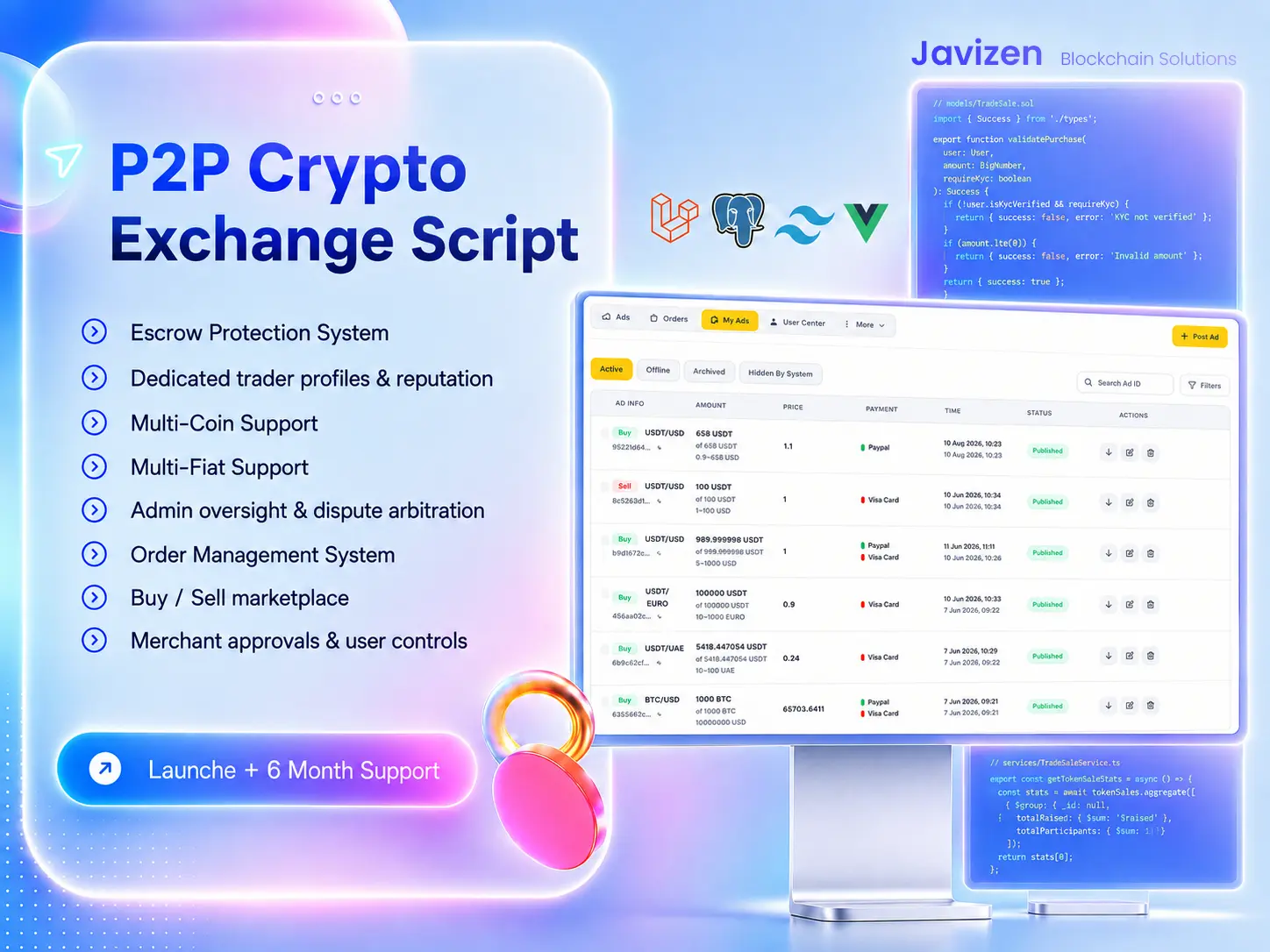 Peer-to-Peer
P2P Crypto Exchange Script
Match buyers and sellers directly with escrow, ratings and dispute resolution. Included in the Javizen CEX Full Suite, or licensed separately for existing exchanges.
Explore moduleOne panel behind every project
You define the asset, the rules and the round; the platform runs them — from an investor's first registration to the moment a claim settles.
How an investor moves through it
Every investor follows the same path, under the rules the project sets:
- Registers and completes KYC or KYB verification
- Is checked against the project's eligibility and jurisdiction rules
- Participates in an open offering round and pays through an allowed method
- Receives a token allocation, subject to vesting where it applies
- Monitors the portfolio and claims what is eligible, or is refunded
What you configure
A tokenization project is defined in the admin panel, not in code:
- Asset structure, documents and valuation references
- Investor eligibility, country restrictions and consent requirements
- Offering rounds, pricing method and supply controls
- Transfer restrictions, vesting schedules and holder rights
- Payment options, treasury rules and approval thresholds
What you watch
Reporting and security monitoring give you the operating picture:
- Investor status, approvals and pending reviews
- Offering progress, allocations and outstanding claims
- Treasury position and payment reconciliations
- Blockchain reconciliation and audit records
- Notifications, incident alerts and security events
Questions you might have
Can one deployment run more than one tokenization project?
Yes. The platform is multi-project by design. Each project defines its own asset structure, investor eligibility rules, offering rounds, pricing method, supply controls, transfer restrictions, payment options and holder rights.
Which blockchains does it work with?
EVM-compatible networks, using standard token architecture. Additional networks are part of the expansion path rather than something the first deployment has to carry.
How are investors screened?
Through KYC and KYB screening, eligibility and country restrictions, consent records and approval workflows — applied per project, so a rule that fits one asset and market is not forced on another.
Can we restrict who holds or transfers the tokens?
Yes. Transfer restrictions, holder rights, access permissions and supply controls are enforced by the smart contracts, alongside controlled minting, burning, pausing and vesting.
How are sensitive operations protected?
Sensitive actions can require multisignature approval, timelocks and dual control, and every one of them leaves a complete audit record. Financial processing is idempotent, and on-chain and off-chain records are reconciled rather than assumed to agree.
Does it connect to exchanges?
DEX readiness can be included in scope. A CEX listing is a separate commercial and regulatory workstream — the platform is built to be ready for it, but the listing itself is not something software delivers.
What does the first deployment cover?
It can launch as a focused tokenization and offering platform for one selected asset, then expand across additional projects, networks, payment methods, liquidity services and secondary-market connections.
Can it integrate with systems we already run?
That is what the modular backend is for. Documented APIs, webhooks, payment and wallet adapters, price feeds and blockchain indexers are the integration surface for external services and existing business infrastructure.
What support is included?
Six months of author support and future updates, the same terms as every other Javizen product.
Ready to launch your Tokenization?
Tell us your market and your edge — we'll tailor the platform to your business model, add the modules you need and stay with you through go-live.