
Admin Panel Features Every Crypto Exchange Needs
What Is a Crypto Exchange Admin Panel?
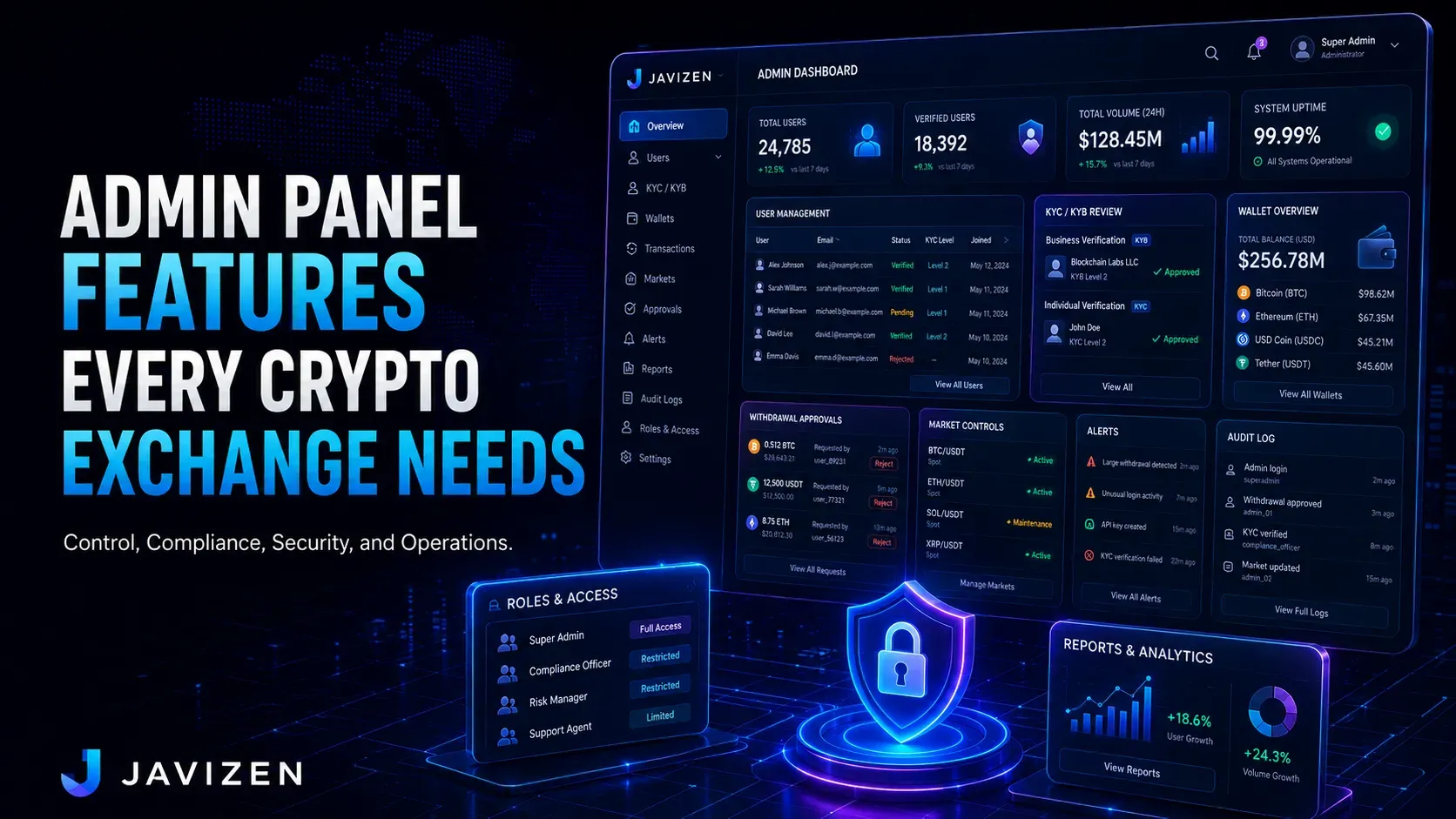
A crypto exchange admin panel is a secure internal interface that gives authorized employees access to the platform’s operational and administrative functions. While customers use the exchange interface to register, deposit funds, trade, and withdraw assets, administrators need a different view. They must review user accounts, manage compliance cases, monitor wallets, configure markets, control permissions, investigate transactions, and respond to technical or financial risks. The admin panel should not be treated as a basic content-management dashboard. It is a privileged financial operations system connected to customer data, account balances, blockchain transactions, trading infrastructure, and security controls. Because of this access, an admin-panel compromise can be more damaging than a customer-account compromise. Attackers who gain administrative privileges may be able to change user limits, approve withdrawals, disable controls, expose personal information, or alter platform settings. OWASP identifies broken access control as one of the most serious application-security risks and recommends deny-by-default policies and least-privilege access. These principles are particularly important for exchange administration systems.
Role-Based Access Control
Not every employee should have access to every administrative function. A customer-support agent may need to review account status and login history but should not be able to approve withdrawals. A compliance analyst may need access to identity documents and transaction-monitoring alerts but should not be able to change trading fees. A finance administrator may manage settlements while having no access to private security configurations. Role-based access control, or RBAC, should define which pages, records, fields, and actions each role can access. Permissions should also distinguish between viewing and modifying information. An employee may be allowed to inspect a wallet transaction but not cancel, release, or approve it. Sensitive privileges should follow the principle of least privilege, meaning administrators receive only the access required for their responsibilities. OWASP also recommends just-in-time access and avoiding permanent administrative privileges where possible. For high-risk actions, the panel should support dual approval. One administrator submits the request, while another authorized person reviews and approves it. This can be used for large withdrawals, cold-wallet transfers, fee changes, market suspension, user-balance adjustments, and security-policy modifications.
Essential Admin Panel Modules
A production-ready crypto exchange admin panel should normally include the following modules:
- Dashboard and system overview: Real-time visibility into registrations, active users, trading volume, deposits, withdrawals, wallet balances, open compliance cases, revenue, and system alerts.
- User management: Customer profiles, verification status, login history, devices, account limits, referrals, balances, restrictions, notes, and communication history.
- KYC and KYB management: Document review, identity-provider results, beneficial ownership data, sanctions and PEP screening, source-of-funds evidence, risk scores, and enhanced due diligence cases.
- Wallet and transaction management: Deposit status, withdrawal requests, blockchain confirmations, transaction hashes, network fees, address screening, approval workflows, and wallet reconciliation.
- Trading and market management: Trading pairs, tick sizes, quantity limits, order types, fee tiers, market status, price controls, liquidity-provider settings, and abnormal-market alerts.
- Compliance and risk monitoring: Transaction alerts, suspicious activity cases, Travel Rule information, sanctions exposure, high-risk wallets, fraud indicators, and reporting workflows.
- Finance and reporting: Trading fees, withdrawal revenue, commissions, rebates, customer liabilities, wallet assets, settlement reports, and downloadable financial records.
- Support and communications: Tickets, customer notifications, email and SMS templates, announcements, dispute history, internal notes, and escalation tools.
These modules should share one consistent source of data. Administrators should not need to move between disconnected systems to understand a customer or transaction.
User Account Management
The user-management section should provide a complete account overview without exposing unnecessary sensitive data. Administrators may need to view identity details, verification status, account type, balances, open orders, transaction history, login records, linked bank accounts, devices, referral activity, and current restrictions. The panel should also make the difference between available, reserved, locked, pending, and total balances clear. Confusing balance presentation can lead to incorrect support decisions or financial adjustments. Administrative actions might include temporarily restricting trading, suspending withdrawals, requiring reverification, resetting selected security controls, or closing an account under an approved procedure. Direct balance editing should be heavily restricted. Where manual adjustments are necessary, the system should require a reason, supporting evidence, authorization, and a corresponding ledger entry. Administrators should never be able to change balances silently.
KYC, KYB, and Compliance Case Management
Compliance teams need more than a simple approve-or-reject button. The admin panel should display documents, identity-verification results, biometric checks, company records, directors, shareholders, beneficial owners, sanctions matches, risk indicators, and previous review decisions. Cases should move through clearly defined states such as pending review, additional information requested, enhanced due diligence, approved, rejected, or escalated. FATF expects virtual asset service providers to apply customer due diligence, record-keeping, suspicious transaction reporting, and transfer-information requirements comparable to those used by financial institutions. The exchange panel should therefore connect customer identity data with transaction monitoring. A compliance analyst investigating a suspicious withdrawal should be able to review the customer profile, blockchain exposure, previous deposits, connected accounts, verification history, and risk score from one case interface. Every decision should include the reviewer, date, reason, evidence, and applied policy.
Deposit and Withdrawal Controls
Deposits and withdrawals are among the most sensitive areas of exchange administration. For deposits, administrators need visibility into addresses, networks, transaction hashes, confirmation status, credited amounts, duplicate-detection results, and chain-reorganization events. For withdrawals, the panel should show the destination address, network, amount, fee, risk score, device history, account changes, sanctions results, and approval state. High-risk withdrawals may require manual review or multiple approvals. The panel should support address allowlists, velocity limits, cooling-off periods, transaction-risk rules, and automatic holds after password, device, email, or multifactor-authentication changes. Administrators should be able to pause withdrawals for one user, one asset, one blockchain network, or the entire platform without affecting unrelated operations. Emergency controls must be prominent but protected from accidental use.
Wallet Management and Reconciliation
An exchange admin panel should provide an operational view of hot, warm, and cold wallet balances. Teams need to know whether hot-wallet funds are sufficient for expected withdrawals, whether a network requires rebalancing, and whether on-chain holdings match internal customer liabilities. The panel should display pending deposits, queued withdrawals, failed transactions, network fees, nonce issues, wallet status, and unusual balance movements. Automated reconciliation should compare blockchain assets with the internal ledger. Any mismatch should generate an immediate alert and investigation case. Private keys and seed phrases must never appear in the admin panel. Signing infrastructure should remain isolated, with the panel submitting policy-controlled requests rather than directly exposing cryptographic credentials.
Trading and Market Controls
Market operations teams need tools to configure and supervise trading pairs without deploying new application code. Administrators should be able to manage minimum order sizes, price increments, quantity increments, maker and taker fees, market status, supported order types, and user eligibility. A market may need to be placed into pre-launch, active, cancel-only, close-only, suspended, or maintenance mode. The panel should also monitor price deviation, spread, order-book depth, trade frequency, failed orders, and liquidity-provider availability. Risk controls may include maximum price deviation from an external index, protection against clearly erroneous orders, self-trade prevention, and temporary circuit breakers during abnormal volatility. Changes to market configuration should be versioned and auditable because an incorrect tick size, fee, or price limit can affect thousands of orders.
Fee and Revenue Management
Exchange operators should be able to configure fees without changing source code. This includes maker-taker fees, VIP tiers, withdrawal charges, conversion spreads, referral commissions, staking commissions, market-specific fees, and temporary promotions. The panel should show the effective fee applied to each transaction and explain which rule produced it. This is important when customers dispute charges or when finance teams reconcile revenue. Fee changes should have an effective date and approval workflow. Historical transactions must retain the original fee rule rather than being recalculated using a new configuration. Revenue dashboards should separate gross fees from rebates, liquidity incentives, payment-provider costs, network expenses, and affiliate commissions.
Security Monitoring and Administrative Sessions
Security Monitoring and Administrative Sessions The admin panel itself needs stronger security than a standard internal business application. Administrative access should require multifactor authentication, trusted-device controls, session expiration, IP or network restrictions where practical, and alerts for unusual access. The system should record successful and failed login attempts, password and authentication changes, permission updates, data exports, sensitive record views, and all administrative actions. OWASP recommends logging administrative functions and security-configuration changes. NIST guidance also emphasizes structured log management and the collection of security events such as authentication attempts, account changes, and policy modifications. Session information should show the administrator, role, device, IP address, location indicator, login time, last activity, and authentication method. Security teams should be able to terminate active sessions immediately.
Audit Logs and Action History
Every important administrative action should create an immutable audit record. The record should identify who performed the action, what was changed, the previous and new values, when it occurred, which account or resource was affected, and why the action was taken. Audit logs should cover user restrictions, KYC decisions, balance adjustments, withdrawal approvals, permission changes, market settings, fee updates, data exports, and system-security changes. Administrators should not be able to delete or modify their own action history. Access to logs should itself be restricted and monitored. A searchable audit trail supports investigations, regulatory reviews, internal controls, dispute resolution, and incident response. It also discourages unauthorized behavior because sensitive actions remain attributable to specific individuals.
Alerts and Incident Management
A useful admin panel should help teams identify problems before customers report them. Alerts may be generated for hot-wallet shortages, unusual withdrawals, rapid balance changes, failed blockchain transactions, pricing deviations, liquidity loss, repeated login failures, API errors, or reconciliation differences. Alerts should include severity, affected service, supporting data, assigned owner, status, and escalation history. The goal is not to display hundreds of undifferentiated warnings. The system should prioritize incidents according to financial, security, customer, and regulatory impact. Administrators should be able to acknowledge, investigate, escalate, and resolve alerts while preserving the complete incident timeline.
Reporting and Data Export
Management, finance, compliance, and operations teams require different reports. The exchange should provide reports for customer registrations, verification outcomes, trading volume, fees, deposits, withdrawals, wallet balances, liabilities, suspicious activity, support performance, and administrator actions. Exports should follow the same permission model as on-screen data. An employee who cannot view identity documents should not be able to export them through a report. Large or sensitive exports may require approval, encryption, expiration, and download logging. Reports should also distinguish real-time operational estimates from finalized accounting data. This prevents management dashboards from being mistaken for audited financial statements.
Common Admin Panel Design Mistakes
One common mistake is giving a single “super admin” role to several employees. This eliminates separation of duties and makes it difficult to determine who should have access to sensitive functions. Another problem is relying on manual database edits for operations that the panel does not support. These changes may bypass validation, ledger rules, approvals, and audit logs. Poor panels also show data without context. A withdrawal record is far more useful when it includes customer risk, device changes, address exposure, confirmation status, and related case history. Other serious mistakes include allowing silent balance changes, storing sensitive documents without field-level restrictions, exposing security credentials, using shared administrator accounts, and failing to log configuration changes.
Crypto Exchange Admin Panel Checklist
Before launching, founders should confirm that the admin platform can:
- Enforce role-based, field-level, and action-level permissions
- Require dual approval for sensitive financial and security actions
- Connect user profiles with KYC, transactions, wallets, trades, support cases, and risk alerts
- Manage deposits, withdrawals, confirmations, wallet balances, and reconciliation
- Configure trading pairs, fees, limits, liquidity settings, and market states
- Preserve immutable audit logs for every privileged action
- Generate operational, compliance, security, and financial reports
- Suspend users, assets, networks, markets, or withdrawals during an incident
The panel should also be tested with realistic operational scenarios rather than only technical acceptance tests.
How Javizen Supports Exchange Administration
Javizen develops modular crypto exchange infrastructure with a centralized administrative environment for customer management, KYC/KYB, wallets, transactions, markets, fees, reports, notifications, and security operations. Depending on the exchange model, the admin panel can support spot trading, futures, options, P2P transactions, staking, referrals, token sales, liquidity providers, and institutional accounts. Role-based permissions and approval workflows can separate customer support, compliance, finance, wallet operations, market operations, and senior administration. The objective is to give operators direct control over business rules and daily operations without requiring developers to modify production data or deploy code for routine changes.
Conclusion
A crypto exchange admin panel is not simply a dashboard for viewing statistics. It is the operational and security control layer of the entire platform. The right admin system gives authorized teams the ability to manage users, review compliance cases, control wallets, investigate transactions, configure markets, monitor liquidity, manage fees, and respond to incidents safely. Every privileged action should follow clear permissions, approval requirements, and audit rules. Administrators should never need unrestricted database access to perform routine operational work. For founders, investing in a complete admin panel is as important as building the trading interface or matching engine. A platform cannot scale safely if its internal teams lack the visibility, controls, and accountability required to operate it.
Frequently asked questions
What is the most important feature in a crypto exchange admin panel?
Role-based access control is one of the most important features because it determines who can view data and perform sensitive actions. It should be combined with audit logs and approval workflows.
Should administrators be able to edit user balances?
Only through a controlled ledger-adjustment workflow with a documented reason, supporting evidence, restricted permissions, and an immutable audit record.
What should a crypto exchange dashboard display?
It should display the most important operational indicators, including users, trading activity, deposits, withdrawals, wallet health, compliance alerts, system incidents, liquidity, and revenue.
Does the admin panel store private keys?
It should not display or directly expose private keys. Signing systems should be isolated and controlled through secure wallet policies.
Why are dual approvals necessary?
Dual approvals reduce the risk of fraud, account compromise, and accidental actions by requiring a second authorized administrator to confirm sensitive operations.
Can one admin panel manage multiple exchange products?
Yes. A modular panel can manage spot, futures, P2P, staking, token sales, wallets, compliance, and other products while maintaining separate permissions and workflows.
Latest Post
 06 Sep, 2026
How to Build a Crypto Options Trading Platform
 05 Sep, 2026
How to Launch a Crypto Prop Trading Platform
 03 Sep, 2026
How to Scale a Crypto Exchange for High Trading Volume
 02 Sep, 2026
How to Design a Crypto Exchange Fee Structure
 01 Sep, 2026
Market Makers vs Liquidity Providers: What Is the Difference?
Build with Javizen.
Planning an exchange, token or blockchain product? Talk to our team and turn the ideas in this article into a launch-ready platform.