
How to Build a Crypto Options Trading Platform
What Is a Crypto Options Trading Platform?
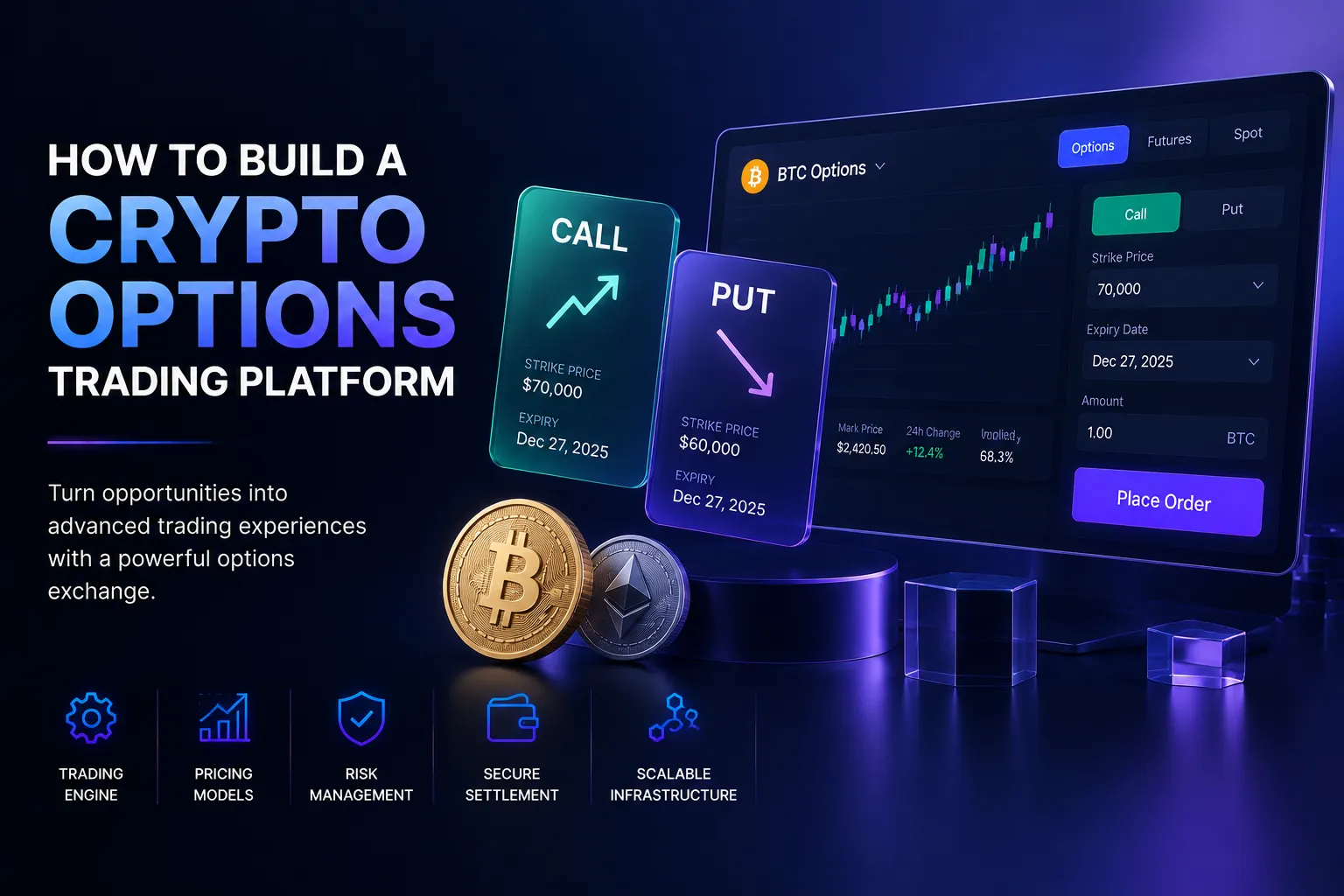
A crypto options trading platform is an exchange infrastructure that allows users to buy and sell options contracts based on digital assets such as Bitcoin, Ethereum, and other cryptocurrencies. An option gives the buyer the right, but not the obligation, to buy or sell an asset at a predefined price before or at a specific expiration time.
The two primary types of options are:
- Call options: Give traders the right to buy an asset at a specific strike price.
- Put options: Give traders the right to sell an asset at a specific strike price.
Options are commonly used for speculation, hedging, portfolio management, and advanced trading strategies. Compared with spot and futures markets, options require more complex calculations because their value depends on multiple variables, including asset price, volatility, time remaining, and market conditions.
Why Build a Crypto Options Trading Platform?
As the digital asset market matures, traders increasingly look for more advanced financial instruments beyond traditional spot trading. Options provide additional flexibility because traders can create strategies designed for different market conditions. Institutional participants often use options for hedging and risk management, while professional traders use them to create advanced strategies. For exchange operators, adding options can create new revenue opportunities and attract more experienced market participants. However, options trading also requires deeper infrastructure compared with standard exchange products. The platform must accurately calculate pricing, manage exposure, and ensure reliable settlement. A poorly designed options system can create significant financial risks, especially during periods of high volatility.
What Makes Options Platforms Different From Spot and Futures Exchanges?
Although options, futures, and spot trading are all part of the digital asset ecosystem, they operate differently. Spot exchanges focus on immediate asset ownership. Futures platforms manage leveraged contracts where traders speculate on future prices. Options platforms introduce additional variables because contracts have expiration dates, strike prices, and different risk profiles. The biggest difference is the pricing complexity. A futures contract mainly depends on the underlying asset price, while options require models that evaluate probability and market expectations. This means an options exchange needs specialized systems for pricing, risk analysis, volatility management, and settlement.
Core Components of a Crypto Options Trading Platform
A complete crypto options exchange requires several interconnected systems working together.
The most important components include:
- Options trading engine and order execution system
- Pricing and volatility calculation infrastructure
- Risk management and exposure monitoring
- Wallet, collateral, and settlement systems
- Trading APIs and administrative controls
Each component affects the reliability and scalability of the platform.
1. Design the Options Trading Model
The first step in building an options platform is defining how the market will operate. The exchange must determine which types of options will be supported, including European-style or American-style options, supported assets, expiration periods, settlement methods, and collateral requirements. Many crypto options platforms focus on European-style options because they are simpler to manage from a settlement perspective. The business model should also define whether options will be cash-settled or physically settled. Cash settlement means the difference between the contract price and market price is paid in currency or cryptocurrency. Physical settlement involves transferring the underlying asset. These decisions influence wallet architecture, risk systems, accounting, and operational workflows.
2. Build the Options Trading Engine
The options trading engine is the core execution layer of the platform. It manages option contracts, receives orders, matches buyers and sellers, and updates positions. Unlike spot trading, the engine must understand additional contract parameters such as strike price, expiration date, contract size, and premium. A scalable options engine should handle high trading activity while maintaining accurate contract states.
It must communicate with:
- Market data services
- Pricing systems
- Risk engines
- Settlement infrastructure
Execution accuracy is critical because options positions can create complex exposure for both traders and the exchange.
3. Develop Options Pricing Infrastructure
Pricing is one of the most technically challenging parts of an options exchange. The value of an option depends on several factors, including the underlying asset price, strike price, expiration time, implied volatility, and market conditions. Traditional options markets often use mathematical models such as Black-Scholes and its variations. Crypto markets require additional considerations because digital assets usually experience higher volatility and operate continuously. A professional options platform needs pricing systems that can calculate fair values, update prices based on market changes, and provide accurate information to traders. Market data quality is essential because inaccurate pricing can affect trading decisions, risk calculations, and settlement results.
4. Implement Risk Management Systems
Risk management is one of the most important parts of an options trading platform. Options create different risk scenarios compared with spot and futures because traders can combine multiple contracts into complex positions. The platform must monitor exposure across individual traders, markets, and the entire exchange.
Risk systems should evaluate:
- Open positions and collateral requirements
- Market exposure
- Volatility changes
- Potential losses
- Settlement obligations
The exchange should have real-time visibility into risk conditions and the ability to adjust trading limits when market conditions change. For example, during extreme volatility, the platform may need to reduce exposure limits or adjust risk parameters to protect the exchange.
5. Create Wallet and Settlement Infrastructure
Options platforms require secure financial settlement systems. The exchange must manage collateral deposits, option premiums, profits, losses, fees, and settlement payments. The wallet system should connect with the internal ledger to ensure every financial movement is recorded accurately.
A professional settlement system handles:
- Contract expiration
- Profit and loss calculation
- Collateral management
- Fee processing
- Final settlement
Accuracy is essential because settlement errors can directly impact user funds and exchange reputation.
6. Build the Trading Interface and User Experience
Options trading interfaces must present more information than traditional exchange screens. Traders need to understand contract details, pricing, expiration dates, strike prices, implied volatility, positions, and potential outcomes. A professional options interface should provide clear visualization of available contracts and allow traders to analyze different strategies. The platform should also provide real-time updates through efficient market-data systems. Complex financial products require especially clear user experience because confusion can lead to incorrect trading decisions.
7. Provide APIs for Professional Traders
Professional traders and institutions often rely on APIs for automation and integration. A crypto options platform should provide secure APIs that allow users to access market data, manage positions, submit orders, and monitor accounts. API infrastructure should include authentication, permission management, rate limits, and detailed documentation. Institutional clients may also require advanced connectivity solutions such as FIX API. Reliable API performance is especially important for quantitative traders who depend on accurate timing and fast execution.
8. Add Security and Compliance Controls
Options platforms handle sensitive financial activity and require strong security systems. The exchange must protect user accounts, wallets, trading data, and operational systems. Security measures should include account protection, access control, encryption, monitoring, audit logs, and withdrawal management. Compliance requirements also need to be considered. Depending on the jurisdiction and business model, the exchange may require KYC, AML monitoring, transaction screening, and reporting processes. A secure options platform is built on both technical protection and operational discipline.
9. Develop Administration and Monitoring Tools
Operating an options exchange requires comprehensive internal management tools. Administrators need to manage contracts, markets, users, fees, risk settings, settlement processes, and system configurations.
The admin system should provide visibility into:
- Trading activity
- Contract performance
- User positions
- Risk exposure
- Settlement operations
Role-based permissions are essential because financial systems require strict control over sensitive actions. Audit trails should record changes to trading parameters, risk settings, and financial operations.
White-Label vs Custom Crypto Options Platform Development
Businesses launching an options exchange usually choose between custom development and modular infrastructure. A fully custom platform provides maximum flexibility but requires significant engineering expertise. Building pricing engines, risk systems, settlement infrastructure, and trading technology from scratch requires substantial time and resources. A white-label or modular options platform provides existing infrastructure that can be customized with branding, supported assets, trading rules, and integrations. For many businesses, a modular approach provides a faster path to market while maintaining the ability to expand with additional products. The right approach depends on the company's goals, target users, required features, and long-term strategy.
Development Roadmap for a Crypto Options Exchange
A practical development process usually follows several stages: Phase 1 — Planning and architecture: Define supported contracts, markets, risk models, settlement methods, and technical requirements. Phase 2 — Core infrastructure: Build or configure trading engines, pricing systems, wallets, settlement, and risk management. Phase 3 — Integration and testing: Connect APIs, liquidity sources, security systems, compliance tools, and user interfaces. Phase 4 — Launch and scaling: Deploy the platform, monitor performance, optimize infrastructure, and expand markets. The timeline depends on customization level, supported products, integrations, and operational requirements.
How Javizen Helps Build Crypto Options Trading Platforms
Javizen provides modular crypto exchange infrastructure for businesses building advanced digital asset platforms. The infrastructure supports professional trading environments with exchange components such as trading engines, APIs, wallets, risk systems, administration tools, and blockchain integrations. Businesses can develop options trading platforms while connecting them with broader exchange ecosystems, including spot trading, futures, P2P trading, token-sale platforms, and other Web3 products. A modular approach allows companies to launch specialized trading products without rebuilding their entire exchange infrastructure.
Final Thoughts
Building a crypto options trading platform requires advanced financial technology, accurate pricing systems, strong risk management, and reliable settlement infrastructure. Unlike basic trading platforms, options exchanges must manage complex contracts, volatility calculations, expiration processes, and multi-layer risk exposure. The most successful platforms combine professional trading capabilities with secure architecture and a clear user experience. For businesses entering the crypto derivatives market, building on scalable exchange infrastructure can reduce complexity and accelerate market entry. Javizen provides customizable crypto exchange technology that helps businesses develop professional trading platforms and expand their digital asset ecosystem.
Frequently asked questions
What is a crypto options trading platform?
A crypto options trading platform allows users to trade derivative contracts based on cryptocurrency prices, including call and put options.
How is an options exchange different from a futures exchange?
Futures require traders to buy or sell contracts at a future point, while options give traders the right but not the obligation to buy or sell an asset.
What technology is needed to build a crypto options platform?
An options platform requires a trading engine, pricing system, risk management, settlement infrastructure, wallets, APIs, security systems, and administration tools.
Can a white-label platform support crypto options trading?
Yes. A modular exchange infrastructure can support options functionality through customizable trading, risk, settlement, and integration systems.
Why is risk management important for options exchanges?
Options create complex exposure because contract values depend on multiple factors such as price, volatility, and expiration. Strong risk management protects both users and the exchange.
Can crypto options platforms support automated trading?
Yes. Professional options platforms can provide APIs for trading bots, quantitative strategies, and institutional systems.
Latest Post
- 06 Sep, 2026
How to Build a Crypto Options Trading Platform
 05 Sep, 2026
How to Launch a Crypto Prop Trading Platform
 03 Sep, 2026
How to Scale a Crypto Exchange for High Trading Volume
 02 Sep, 2026
How to Design a Crypto Exchange Fee Structure
 01 Sep, 2026
Market Makers vs Liquidity Providers: What Is the Difference?
Build with Javizen.
Planning an exchange, token or blockchain product? Talk to our team and turn the ideas in this article into a launch-ready platform.