
Market Makers vs Liquidity Providers: What Is the Difference?
What Is Liquidity in a Crypto Exchange?
Liquidity refers to how easily an asset can be bought or sold without causing a significant price change. In a liquid market, traders can execute orders quickly because there are enough buyers and sellers available at different price levels. For example, a BTC/USDT market with strong liquidity may have thousands of buy and sell orders close to the current market price. A trader can execute a large order with minimal price impact. A low-liquidity market has fewer participants and thinner order books. In this situation, even smaller trades may create large price movements or unexpected execution prices. For crypto exchanges, liquidity is not only a trading feature. It directly affects user experience, market credibility, trading volume, and revenue potential.
What Is a Market Maker?
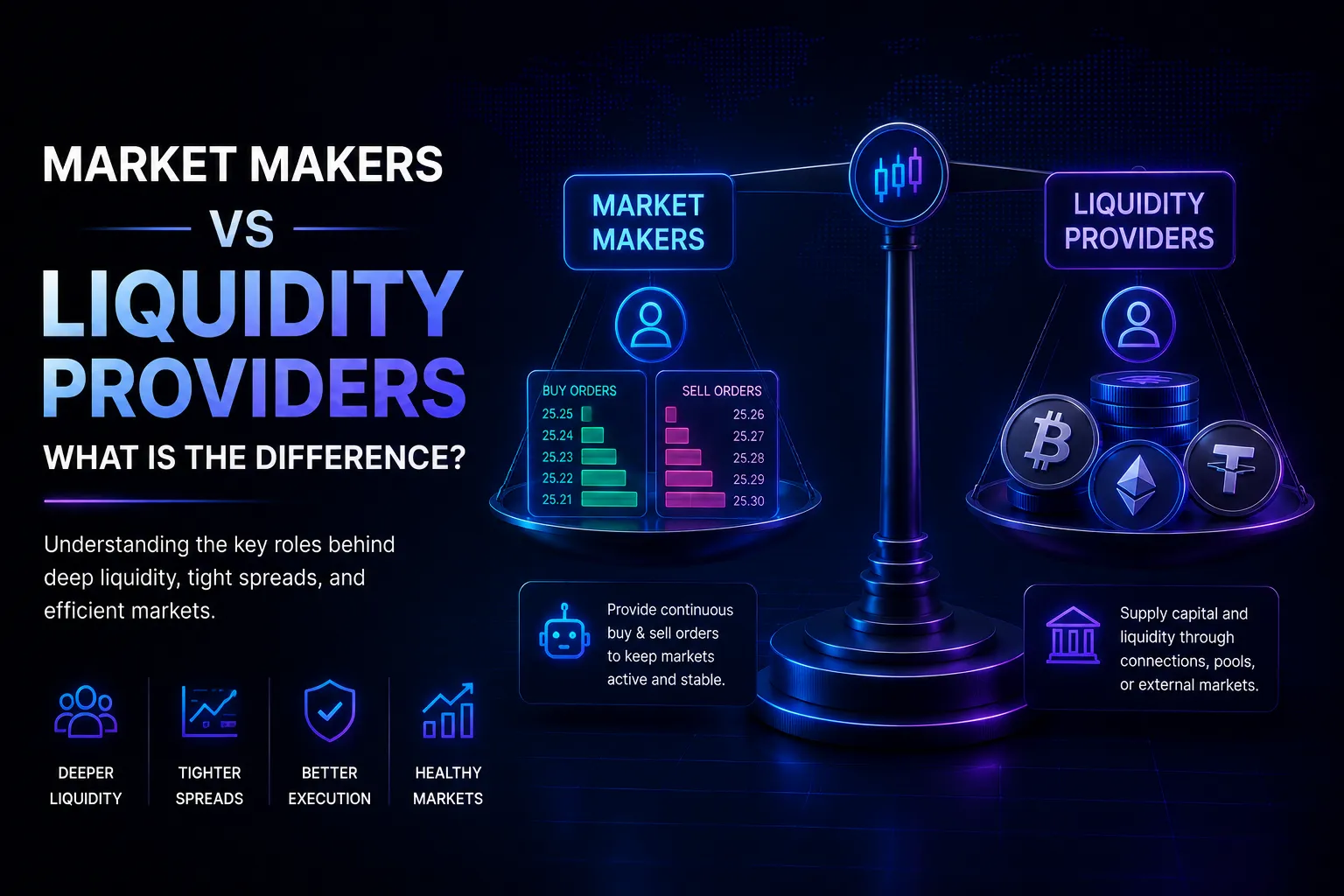
A market maker is an individual, company, or automated trading system that continuously provides buy and sell orders in a market. The main responsibility of a market maker is to maintain an active order book by placing bids and offers around the current market price. For example, in a BTC/USDT market, a market maker may place buy orders slightly below the current price and sell orders slightly above it. The difference between these prices is called the spread. Market makers typically use automated trading algorithms that react to market conditions, adjust order sizes, and manage inventory risk. In crypto exchanges, market makers are especially important for newly launched tokens or trading pairs that do not yet have enough natural trading activity.
What Is a Liquidity Provider?
A liquidity provider supplies the exchange with access to trading liquidity. Unlike a market maker that actively manages orders inside a market, a liquidity provider may provide liquidity through external connections, aggregated order books, institutional trading networks, or capital allocation. Liquidity providers help exchanges access deeper markets without building all liquidity internally. For example, a new exchange may connect to external liquidity sources that provide pricing and order depth for major assets such as BTC, ETH, or stablecoins. This allows the exchange to offer competitive markets from the beginning instead of waiting for organic user volume.
Market Makers vs Liquidity Providers: The Main Difference
The difference between market makers and liquidity providers is mainly related to their role in the market. A market maker actively participates in trading by placing and managing orders. Its goal is to create continuous buying and selling activity while earning from spreads and trading strategies. A liquidity provider focuses on supplying access to available liquidity. It may connect exchanges to larger markets, provide capital, or aggregate liquidity from multiple sources. In practice, the two roles often work together. A liquidity provider can support an exchange with market access, while market makers maintain healthy order books and trading activity within specific markets.
The relationship can be summarized as:
- Market makers actively create and manage market depth.
- Liquidity providers supply liquidity sources and infrastructure.
- Both help exchanges improve execution quality and reduce spreads.
Why Crypto Exchanges Need Market Makers and Liquidity Providers
A new crypto exchange faces a common challenge: users need liquidity to trade, but liquidity requires users. Without existing trading activity, order books may remain empty, creating a poor experience for early customers. Market makers and liquidity providers solve this problem by creating initial market activity.
They help exchanges achieve:
- Better order-book depth and tighter spreads
- Faster trade execution with lower slippage
- More attractive markets for traders
- Greater confidence from professional users
Liquidity is especially important for exchanges launching new assets, entering competitive markets, or targeting institutional traders.
How Market Making Works Inside a Crypto Exchange
Inside an exchange, market makers usually connect through APIs and automated trading systems. They monitor market conditions, analyze prices, and continuously update their orders. A market maker may adjust its strategy based on factors such as volatility, trading volume, inventory balance, and external market prices. For example, if the market moves quickly in one direction, the market maker may reduce exposure by adjusting order sizes or moving prices closer to external reference markets. A professional exchange must provide secure API access, trading permissions, monitoring tools, and risk controls for market-making activity. Market-making accounts should also remain separate from customer accounts. This separation improves transparency and prevents operational conflicts.
How Liquidity Providers Connect to Crypto Exchanges
Liquidity providers usually connect through APIs, trading gateways, or institutional connectivity solutions. The exchange receives market data, prices, or order flow from external sources and uses this information to improve its own markets. A liquidity integration requires careful technical planning.
The exchange needs to manage:
- Price synchronization
- Order routing
- Asset availability
- Trading fees
- Risk exposure
- Connection reliability
A strong liquidity system should not depend on a single source. Many professional exchanges combine multiple liquidity providers to improve stability and reduce dependency risk.
The Role of Liquidity in New Token Listings
Liquidity becomes especially important when listing new tokens. A token can be technically integrated into an exchange, but without active buyers and sellers, users may experience large spreads and unstable prices. Market makers often support new listings by creating initial order-book activity. Liquidity providers can also help by connecting the exchange with broader trading markets. This allows users to trade new assets with better execution quality from the beginning. For exchange operators, liquidity planning should be part of the listing strategy rather than something considered after the token goes live.
Liquidity Management for Different Exchange Models
Different exchange types require different liquidity strategies. A centralized exchange usually focuses on deep order books, professional market-making relationships, and external liquidity connections. A decentralized exchange relies on liquidity pools where users provide assets and receive rewards based on trading activity. Hybrid models combine centralized order execution with decentralized liquidity mechanisms. The right approach depends on the exchange’s business model, supported assets, target users, and operational capabilities.
How Exchanges Choose Between Building Internal Liquidity and Using Providers
Exchange operators usually choose between developing internal market-making capabilities or partnering with external liquidity providers. Building internal liquidity systems provides more control but requires experienced trading teams, significant capital, risk management, and sophisticated technology. Working with liquidity providers allows exchanges to access professional infrastructure faster and focus resources on customer acquisition, compliance, and product development. Many successful exchanges use a combination of both approaches. External liquidity provides market depth, while internal systems manage specific markets, promotions, or strategic assets.
Technical Requirements for Exchange Liquidity Management
Liquidity management requires more than connecting an API. The exchange infrastructure should support real-time market data, trading permissions, risk controls, monitoring dashboards, and detailed reporting. Operators need visibility into liquidity quality, including spread levels, order-book depth, execution performance, and abnormal trading activity. A modular exchange architecture makes this easier because liquidity systems can connect directly with matching engines, market data services, trading APIs, and administrative tools. Javizen provides exchange infrastructure with liquidity integration capabilities, market management tools, trading APIs, and operational controls that help businesses build scalable cryptocurrency trading platforms.
How Javizen Supports Crypto Exchange Liquidity Infrastructure
Javizen helps businesses launch and operate crypto exchanges with infrastructure designed for professional trading environments. The platform supports centralized exchange development with components such as spot trading, futures, P2P exchange, wallet systems, liquidity integrations, APIs, reporting, and administration tools. By connecting liquidity management with core exchange systems, operators can create more reliable markets while maintaining control over trading operations. For businesses launching new exchanges or expanding existing platforms, liquidity infrastructure is a key part of creating a competitive trading environment.
Final Thoughts
Market makers and liquidity providers play different but complementary roles in crypto exchange ecosystems. Market makers actively maintain trading activity by managing buy and sell orders, while liquidity providers help exchanges access deeper sources of market liquidity. Both are essential for creating efficient markets with better execution, lower spreads, and improved user experience. For exchange operators, liquidity should be considered part of the core infrastructure strategy from the beginning. A strong combination of technology, liquidity partnerships, risk controls, and market management creates the foundation for long-term growth. Javizen provides modular crypto exchange infrastructure that helps businesses build scalable trading platforms with liquidity integration, advanced trading modules, and professional exchange management tools.
Frequently asked questions
What is the difference between a market maker and a liquidity provider?
A market maker actively creates buy and sell orders in a market, while a liquidity provider supplies access to liquidity through capital, infrastructure, or external market connections.
Why do crypto exchanges need market makers?
Market makers help create active order books, reduce spreads, improve execution quality, and provide better trading conditions, especially for new markets.
Are liquidity providers necessary for a new crypto exchange?
Liquidity providers can help new exchanges access deeper markets and provide competitive trading conditions before organic user volume develops.
Can one company be both a market maker and liquidity provider?
Yes. Some firms provide both liquidity access and active market-making services depending on their business model and agreement with exchanges.
How does liquidity affect crypto trading?
Higher liquidity usually leads to tighter spreads, faster execution, and lower price impact when users trade.
Can a crypto exchange build its own liquidity?
Yes, but internal market making requires significant capital, trading expertise, risk management systems, and operational infrastructure.
Latest Post
 06 Sep, 2026
How to Build a Crypto Options Trading Platform
 05 Sep, 2026
How to Launch a Crypto Prop Trading Platform
 03 Sep, 2026
How to Scale a Crypto Exchange for High Trading Volume
 02 Sep, 2026
How to Design a Crypto Exchange Fee Structure
- 01 Sep, 2026
Market Makers vs Liquidity Providers: What Is the Difference?
Build with Javizen.
Planning an exchange, token or blockchain product? Talk to our team and turn the ideas in this article into a launch-ready platform.