
Crypto Exchange API Explained: REST, WebSocket, and FIX
What Is a Crypto Exchange API?
A crypto exchange API is a set of programming interfaces that allows software applications to communicate with exchange services. Instead of a user opening a website, selecting a trading pair, and placing an order manually, an automated system can interact directly with the exchange through API requests. For example, a trading bot can receive market prices, analyze trading conditions, create orders, and monitor executions automatically through API connections. For exchange operators, APIs are also essential for building a complete trading ecosystem. Mobile applications, third-party portfolio trackers, institutional clients, market makers, and automated trading platforms all depend on reliable API access. A professional crypto exchange API should be secure, well-documented, scalable, and connected with the exchange’s core infrastructure, including the matching engine, wallet system, internal ledger, risk management module, and account services.
Why Are APIs Important for Crypto Exchanges?
A modern cryptocurrency exchange is no longer limited to a single web interface. Users expect to trade through mobile applications, desktop platforms, automated bots, and professional trading terminals. APIs allow exchanges to provide these different experiences while maintaining one central trading infrastructure.
The main purposes of crypto exchange APIs include:
- Connecting trading applications and automated systems
- Providing real-time market information
- Supporting institutional and algorithmic trading
- Enabling third-party integrations
Without a strong API architecture, an exchange may struggle to scale beyond basic retail trading.
REST API in Crypto Exchanges
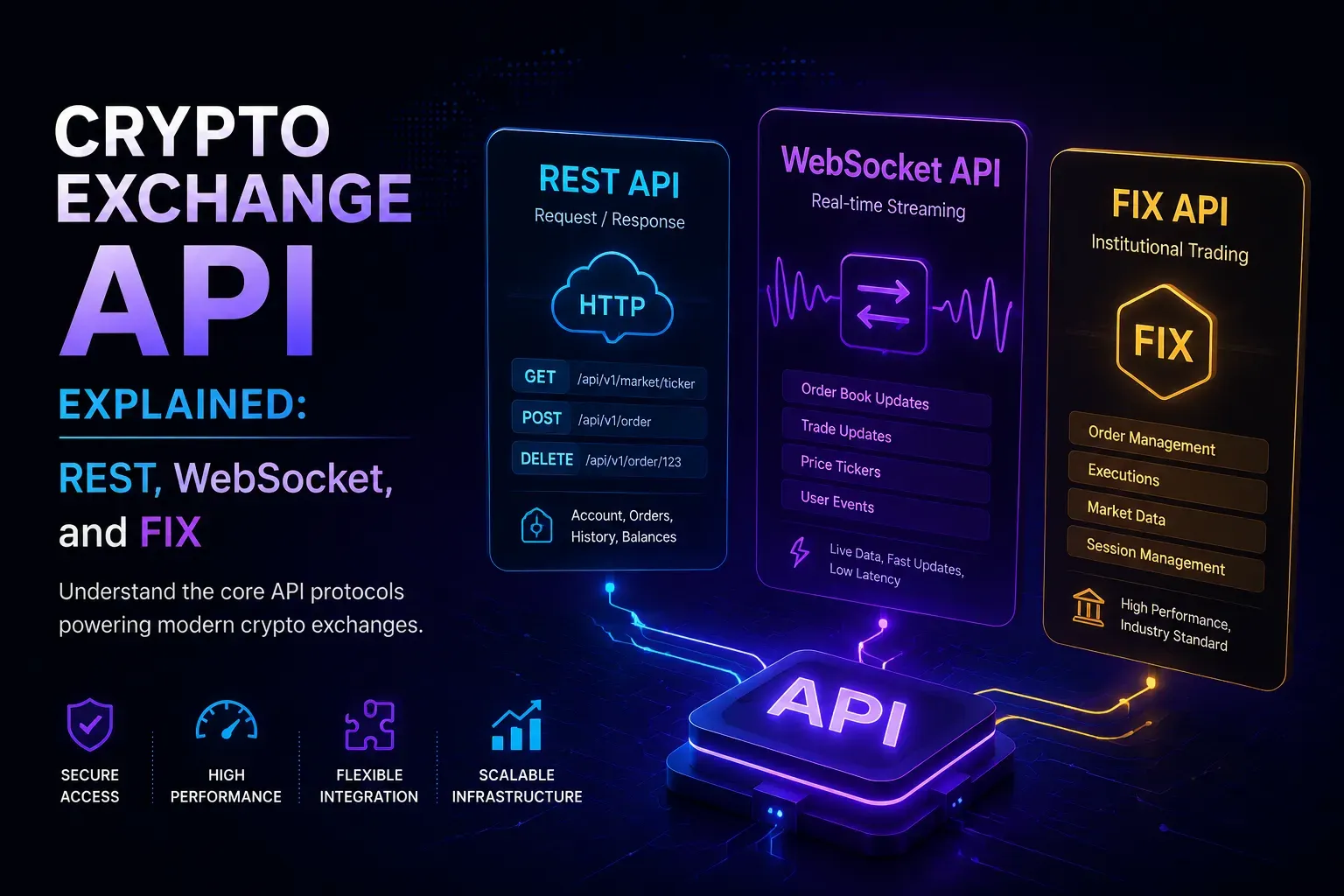
REST (Representational State Transfer) API is one of the most common API architectures used in crypto platforms. REST works through standard HTTP communication. A client sends a request to an exchange endpoint, and the server returns a response containing the requested information. For example, a trading application may send a REST request to retrieve account balances or submit a new order. REST APIs are ideal for operations that do not require continuous real-time communication. Common REST API operations include account management, order submission, trade history retrieval, and deposit or withdrawal requests. Because REST uses simple web standards, it is relatively easy for developers to integrate. However, it has limitations for high-frequency updates because the client must repeatedly request new information. For example, constantly requesting Bitcoin price updates every second creates unnecessary network traffic. Real-time market data is usually handled through WebSocket connections instead.
WebSocket API for Real-Time Trading
WebSocket API provides continuous two-way communication between the exchange and connected applications. Unlike REST, where the client repeatedly asks for updates, WebSocket allows the exchange to automatically send new information whenever an event occurs. This makes WebSocket essential for trading platforms where speed and accuracy are important. A trading interface can receive live information such as price movements, order book changes, completed trades, open orders, and account balance updates. For example, when a large BTC order is executed, the exchange can immediately broadcast the updated market information to connected traders. A professional WebSocket system must handle connection stability, authentication, message ordering, rate limits, and automatic reconnection. Poor implementation can result in delayed prices, inconsistent order books, or failed trading actions during periods of high market activity.
FIX API for Institutional Trading
FIX (Financial Information Exchange) is a standardized communication protocol widely used in traditional financial markets and increasingly adopted by institutional crypto traders. While REST and WebSocket APIs are commonly used by retail applications, FIX APIs are designed for professional trading environments that require structured, high-speed communication. Institutional participants such as hedge funds, market makers, liquidity providers, and algorithmic trading firms often use FIX connections to communicate with exchanges. FIX APIs allow professional traders to integrate their existing trading infrastructure with cryptocurrency exchanges without creating completely new systems. For exchanges targeting institutional clients, FIX connectivity can improve liquidity access and attract professional market participants.
REST vs WebSocket vs FIX: Understanding the Difference
REST, WebSocket, and FIX are not alternatives where one replaces the others. They serve different roles inside a complete exchange ecosystem. REST is mainly used for request-based actions. A user or application sends a request and receives a response. It works well for account information, order management, and historical data. WebSocket is designed for continuous communication. It is the preferred choice for live prices, order books, and account updates. FIX focuses on institutional trading workflows. It provides standardized messaging for professional investors, market makers, and financial systems. A mature cryptocurrency exchange often supports all three because different users require different levels of speed, automation, and functionality.
How Crypto Exchange APIs Work With Exchange Infrastructure
An API is not an isolated feature. It connects external applications with the internal systems that power the exchange. When a trader places an order through an API, the request usually moves through several internal components. The API gateway first authenticates the user and checks permissions. The trading system then validates available balance and risk conditions before sending the order to the matching engine. After execution, the internal ledger records the financial movement, and WebSocket services distribute the updated information back to connected applications. This architecture ensures that API users follow the same trading rules, security policies, and accounting processes as users trading through the exchange interface.
For a professional exchange, API design must be closely connected with core systems such as:
- Matching engine
- Wallet infrastructure
- Internal ledger
- Risk management
- Market data services
Javizen’s centralized exchange infrastructure follows a modular architecture where APIs can connect trading products, wallets, user accounts, and additional services such as P2P, futures, and other exchange modules.
Crypto Exchange API Security Requirements
Since APIs provide direct access to trading accounts and financial operations, security is one of the most important considerations. A secure exchange API should control who can access the system, what actions they can perform, and how suspicious activity is detected.
Important security practices include:
- API key management and permission controls
- Request signing and authentication
- Rate limiting and abuse prevention
- IP restrictions and activity monitoring
- Detailed audit logs
API permissions should follow the principle of least privilege. For example, a trading bot may require order placement access but should not automatically have permission to withdraw funds. Exchange operators should also monitor unusual API activity, repeated failed requests, unauthorized access attempts, and abnormal trading patterns.
Public API vs Private API
Crypto exchanges generally provide two categories of APIs. Public APIs provide market information that does not require user authentication. They are commonly used for price feeds, trading pairs, market statistics, and order book information. Private APIs require authentication and provide access to user-specific actions such as account balances, order management, trade history, and withdrawals. Separating public and private APIs improves security and allows exchanges to control access based on different user requirements.
API Design Considerations for Exchange Developers
Building a reliable exchange API requires more than exposing endpoints. The API should have clear documentation, predictable responses, version control, and consistent error handling.
Developers should consider:
- Backward compatibility when updating API versions
- Clear authentication workflows
- Detailed error messages
- Performance monitoring
- Developer documentation and testing environments
A well-designed API reduces integration problems and makes it easier for external developers and institutional partners to connect with the exchange.
The Role of APIs in Building a Scalable Crypto Exchange
As exchanges grow, APIs become the foundation for expansion. A small exchange may initially need APIs only for mobile applications and basic trading automation. As it grows, it may require institutional connectivity, liquidity integrations, advanced trading tools, and external financial services. A modular API architecture allows new products to be added without rebuilding the entire platform. For example, an exchange can introduce P2P trading, futures markets, staking services, or token-launch platforms while maintaining the same account, security, and trading infrastructure.
Final Thoughts
Crypto exchange APIs are one of the most important components of modern digital asset platforms. REST, WebSocket, and FIX each solve different communication challenges, from simple account operations to real-time trading and institutional connectivity. A successful exchange needs more than functional APIs. It requires secure integration between APIs and core systems such as the matching engine, wallets, ledger, compliance tools, and risk management. Businesses building a crypto exchange should consider API architecture from the beginning because it directly affects scalability, user experience, automation capabilities, and future product expansion. Javizen provides modular crypto exchange infrastructure with API-ready architecture, enabling businesses to launch centralized exchanges and expand with advanced trading products, liquidity integrations, and custom blockchain solutions.
Frequently Asked Questions
Frequently asked questions
What is a crypto exchange API?
A crypto exchange API allows applications, trading bots, and external systems to communicate with an exchange for accessing market data, managing accounts, and executing trades.
What is the difference between REST and WebSocket APIs?
REST APIs use request-response communication and are suitable for account actions and transactional operations. WebSocket APIs provide continuous real-time updates and are commonly used for live market data.
What is FIX API used for in crypto trading?
FIX API is mainly used by institutional traders, liquidity providers, and professional trading firms that require standardized and high-speed communication with exchanges.
Do crypto exchanges need all three API types?
Professional exchanges often support REST, WebSocket, and FIX because each serves different users and technical requirements.
Are crypto exchange APIs secure?
APIs can be secure when implemented with proper authentication, permission controls, encryption, rate limits, monitoring, and audit systems.
Can APIs be added to a white-label crypto exchange?
Yes. A modular white-label exchange can provide APIs for mobile applications, automated trading, institutional clients, and third-party integrations.
Latest Post
 06 Sep, 2026
How to Build a Crypto Options Trading Platform
 05 Sep, 2026
How to Launch a Crypto Prop Trading Platform
 03 Sep, 2026
How to Scale a Crypto Exchange for High Trading Volume
 02 Sep, 2026
How to Design a Crypto Exchange Fee Structure
 01 Sep, 2026
Market Makers vs Liquidity Providers: What Is the Difference?
Build with Javizen.
Planning an exchange, token or blockchain product? Talk to our team and turn the ideas in this article into a launch-ready platform.