
How to Build a Crypto Futures Trading Platform
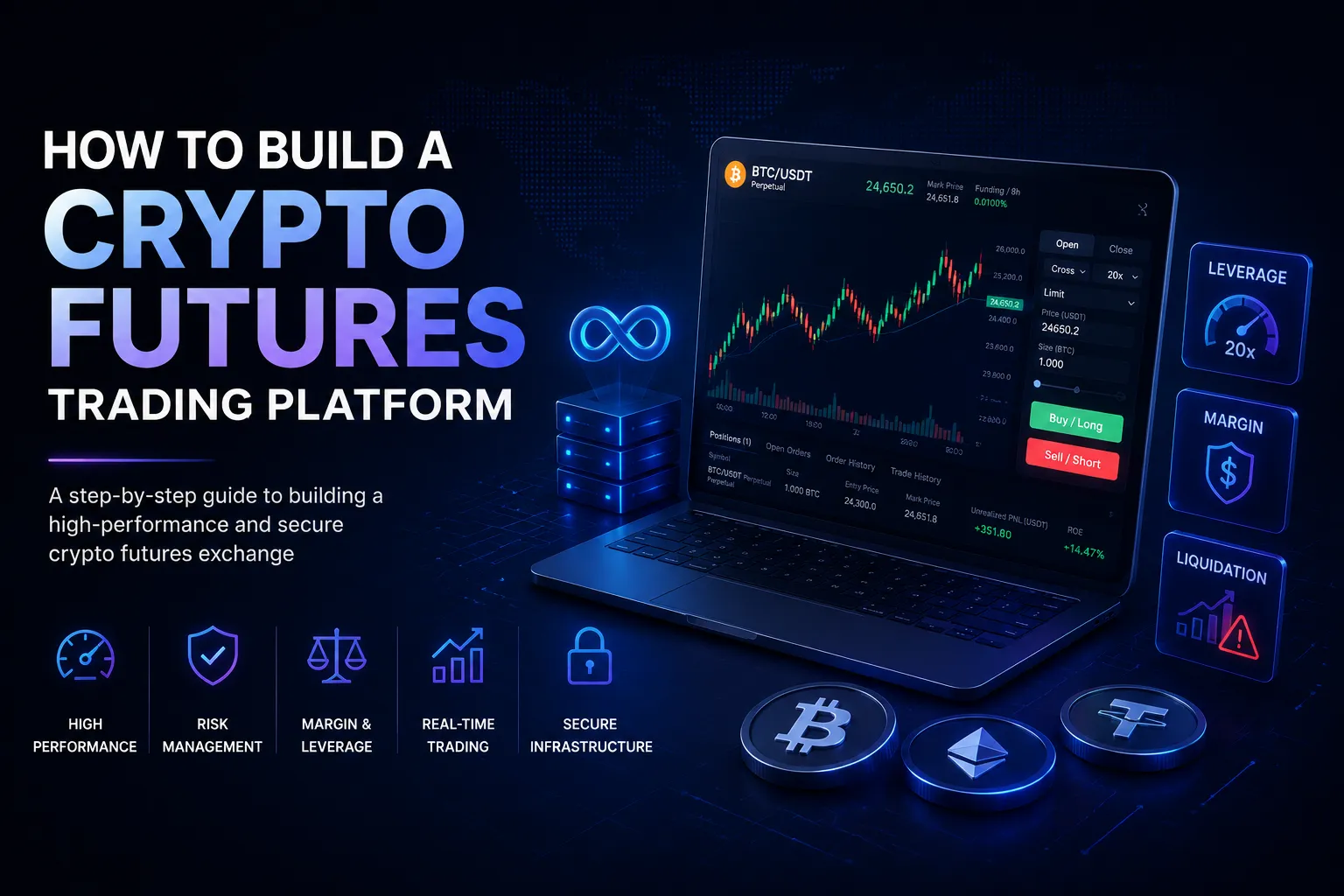
What Is a Crypto Futures Trading Platform?
A crypto futures trading platform allows users to trade derivative contracts based on cryptocurrency prices without directly owning the underlying asset. For example, instead of purchasing Bitcoin, a trader can open a BTC/USDT perpetual futures position and speculate whether the price will increase or decrease.
Futures platforms typically support:
- Long and short positions
- Leverage trading
- Margin management
- Perpetual contracts
- Funding rate calculations
- Position tracking
- Liquidation systems
The complexity comes from the fact that every open position creates financial exposure for both the trader and the exchange. The platform must continuously calculate risk and ensure that accounts maintain enough collateral.
1. Design the Futures Trading Model
1. Design the Futures Trading Model The first step in building a futures exchange is defining the trading model. Most crypto futures platforms use perpetual contracts because they allow traders to maintain positions without a fixed expiration date. However, exchanges can also support traditional futures contracts with settlement dates. The business must define supported assets, leverage limits, margin models, fees, funding mechanisms, and risk parameters.
Important design decisions include whether the platform supports:
- Cross margin, where multiple positions share available collateral
- Isolated margin, where each position has separate collateral
- One-way mode, where users hold one direction per contract
- Hedge mode, where users can maintain long and short positions simultaneously
These decisions directly affect the risk engine and user experience.
2. Build a Futures Matching Engine
The matching engine is the core execution system of a futures exchange. It receives orders from traders, matches buyers and sellers, and updates open positions. Because futures traders often use leverage and react quickly to market movements, execution speed and reliability are critical. A futures matching engine must support advanced order types and continuously communicate with other systems.
Unlike spot trading, futures execution requires additional calculations after each trade, including:
- Position size updates
- Average entry price calculations
- Margin adjustments
- Unrealized PnL updates
- Funding-related changes
The engine must also handle extreme market conditions, such as sudden price movements and high trading volume. A delay or incorrect calculation in futures execution can create significant financial risks for both traders and the exchange.
3. Implement Margin and Leverage Management
Leverage is one of the main reasons traders use futures platforms, but it also creates additional risk. A futures exchange must calculate how much collateral users need to maintain their positions. For example, a trader opening a leveraged Bitcoin position does not need to deposit the full position value. Instead, they provide margin as collateral.
The platform continuously monitors:
- Initial margin requirements
- Maintenance margin levels
- Available collateral
- Position exposure
- Unrealized profit and loss
If an account falls below the required maintenance margin, the system must automatically reduce or close positions according to predefined rules. Leverage limits should also be configurable by market. Highly volatile assets may require lower leverage compared with more established trading pairs.
4. Develop a Liquidation Engine
The liquidation system is one of the most important components of a futures exchange. When a trader’s losses become too large and their margin is insufficient, the platform must protect itself and other users by closing the position. A liquidation engine monitors account health in real time and automatically triggers risk actions when necessary.
A complete liquidation system should manage:
- Margin ratio calculations
- Partial liquidation
- Full liquidation
- Bankruptcy price handling
- Insurance fund interaction
- Loss prevention mechanisms
Poor liquidation design can create cascading losses during extreme market events. The system should prioritize controlled risk reduction rather than waiting until a position creates a larger exposure problem.
5. Add Mark Price and Funding Rate Systems
Futures markets require additional pricing mechanisms to prevent manipulation. The last traded price alone is not always suitable for liquidation calculations because temporary market movements can create unfair liquidations. Many futures platforms use a mark price based on external market data and index prices.
The mark price helps determine:
- Unrealized profit and loss
- Liquidation conditions
- Fair contract valuation
Perpetual futures platforms also use funding rates to balance long and short positions. Funding payments encourage market equilibrium by transferring payments between traders depending on the difference between contract price and the underlying market price. The exchange needs accurate funding calculations, transparent reporting, and reliable market data sources.
6. Create Risk Management Infrastructure
Risk management is the foundation of a secure futures exchange. The platform must monitor individual traders, markets, and total exchange exposure. Risk controls may include position limits, maximum leverage, price protection rules, emergency trading restrictions, and market-level monitoring.
The exchange should also maintain systems for:
- Exposure monitoring
- Abnormal trading detection
- Market volatility controls
- Account restrictions
- Emergency shutdown procedures
Professional futures platforms need real-time risk dashboards that allow operators to understand market conditions and respond quickly.
7. Integrate Wallets and Internal Accounting
Although futures contracts do not require users to transfer cryptocurrency after every trade, the platform still needs a secure wallet and accounting system. User collateral must be accurately recorded. Deposits, withdrawals, trading fees, funding payments, realized profit and loss, and liquidation results must all update the internal ledger correctly.
The futures system should connect with:
- User wallets
- Spot balances
- Internal ledger
- Fee management
- Settlement systems
Financial accuracy is critical because even small accounting errors can create disputes and operational problems.
8. Build the Trading Interface
The futures trading interface needs to provide more information than a basic spot exchange.
Traders expect to see:
- Real-time charts
- Order books
- Open positions
- Margin information
- Entry price
- Liquidation price
- Unrealized PnL
- Funding rate
- Order history
The interface should clearly communicate risk. Users should understand their leverage, available margin, and liquidation conditions before opening positions. A professional trading experience also requires fast updates through WebSocket connections so traders receive market changes immediately.
9. Provide APIs for Automated Trading
Advanced futures traders often rely on APIs for automation. A futures exchange API allows users to connect trading bots, quantitative strategies, portfolio systems, and institutional platforms. The API infrastructure should support secure authentication, permission management, rate limits, order management, market data access, and account monitoring. Institutional traders may also require advanced connectivity such as FIX API for professional execution workflows. API reliability is especially important in futures because automated strategies often depend on precise timing.
10. Add Administration and Monitoring Tools
Operating a futures exchange requires comprehensive administrative tools. The admin panel should allow authorized teams to manage markets, leverage settings, trading fees, risk parameters, liquidation rules, users, and system activity.
Operators need visibility into:
- Open positions
- Total exposure
- Liquidation activity
- Insurance fund status
- Trading volume
- Abnormal behavior
Role-based permissions and audit logs are essential because futures operations involve sensitive financial controls.
White-Label vs Custom Futures Exchange Development
Businesses have two main approaches when building a crypto futures platform. A fully custom futures exchange provides maximum flexibility but requires extensive development in areas such as matching engines, risk systems, settlement, security, and testing. A white-label futures platform provides existing infrastructure that can be customized with branding, markets, leverage settings, fees, integrations, and operational workflows. For businesses entering the market faster, a modular white-label solution can reduce development complexity while still allowing future expansion. The best approach depends on the required features, regulatory environment, target users, and long-term product strategy.
How Long Does It Take to Build a Crypto Futures Platform?
The timeline depends on whether the platform is built from scratch or based on existing infrastructure. A basic futures module requires trading execution, margin calculations, risk controls, wallets, and administration. A professional multi-market platform requires additional development for liquidity, APIs, mobile applications, security testing, and operational systems. The most time-consuming areas are usually risk management, financial accuracy, testing, and security rather than the user interface itself. A phased launch strategy is often more practical. Businesses can start with a limited number of futures markets and expand as liquidity, users, and operational experience increase.
Final Thoughts
Building a crypto futures trading platform requires advanced financial infrastructure, not just a trading interface. The foundation includes a reliable matching engine, accurate margin calculations, liquidation systems, secure accounting, risk management, real-time data, and strong operational controls. Businesses that want to launch a futures exchange should prioritize security and risk management before adding complexity. A modular architecture allows the platform to start with essential functionality and expand into additional products over time. Javizen provides customizable crypto futures exchange infrastructure that enables businesses to launch professional trading platforms with futures capabilities, risk controls, APIs, wallets, and scalable blockchain infrastructure.
Frequently Asked Questions
Frequently asked questions
What is needed to build a crypto futures exchange?
A futures exchange requires a matching engine, margin system, liquidation engine, risk management, wallet infrastructure, market data, trading interface, APIs, and administration tools.
How is a futures exchange different from a spot exchange?
Spot exchanges allow users to buy and own cryptocurrencies directly. Futures exchanges allow users to trade contracts based on price movements using leverage and margin.
What is the most important part of a futures trading platform?
The risk management system is one of the most critical components because it controls leverage, margin requirements, and liquidation processes.
Can a white-label crypto futures platform be customized?
Yes. A white-label futures platform can usually be customized with branding, supported markets, leverage settings, fees, integrations, and additional exchange modules.
How does liquidation work in crypto futures?
When a trader’s margin falls below the required maintenance level, the liquidation engine automatically closes or reduces the position to protect the trader and exchange.
Can a futures platform support automated trading?
Yes. Futures exchanges can provide APIs for trading bots, algorithmic strategies, and institutional trading systems.
Latest Post
 06 Sep, 2026
How to Build a Crypto Options Trading Platform
 05 Sep, 2026
How to Launch a Crypto Prop Trading Platform
 03 Sep, 2026
How to Scale a Crypto Exchange for High Trading Volume
 02 Sep, 2026
How to Design a Crypto Exchange Fee Structure
 01 Sep, 2026
Market Makers vs Liquidity Providers: What Is the Difference?
Build with Javizen.
Planning an exchange, token or blockchain product? Talk to our team and turn the ideas in this article into a launch-ready platform.