
How Crypto Exchanges Make Money

How Does a Crypto Exchange Business Model Work?
A cryptocurrency exchange connects buyers and sellers, executes trades, manages customer balances, and provides the infrastructure required to deposit, store, exchange, and withdraw digital assets. On an order-book exchange, users submit buy and sell orders. The matching engine pairs compatible orders, records the transaction, and updates both customers’ balances. The exchange normally charges one or both sides of the transaction. The amount of revenue generated depends on trading volume, fee rates, the number of active users, supported markets, product adoption, and the exchange’s ability to retain customers. This relationship can be expressed simply: Trading revenue = trading volume × average effective fee rate An exchange processing $1 billion in monthly trading volume at an average effective fee of 0.10% would generate approximately $1 million in gross trading-fee revenue. This is gross revenue rather than profit because the operator must still pay for liquidity, infrastructure, compliance, staff, banking, security, customer support, and marketing.
Main Ways Crypto Exchanges Make Money
Although every platform uses a different combination, the most common crypto exchange revenue streams include:
- Spot trading fees: Fees collected whenever users trade one asset for another through an order book.
- Spreads and conversion margins: Revenue generated from the difference between the market price and the price quoted to the customer.
- Derivatives fees: Charges applied to futures, perpetual contracts, options, margin products, and leveraged positions.
- Deposit, withdrawal, and payment fees: Charges for selected blockchain withdrawals, card purchases, bank transfers, or fiat-processing services.
- Staking commissions: A percentage deducted from blockchain rewards earned on behalf of customers.
- Custody and institutional services: Fees for secure asset storage, reporting, execution, financing, and account management.
- Subscriptions and premium accounts: Recurring payments for reduced fees, priority support, enhanced limits, analytics, or other benefits.
- Stablecoin, lending, and financing revenue: Income from eligible stablecoin arrangements, customer financing, institutional loans, and interest-bearing balances.
Transaction fees remain important, but established exchanges increasingly diversify their businesses. Coinbase, for example, reports transaction revenue separately from subscription and services revenue, which includes stablecoin revenue, blockchain rewards, interest and finance fee income, and other services. Its 2025 shareholder disclosures show that both categories contributed materially to total revenue.
Trading Fees: The Core Exchange Revenue Stream
Trading fees are the most recognizable way crypto exchanges make money. Professional trading platforms usually use a maker-taker model. A maker places an order that adds liquidity to the order book, while a taker executes against an existing order and removes liquidity. Exchanges may charge different rates to each participant. Maker fees are often lower because limit orders improve market depth. Some exchanges even offer maker rebates in selected markets to attract liquidity. Fee levels commonly depend on the user’s rolling 30-day trading volume. Higher-volume traders receive lower rates because they contribute more activity and liquidity to the platform. Both Coinbase Exchange and Kraken use volume-based fee structures for professional trading products. The exchange earns revenue every time an order is executed, regardless of whether the trader later makes a profit or loss. For this reason, trading activity and market volatility can directly affect exchange revenue. When markets become active, users tend to trade more frequently. During quiet or bearish periods, transaction revenue may decline even when the exchange continues to maintain the same infrastructure and compliance operations.
How Exchanges Earn Money from Spreads
Retail customers often prefer a simple interface where they can instantly buy, sell, or convert cryptocurrency without interacting directly with an order book. In this model, the platform displays a quoted price that may include both a service fee and a spread. The spread is the difference between the underlying market price and the price offered to the customer. For example, if Bitcoin has a reference market price of $100,000, a retail exchange might quote a slightly higher purchase price or a slightly lower selling price. Part of this difference helps the exchange manage price movement, liquidity costs, and execution risk. Coinbase explains that its simple trading quotes may include applicable fees and a spread, while its advanced order-book product uses volume-based trading fees without adding a spread to the order-book price. Spreads can generate more revenue per transaction than professional maker-taker fees. However, they must be disclosed clearly. Poorly explained pricing can damage customer trust, particularly when users compare the final execution price with prices displayed on other platforms.
Revenue from Futures and Derivatives
Derivatives can become a significant source of revenue because active traders may open and close positions frequently and use leverage to obtain greater market exposure. Exchanges can charge trading fees when a futures or perpetual position is opened and again when it is closed. They may also charge fees for options contracts, margin borrowing, settlement, or liquidation-related operations, depending on the product and jurisdiction. Leverage can increase the notional trading volume processed by the exchange. A customer with $1,000 of collateral might control a position worth several times that amount, causing fee-generating volume to grow faster than deposited capital. However, perpetual futures funding payments should not automatically be counted as exchange revenue. Funding is typically transferred between traders holding long and short positions to help keep the contract price close to the underlying market. Binance explicitly describes funding as a payment between traders rather than a fee charged by the exchange. A derivatives business also creates additional costs. The operator needs a reliable risk engine, mark-price system, insurance fund, liquidation process, margin controls, monitoring tools, and strong safeguards against market manipulation.
Withdrawal and Payment Processing Fees
Crypto exchanges may charge users when they withdraw assets to an external blockchain address. Part of this amount covers the network fee paid to miners or validators. Depending on the pricing model, the exchange may charge a fixed amount, a dynamic network-based amount, or an additional service margin. Fiat-related transactions can generate separate fees. Card purchases, instant bank payments, currency conversions, wire transfers, and third-party payment gateways may each have their own cost structure. These fees should not be viewed entirely as profit. Payment providers, banks, blockchain networks, fraud-prevention vendors, and liquidity partners may receive a substantial portion of the amount paid by the customer. An exchange must balance revenue with user experience. Excessive withdrawal or payment fees can encourage customers to move to competing platforms.
Staking Commissions
Proof-of-stake networks allow eligible asset holders to earn rewards by participating in network validation. Crypto exchanges simplify this process by aggregating customer assets, managing validator infrastructure, distributing rewards, and providing reporting. In return, the exchange can retain a percentage of the rewards before crediting the remainder to users. Coinbase, for example, states that it does not charge a separate fee to stake or unstake but deducts a commission from rewards received from the network. Staking can create recurring revenue while increasing customer retention because users are more likely to keep assets on the platform. Nevertheless, the service introduces operational, regulatory, custody, lock-up, and slashing risks that must be communicated and managed properly.
Custody and Institutional Services
Institutional customers often require more than a retail trading interface. Funds, corporations, asset managers, miners, high-net-worth clients, and professional trading firms may need qualified custody, segregated storage, governance controls, reporting, API execution, financing, and dedicated account management. An exchange or affiliated custodian can charge onboarding fees, annual custody fees, execution fees, financing fees, or service charges based on assets under custody. Coinbase publishes institutional custody pricing that includes a possible implementation fee and an annualized custody charge, illustrating how secure storage can become a direct business line separate from retail trading. Institutional services may produce more predictable revenue than retail trading, but they require stronger security, insurance arrangements, service-level agreements, compliance controls, and operational support.
Subscription and Premium Account Revenue
Some exchanges offer monthly or annual memberships that provide benefits such as reduced trading fees, enhanced rewards, priority support, account protection, higher limits, analytics, or concierge services. Subscriptions generate recurring revenue even when customers are not trading heavily. This makes the business less dependent on transaction volume. Coinbase One is an example of this model. Its membership tiers combine subscription payments with benefits such as zero-fee allowances for certain simple trades, enhanced staking rewards, fee rebates, and priority support. A spread may still apply to eligible simple trades. A successful subscription product must provide enough measurable value to justify the recurring cost. Otherwise, customers may cancel during periods of low market activity.
Stablecoin and Interest Revenue
Large exchanges may earn revenue through stablecoin distribution agreements, customer financing, institutional lending, or interest on eligible fiat balances. Stablecoin-related income may depend on the amount of the asset held on the platform, usage across exchange products, commercial agreements with the issuer, and prevailing interest rates. Coinbase’s financial disclosures identify stablecoin revenue and interest and finance fee income as separate components of its subscription and services business. The company also notes that changes in interest rates can affect the revenue earned from these activities. This revenue can diversify the exchange, but it may introduce exposure to interest-rate movements, counterparties, credit conditions, stablecoin regulation, and concentration risk.
Do Exchanges Make Money from Token Listings?
Token listings can create indirect revenue by attracting users, deposits, liquidity, and trading volume. A newly listed asset may generate substantial activity, which then produces trading fees. Some platforms or service providers may charge for technical integration, marketing campaigns, market-making support, due diligence, or launch services. However, operators must distinguish legitimate service charges from undisclosed pay-to-list arrangements. Listing decisions should be governed by documented technical, legal, liquidity, security, and compliance reviews. Prioritizing short-term listing revenue over asset quality can expose an exchange to market manipulation, regulatory action, reputational damage, and customer losses.
How Decentralized Exchanges Make Money
A decentralized exchange, or DEX, normally executes trades through smart contracts rather than a centralized matching engine and custodial ledger. Users pay a swap fee when trading through a liquidity pool. Depending on the protocol, most or all of that fee may go to liquidity providers. Some protocols also have the ability to activate a separate protocol fee that directs part of the revenue to a treasury or governance-controlled destination. DEX revenue should not be confused with total trading fees paid by users. When fees are distributed directly to liquidity providers, they represent earnings for those providers rather than revenue retained by the protocol operator. The model therefore depends heavily on smart-contract design, governance decisions, liquidity incentives, and how fees are divided between providers and the protocol.
Revenue Is Not the Same as Profit
High trading volume does not guarantee a profitable exchange. Operating a secure crypto platform requires continuous spending on cloud infrastructure, wallet management, liquidity, cybersecurity, licences, banking, KYC/KYB providers, transaction monitoring, blockchain analytics, customer support, engineering, insurance, and legal services. Customer acquisition can also be expensive. Referral rewards, affiliate commissions, advertising, promotional fee discounts, and market-maker incentives reduce the net value of new trading volume. An exchange should therefore measure contribution margin by product rather than evaluating success only through total volume or registered users.
What Determines Crypto Exchange Profitability?
The following factors have the greatest influence on whether an exchange can convert revenue into sustainable profit:
- Trading volume and active-user retention, which determine how frequently the platform generates fees
- Effective fee rate, after discounts, rebates, VIP tiers, and promotional offers
- Liquidity quality, which affects spreads, execution, user retention, and market-maker costs
- Product mix, including spot, derivatives, staking, custody, subscriptions, and institutional services
- Customer acquisition cost, compared with the long-term revenue generated by each customer
- Compliance and operational efficiency, including the cost of onboarding, monitoring, support, and manual reviews
- Infrastructure scalability, because inefficient architecture can make every increase in activity more expensive
- Security and risk management, since fraud, wallet incidents, liquidations, or regulatory failures can eliminate years of operating profit
A sustainable exchange does not simply maximize fees. It creates a pricing structure that remains competitive while covering the real cost of operating a secure and compliant financial platform.
Building a Sustainable Exchange Revenue Model
New exchange operators often assume that listing many assets and charging trading fees will be sufficient. In practice, revenue requires liquidity, active users, reliable payments, competitive execution, trusted custody, and products that encourage customers to return. The initial business model should be designed around a specific market. A retail-focused local exchange may earn most of its revenue from fiat purchases, conversions, and withdrawals. A professional platform may depend on order-book volume and API traders. An institutional platform may prioritize custody, OTC execution, reporting, and financing. Operators should also model conservative and optimistic scenarios. Revenue forecasts should account for changes in trading volume, market volatility, fee discounts, payment costs, liquidity expenses, compliance staffing, and customer acquisition. Diversification becomes increasingly important as the exchange grows. Recurring services such as subscriptions, custody, staking, or institutional products can reduce reliance on unpredictable retail trading cycles.
How Javizen Supports Crypto Exchange Monetization
Javizen develops modular crypto exchange infrastructure that can support multiple revenue models within one platform. Depending on the operator’s business strategy, the system can be configured for maker-taker trading fees, user fee tiers, spreads, commissions, deposit and withdrawal charges, referral programmes, staking services, futures, options, P2P trading, token sales, institutional accounts, and other monetization workflows. Administrative tools can help operators manage fee schedules, VIP levels, markets, user limits, commissions, settlements, reports, and revenue-related configurations without rebuilding the core exchange. The most appropriate model depends on the target jurisdiction, customer segment, liquidity strategy, supported products, and regulatory obligations. Exchange monetization should therefore be defined during product planning rather than added after development is complete.
Frequently asked questions
What is the main source of revenue for a crypto exchange?
Trading fees are usually the most direct source of revenue. The exchange charges a percentage or fixed fee whenever users complete spot or derivatives trades.
Do crypto exchanges profit when users lose money?
In a standard agency or order-book model, the exchange earns transaction fees regardless of whether an individual trader wins or loses. The exchange is not necessarily the counterparty to the trade.
How much does a crypto exchange make per trade?
Revenue depends on the trade value and the effective fee rate. A $10,000 trade with a 0.10% fee produces $10 in gross trading revenue before discounts, rebates, taxes, liquidity costs, and operating expenses.
Are withdrawal fees pure profit?
No. A portion may be used to cover blockchain network fees, payment-provider costs, fraud risk, or operational expenses. Any remaining margin depends on the exchange’s pricing model.
Do exchanges earn perpetual futures funding payments?
Usually, funding payments are exchanged between long and short traders. The platform generally earns trading and related service fees rather than retaining the normal funding payment itself.
Can a crypto exchange make money without trading fees?
Yes. An exchange may use spreads, subscriptions, custody, staking commissions, financing, stablecoin services, payment processing, or institutional products. However, zero-fee trading often has limits or is supported by another revenue channel.
Conclusion
Crypto exchanges make money through a combination of transaction fees, spreads, derivatives, withdrawals, staking commissions, custody, subscriptions, institutional financing, and stablecoin-related services. Trading remains the foundation for many platforms, but relying on a single revenue stream creates significant exposure to market cycles. Mature exchanges increasingly combine volume-dependent transaction income with recurring services that can remain active during quieter markets. The strongest revenue model is not necessarily the one with the highest fees. It is the model that aligns competitive pricing, reliable liquidity, regulatory compliance, security, customer retention, and scalable infrastructure. For founders planning to launch a crypto exchange, monetization should be designed alongside the matching engine, wallets, liquidity, risk management, payments, and compliance architecture. When these components operate as one connected system, the exchange is better positioned to generate sustainable revenue while delivering a trustworthy trading experience.
Latest Post
 06 Sep, 2026
How to Build a Crypto Options Trading Platform
 05 Sep, 2026
How to Launch a Crypto Prop Trading Platform
 03 Sep, 2026
How to Scale a Crypto Exchange for High Trading Volume
 02 Sep, 2026
How to Design a Crypto Exchange Fee Structure
 01 Sep, 2026
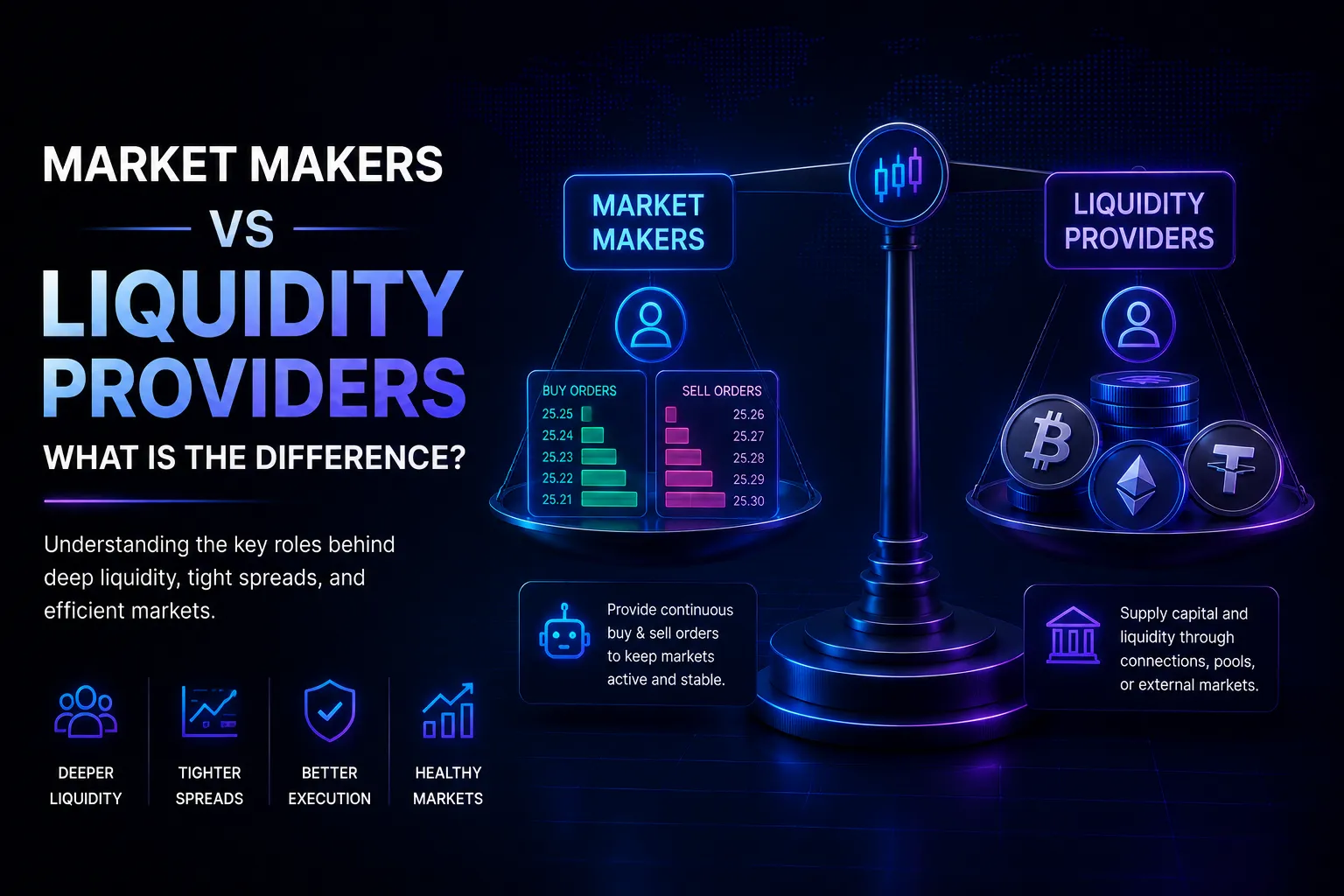
Market Makers vs Liquidity Providers: What Is the Difference?
Build with Javizen.
Planning an exchange, token or blockchain product? Talk to our team and turn the ideas in this article into a launch-ready platform.