
KYC/KYB Requirements for Crypto Exchanges
Quick Answer
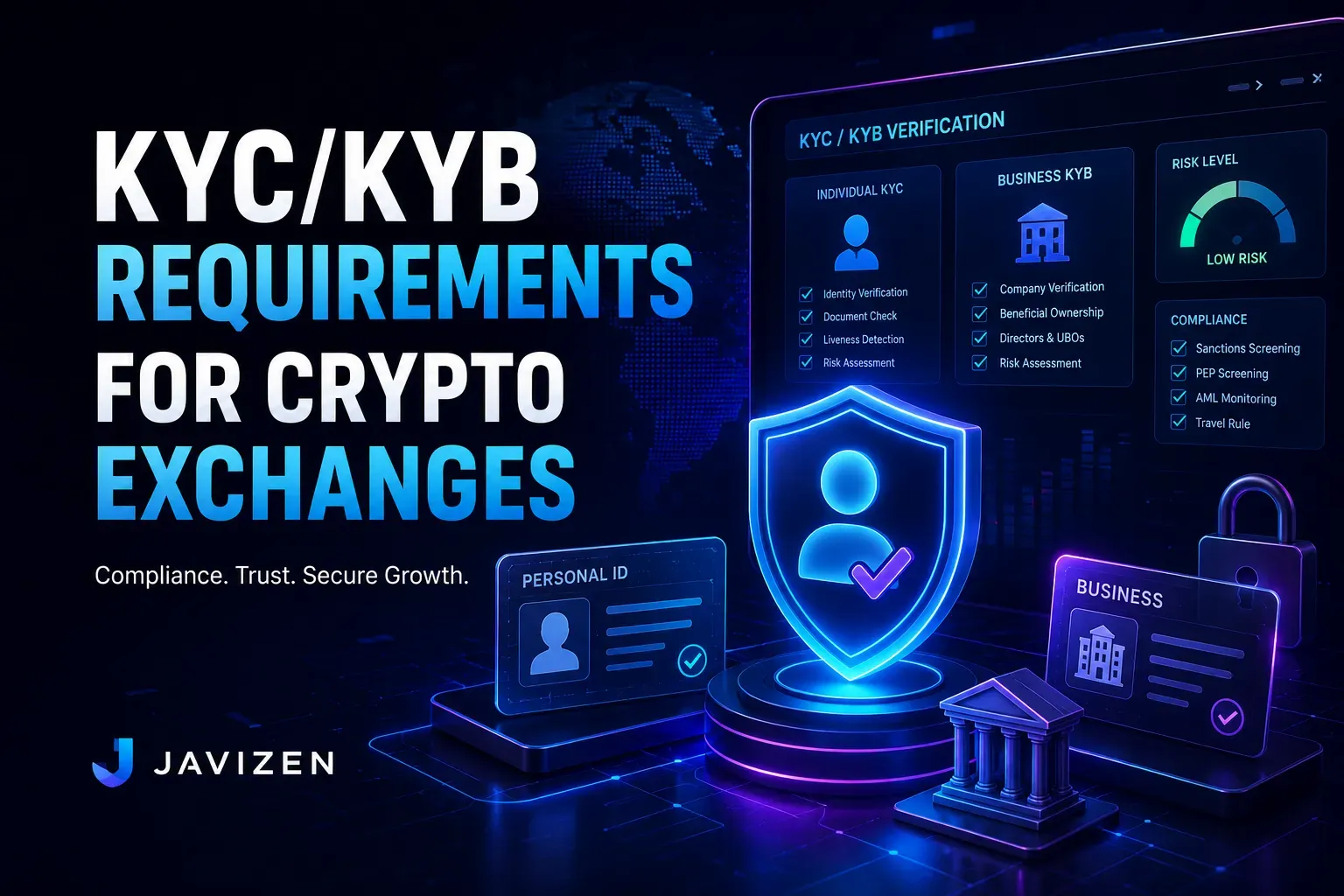
KYC and KYB requirements for crypto exchanges are the controls used to identify individual and corporate customers, assess their financial-crime risk, and monitor their activity throughout the business relationship. A complete compliance framework generally includes identity verification, beneficial ownership checks, sanctions and politically exposed person screening, customer risk scoring, enhanced due diligence, transaction monitoring, record retention, suspicious activity reporting, and Travel Rule compliance. These requirements are not identical in every country. They depend on the exchange’s jurisdiction, licences, customer base, supported assets, transaction types, and regulatory classification. However, the Financial Action Task Force expects virtual asset service providers, or VASPs, to apply preventive measures comparable to those used by financial institutions, including customer due diligence, record-keeping, and suspicious transaction reporting. KYC and KYB should therefore be designed as core components of crypto exchange infrastructure rather than simple document-upload steps added shortly before launch.
What Is KYC in a Crypto Exchange?
Know Your Customer, commonly called KYC, is the process of identifying an individual customer, verifying that identity, understanding the intended use of the account, and evaluating the risks associated with the relationship. For a cryptocurrency exchange, KYC helps establish whether an account belongs to a real person, whether that person is legally permitted to use the platform, and whether their expected transactions are reasonable given their profile. KYC forms part of the broader Customer Due Diligence process. Customer due diligence does not end when an identity document is approved. Exchanges must continue assessing customers after onboarding through sanctions rescreening, transaction monitoring, account reviews, document updates, and investigations into unusual activity. A risk-based approach is fundamental. Low-risk retail customers may be handled through a streamlined automated workflow, while higher-risk customers may require additional evidence, manual investigation, or senior compliance approval. FATF guidance explicitly applies this risk-based model to virtual assets and virtual asset service providers.
What Is KYB?
Know Your Business, or KYB, is the corporate equivalent of KYC. It applies when an exchange serves companies, funds, brokers, merchants, market makers, payment providers, institutional traders, Web3 projects, or other legal entities. KYB verifies that the business legally exists, identifies the people who own or control it, determines whether the person opening the account is authorised to act on its behalf, and assesses whether its expected activity is consistent with its commercial purpose. Corporate verification is usually more complex than individual verification. A company may operate through subsidiaries, holding companies, nominees, trusts, offshore entities, or shareholders in several jurisdictions. The exchange must therefore look beyond the company name and identify the natural persons who ultimately own or control the entity. Beneficial ownership transparency is an essential part of global anti-money laundering standards because shell companies and complex legal structures can be misused to conceal sanctions evasion, corruption, tax crimes, money laundering, and other illicit activity.
Core KYC and KYB Requirements for Crypto Exchanges
Although implementation differs by jurisdiction, a comprehensive crypto exchange compliance programme normally includes the following controls:
- Identity and entity data collection: The exchange collects a customer’s legal name, date of birth, nationality, residential address, contact information, identification number, or, for a company, its registration details, legal form, tax information, registered address, and operating address.
- Identity document verification: Individual customers, company representatives, directors, and beneficial owners may need to provide passports, national identity cards, residence permits, registry extracts, incorporation certificates, licences, or constitutional documents.
- Biometric and authenticity checks: Automated onboarding may include facial comparison, liveness detection, document authenticity analysis, duplicate-account detection, and checks for stolen, expired, altered, or digitally manipulated documents.
- Beneficial ownership identification: Business customers must disclose the individuals who ultimately own, control, or materially influence the entity. Layered ownership structures may require an ownership chart and supporting corporate documents.
- Sanctions, PEP, and adverse-media screening: Customers and related parties should be screened against applicable sanctions lists, politically exposed person databases, law-enforcement information, internal blocklists, and credible adverse information.
- Purpose and expected activity assessment: The exchange should understand why the account is being created, which services will be used, expected transaction volumes, source of funds, geographical exposure, and the nature of the customer’s business.
- Customer risk scoring: Customers should be assigned a risk level based on factors such as jurisdiction, occupation, industry, ownership structure, transaction profile, products used, sanctions exposure, and source-of-funds information.
- Ongoing monitoring and review: Verification data must be kept current, customers must be rescreened when relevant information changes, and unusual activity must be investigated throughout the relationship.
A technically successful verification is not always sufficient for regulatory acceptance. A genuine passport may belong to a sanctioned individual, a legitimate company may be controlled by a prohibited person, and a verified customer may later begin conducting activity inconsistent with their declared profile. For this reason, crypto exchange KYC requirements must combine identity technology with risk analysis, blockchain monitoring, case management, and human compliance oversight.
Customer Due Diligence and Enhanced Due Diligence
Standard Customer Due Diligence is appropriate when the exchange has collected sufficient information to identify the customer, understand the relationship, assess the risk, and monitor future activity. Enhanced Due Diligence, or EDD, is required when the relationship presents a higher level of money-laundering, terrorist-financing, sanctions, fraud, or reputational risk. EDD may be triggered by connections to high-risk jurisdictions, politically exposed person status, complex ownership structures, unusually large transaction volumes, high-risk business activities, inconsistent explanations, exposure to mixers or illicit marketplaces, questionable source-of-funds evidence, or attempts to avoid verification controls. The purpose of EDD is not simply to collect more documents. It is to understand and resolve the risk that triggered the review. Depending on the case, this may involve obtaining independent financial records, verifying wallet ownership, requesting contracts or invoices, establishing source of wealth, conducting a video interview, obtaining senior management approval, or rejecting the account. An exchange should document why EDD was initiated, what evidence was reviewed, how concerns were resolved, and who approved the final decision. Without an auditable decision trail, even a well-designed verification workflow may be difficult to defend during a regulatory examination.
Source of Funds and Source of Wealth
Source of funds refers to the origin of the money or crypto assets involved in a particular transaction or business relationship. Examples may include salary income, business revenue, investment proceeds, token-sale proceeds, mining income, asset sales, or transfers from another regulated platform. Source of wealth refers to how the customer accumulated their overall financial position. It is usually more relevant to high-value customers, politically exposed persons, institutional accounts, private investment entities, or customers whose transaction volume appears inconsistent with their occupation or declared income. Crypto exchanges should not rely entirely on self-declared information. Depending on the risk level, they may need bank statements, tax records, payroll documents, audited accounts, contracts, invoices, exchange statements, wallet histories, or evidence of an asset sale. Blockchain analytics can support source-of-funds checks by tracing asset exposure and identifying links to theft, ransomware, darknet services, sanctioned entities, mixers, scams, or other high-risk sources. However, blockchain screening should complement rather than replace customer due diligence because on-chain data does not always establish the legal identity or economic purpose behind a transaction.
Transaction Monitoring After Onboarding
A customer can pass KYC and still conduct suspicious activity later. Ongoing transaction monitoring is therefore as important as onboarding verification. Crypto transaction monitoring should analyse both account behaviour and blockchain exposure. Relevant signals may include sudden increases in volume, rapid movement of funds through newly created wallets, repeated transactions just below internal thresholds, unusual use of privacy-enhancing tools, transfers involving high-risk jurisdictions, multiple unrelated funding sources, or activity that conflicts with the customer’s declared purpose. Monitoring systems should generate risk-based alerts rather than treating every anomaly as suspicious. Compliance teams must be able to review alerts, inspect customer and wallet history, request additional information, document conclusions, restrict accounts where necessary, and escalate potentially suspicious activity under the applicable reporting framework. The customer risk profile should also be dynamic. A low-risk customer may become high-risk after changing ownership, entering a new market, using higher-risk products, receiving funds from problematic wallets, or becoming subject to sanctions or adverse information.
The Travel Rule for Crypto Exchanges
The Travel Rule requires certain identifying information about the originator and beneficiary to accompany qualifying virtual asset transfers between regulated service providers. For crypto exchanges, implementation may require collecting transfer-party information, identifying whether the destination is another regulated VASP or a self-hosted wallet, validating required data, securely exchanging information with counterparties, and handling incomplete or inconsistent transfers. FATF describes the Travel Rule as a key AML and counter-terrorist-financing measure under which VASPs obtain, hold, and transmit information about transfer originators and beneficiaries. Counterparty VASP due diligence is also important because an exchange may need to evaluate whether another provider can securely and lawfully receive the required information. Regional implementation differs. In the European Union, the European Banking Authority has issued guidelines concerning the information that should accompany certain transfers of funds and crypto assets and the procedures providers should follow when required information is missing or incomplete. Travel Rule architecture should therefore be configurable by jurisdiction, transaction type, counterparty, and regulatory threshold rather than being hard-coded into a single universal workflow.
KYC Tiers and Account Limits
Many exchanges use tiered verification to reduce onboarding friction while preserving risk controls. A basic tier may allow limited access after collecting essential identity information, while higher tiers may unlock larger deposits, withdrawals, bank transfers, OTC trading, derivatives, institutional services, or advanced account functionality. Tiering must not be used to bypass mandatory due diligence. Where identification is legally required before a specific activity, transaction splitting or low-value account limits cannot be used as a substitute for compliance. A well-designed tier system links permissions to verification status, customer risk, product eligibility, jurisdiction, transaction volume, and monitoring results. Changes to a customer’s risk profile should be capable of reducing limits or triggering reverification automatically.
Data Protection and Security Requirements
KYC and KYB systems store highly sensitive information, including identity documents, facial images, residential addresses, company records, ownership information, and financial evidence. This data should be protected through encryption in transit and at rest, strict role-based access controls, multifactor authentication for compliance users, secure document storage, access logging, retention policies, and controlled deletion procedures. Third-party identity providers do not eliminate the exchange’s responsibility. The exchange must evaluate how vendors collect, process, store, transfer, and delete personal data. It should also understand where data is hosted, which subcontractors have access, how incidents are reported, and whether the service supports the exchange’s regulatory obligations. Compliance data should not be freely accessible from general administrative panels. Sensitive documents, screening results, and investigation notes should be restricted to authorised roles and protected by detailed audit trails.
Common KYC and KYB Implementation Mistakes
One common mistake is treating KYC as a one-time document check. This leaves the exchange unable to respond when a customer’s risk profile, ownership, sanctions status, or transaction behaviour changes. Another mistake is building identical workflows for every jurisdiction. Document types, record-retention periods, Travel Rule obligations, reporting procedures, age restrictions, and acceptable verification methods can differ significantly between markets. Weak KYB design is also a major risk. Verifying a certificate of incorporation without resolving beneficial ownership, authorised representatives, business purpose, or source of corporate funds does not provide a complete understanding of the customer. Other frequent problems include excessive false-positive alerts, disconnected screening systems, undocumented manual decisions, weak case management, inadequate vendor oversight, and poor integration between customer data and blockchain analytics.
Implementation Checklist for Exchange Operators
Before launching or expanding a crypto exchange, operators should confirm that their compliance architecture can:
- Apply configurable KYC and KYB workflows based on customer type, jurisdiction, product, and risk level
- Verify individuals, legal entities, directors, representatives, shareholders, and ultimate beneficial owners
- Perform sanctions, PEP, adverse-information, device-risk, and duplicate-account screening
- Collect and assess source-of-funds and source-of-wealth evidence when required
- Connect customer profiles with fiat activity, account behaviour, and blockchain transaction monitoring
- Support alert investigation, document requests, account restrictions, escalation, and suspicious activity reporting
- Implement Travel Rule data exchange and counterparty VASP due diligence
- Preserve immutable audit logs, decision histories, document versions, and regulatory records
Compliance requirements should be converted into configurable business rules rather than embedded in inflexible application code. This makes it easier to enter new markets, update policies, change vendors, introduce new products, or respond to regulatory changes.
Building KYC and KYB into Crypto Exchange Infrastructure
KYC/KYB requirements affect more than the registration page. They influence account permissions, wallet access, deposit and withdrawal limits, payment methods, trading products, referral programmes, institutional accounts, support workflows, and administrative controls. A robust architecture connects the KYC engine to the customer profile, risk-scoring service, sanctions provider, blockchain analytics platform, wallet system, transaction-monitoring engine, notification system, compliance case management, and admin panel. For example, an unresolved sanctions alert may automatically suspend withdrawals. An expired identity document may reduce account permissions. A high-risk blockchain deposit may create a compliance case. A company ownership change may trigger KYB reverification. A Travel Rule failure may hold an outbound transfer until the required information is completed. These events should be logged consistently and remain visible to authorised compliance teams through a unified operational interface.
How Javizen Supports KYC/KYB-Ready Exchange Development
Javizen develops modular crypto exchange infrastructure that can integrate identity verification, corporate onboarding, user risk levels, role-based permissions, wallet controls, transaction monitoring, reporting, and administrative review workflows. Instead of treating compliance as an isolated external widget, Javizen can connect verification status and risk decisions to the wider exchange lifecycle. This includes deposits, withdrawals, trading permissions, customer limits, account restrictions, administrative approvals, and audit records. Because regulatory requirements differ between markets, the appropriate KYC/KYB configuration must be defined according to the operator’s target jurisdiction, legal advice, customer segments, supported assets, and product model.
Frequently asked questions
Is KYC mandatory for every crypto exchange?
The answer depends on the jurisdiction and the activities performed by the platform. Exchanges that custody assets, exchange crypto for fiat, transmit value, or provide regulated virtual asset services will commonly face AML and customer due diligence obligations. In the United States, for example, FinCEN applies an activity-based analysis to determine whether virtual currency businesses qualify as money transmitters or other regulated money services businesses.
What is the difference between KYC and KYB?
KYC verifies and assesses individual customers. KYB verifies legal entities and examines their registration, ownership, controllers, representatives, business activity, and expected use of the exchange.
Is document verification enough for crypto KYC?
No. Document verification confirms only part of the customer’s identity. A complete programme also requires risk assessment, sanctions screening, transaction monitoring, account review, and ongoing due diligence.
What is a beneficial owner?
A beneficial owner is the natural person who ultimately owns, controls, or benefits from a legal entity or legal arrangement, even when ownership is held through intermediate companies or nominees.
When should an exchange perform Enhanced Due Diligence?
EDD should be considered when a customer, jurisdiction, ownership structure, source of funds, product, or transaction pattern presents higher-than-normal risk.
Does the Travel Rule apply to self-hosted wallets?
Treatment varies by jurisdiction. Exchanges may need to identify whether a wallet is self-hosted, collect information about the transfer parties, assess the wallet’s risk, and apply additional verification or monitoring based on applicable regulations.
Conclusion
KYC/KYB requirements for crypto exchanges extend far beyond collecting passports and incorporation documents. A sustainable programme must identify customers, resolve beneficial ownership, evaluate financial-crime risk, screen relevant parties, monitor transactions, maintain accurate records, and respond to changes throughout the account lifecycle. The most effective approach is to build compliance into the exchange’s technical and operational architecture from the beginning. Verification status, risk scores, wallet activity, customer limits, investigations, Travel Rule information, and administrative decisions should work as parts of one connected system. Operators should define their final requirements with qualified legal and compliance advisers in every jurisdiction where they plan to offer services. Once those requirements are established, modular infrastructure can help translate them into reliable, auditable, and scalable exchange workflows.
Latest Post
 06 Sep, 2026
How to Build a Crypto Options Trading Platform
 05 Sep, 2026
How to Launch a Crypto Prop Trading Platform
 03 Sep, 2026
How to Scale a Crypto Exchange for High Trading Volume
 02 Sep, 2026
How to Design a Crypto Exchange Fee Structure
 01 Sep, 2026
Market Makers vs Liquidity Providers: What Is the Difference?
Build with Javizen.
Planning an exchange, token or blockchain product? Talk to our team and turn the ideas in this article into a launch-ready platform.