
How to Add P2P Trading to a Crypto Exchange
What Is P2P Trading in a Crypto Exchange?
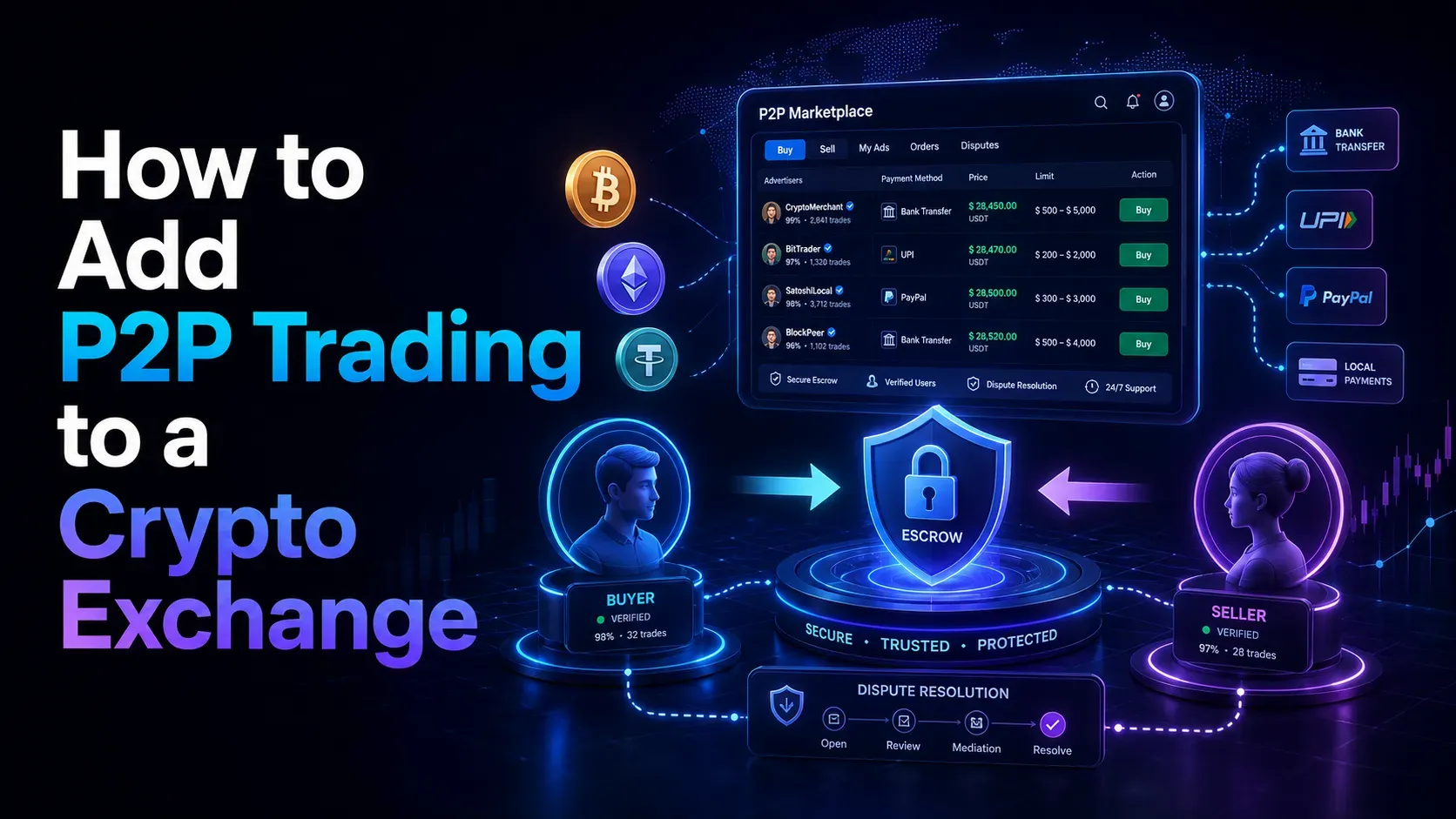
Peer-to-peer crypto trading allows users to buy and sell digital assets directly with other users. Instead of purchasing crypto directly from the exchange, a buyer selects an advertisement published by another trader or merchant. For example, a seller may offer USDT in exchange for a local fiat currency. The buyer opens the order, transfers payment through an accepted bank or payment service, and marks the order as paid. After confirming that the payment was received, the seller releases the cryptocurrency from escrow. Although the fiat payment usually takes place outside the exchange, the platform still controls the order workflow, locks the cryptocurrency, records communications, monitors risk, and manages disputes.
Main Steps for Adding P2P Trading
A complete P2P integration usually requires the following stages:
1.Connect the P2P module to user accounts, KYC, wallets, and the internal ledger. 2.Build an advertisement marketplace for buyers, sellers, and merchants. 3.Implement a secure crypto escrow and controlled order lifecycle. 4.Add regional payment methods and verified payment profiles. 5.Provide order chat, notifications, evidence uploads, and dispute management. 6.Introduce merchant verification, reputation indicators, and trading limits. 7.Build admin controls, fraud monitoring, reporting, and revenue tools.
Each stage should be designed as part of the exchange’s financial architecture. Adding a marketplace interface without proper accounting, escrow, or risk controls can expose the operator and its users to serious operational problems.
1. Choose an Integrated or Standalone P2P Model
The first decision is whether the P2P platform will operate inside an existing crypto exchange or as a separate product. An integrated P2P module uses the exchange’s existing customer accounts, KYC information, authentication, wallet balances, notifications, and administration system. Users can move between spot trading and P2P trading without opening another account or transferring funds to a separate platform. This approach generally provides a smoother experience and gives the operator a unified view of user activity. A customer may purchase USDT through the P2P marketplace and then use the same balance for spot, futures, staking, or other services. A standalone P2P platform has its own user accounts, wallets, verification process, and admin panel. It may be suitable for a business launching a regional marketplace where P2P trading is the primary service. However, standalone platforms require more independent infrastructure. A modular architecture is therefore valuable because it allows the P2P system to operate separately while remaining ready for integration with a larger exchange ecosystem.
2. Build the Advertisement Marketplace
Advertisements are the foundation of P2P trading. Verified users or approved merchants publish offers that define how much crypto they want to buy or sell and under what conditions.
A P2P advertisement usually contains:
- Cryptocurrency, fiat currency, price, and available quantity
- Minimum and maximum order limits
- Accepted payment methods, payment deadline, and trader terms
- Supported region and merchant availability
Prices may be fixed or floating. A fixed-price advertisement remains at a defined rate until the merchant changes it. A floating-price advertisement can follow a market index and apply a configurable margin. The system should verify that sellers have enough cryptocurrency before publishing an advertisement. The available amount must be reserved or controlled so it cannot be committed to several orders at the same time. Advertisements should automatically pause when the available quantity reaches zero, the merchant goes offline, a risk rule is triggered, or the account becomes restricted. Buyers should be able to search and filter offers by asset, fiat currency, payment method, price, order limit, merchant status, completion rate, and average payment time.
3. Implement Secure Crypto Escrow
Escrow is the most important technical component of a custodial P2P exchange. When a buyer opens a sell advertisement, the corresponding amount of cryptocurrency should immediately move from the seller’s available P2P balance into a locked escrow balance. The seller must not be able to withdraw, trade, or use those funds while the order remains active. After the buyer sends the fiat payment, they mark the order as paid. The seller then checks their bank account or payment service directly. Once the seller confirms receipt, the platform releases the escrowed cryptocurrency to the buyer. The exchange should never treat a payment screenshot or the buyer’s confirmation as proof that money was received. Sellers must be clearly instructed to verify the payment through their own financial account before releasing crypto. Every escrow action should create an auditable ledger entry. The system must record when funds were locked, released, refunded, or transferred by an administrator after a dispute. Manual database balance changes should never be required to resolve a P2P order.
4. Design a Controlled Order Lifecycle
A P2P order should move through predefined statuses with clear permissions for the buyer, seller, and administrator. An order may begin in an awaiting-payment state, move to marked-as-paid, and then become completed after the seller releases the assets. It may also be cancelled, expired, placed under appeal, or refunded. Only the buyer should normally be able to mark an order as paid. Only the seller should release the crypto during a standard transaction. Administrators should receive release or refund authority only through a documented dispute workflow. Payment deadlines should be configurable by market or advertisement. If the buyer does not confirm payment before the deadline, the order can expire and the escrowed funds can return to the seller. However, the system should not automatically cancel an order after the buyer has marked it as paid. Doing so could return the crypto to the seller while the fiat payment is still being processed.
5. Add Local Payment Methods
One of the main advantages of P2P trading is its ability to support regional payment options that may not be available through standard exchange payment gateways. Users may trade through bank transfers, mobile payment services, electronic wallets, instant payment networks, or other approved methods. Payment profiles should be connected to verified user identities. Depending on the operator’s compliance policy, the name on the bank account or payment method may need to match the customer’s KYC information. Sensitive payment details should only become visible after an order is opened. They should be encrypted and unavailable to unrelated users or unauthorized employees. Operators should also be able to enable or disable payment methods by country, fiat currency, user level, or risk category.
6. Add Chat, Notifications, and Evidence
Each P2P order should include a dedicated communication channel where buyers and sellers can discuss the transaction. The chat history should remain attached to the order and become available to authorized administrators during an appeal. System messages can remind users about payment deadlines, explain the next step, and warn sellers not to release crypto before verifying receipt. Notifications should be delivered when an order is opened, payment is marked as completed, a new message arrives, escrow is released, a deadline approaches, or a dispute is created. Where evidence uploads are permitted, the platform should securely store screenshots, payment receipts, bank statements, or video evidence. Access should be limited because these files may contain sensitive financial or personal information. The exchange should encourage users to keep communication inside the platform. Off-platform conversations are harder to audit and may increase the risk of impersonation, phishing, or social-engineering fraud.
7. Create Merchant and Reputation Systems
Not every user should automatically receive the same advertisement limits or merchant privileges. A merchant-verification process can require additional identity checks, trading history, a security deposit, minimum account balance, business information, or administrator approval. Trader profiles can display verified status, completed transactions, completion rate, positive feedback, average payment time, account age, and recent activity. These indicators help users evaluate counterparties before opening an order. Reputation metrics must be calculated carefully. Cancelled orders caused by system errors, invalid advertisements, or abusive counterparties should not always affect users in the same way as intentional non-payment. The platform should also detect suspicious feedback patterns, coordinated accounts, and merchants attempting to manipulate their statistics.
8. Integrate KYC, AML, and Risk Controls
P2P trading should not operate outside the exchange’s compliance environment. The platform should apply identity verification, sanctions screening, account restrictions, transaction monitoring, and jurisdiction-based access rules according to the operator’s regulatory obligations. Risk controls may detect repeated cancellations, unusual transaction volumes, rapid changes in payment methods, multiple accounts using the same financial details, or users frequently involved in disputes. Some orders may require additional review before the crypto can be released. High-risk users may also receive lower transaction limits or restrictions on specific currencies and payment methods. Compliance requirements vary between jurisdictions. The platform should therefore support configurable KYC levels, trading limits, document requirements, monitoring rules, and data-retention periods.
9. Build a Complete Dispute Management System
Disputes occur when the buyer claims to have paid but the seller does not confirm receipt, or when one party believes the other has violated the transaction terms. When an appeal opens, the escrowed assets must remain locked. Administrators should receive access to the order timeline, payment method, chat history, uploaded evidence, user profiles, previous disputes, and relevant risk indicators. The final decision may release the crypto to the buyer or return it to the seller. The reason, administrator, timestamp, and evidence used in the decision should be recorded. Administrators should not rely on chat messages alone. A structured dispute interface helps the operator make consistent decisions and reduces the risk of unauthorized asset releases.
10. Add Admin, Reporting, and Revenue Tools
A P2P platform requires more than user-facing trading screens. Administrators need tools to review advertisements, manage merchants, restrict users, configure payment methods, inspect orders, resolve appeals, adjust limits, monitor escrow balances, and review suspicious activity. Role-based access control is essential. Support agents may need to view order information, while only senior risk or finance employees should be able to release escrow or approve sensitive account changes. P2P revenue can come from transaction fees, merchant subscriptions, advertisement promotion, withdrawal fees, spreads, or premium services. The selected model should be transparent and reflected correctly in the exchange ledger and financial reports.
P2P Exchange Launch Checklist
Before launching the module, verify that:
- Escrow, ledger entries, cancellations, refunds, and disputes have been fully tested
- Payment methods, KYC rules, limits, notifications, and merchant permissions are configured
- Admin roles, audit logs, monitoring, backups, and incident procedures are active
- The platform has enough verified merchants and advertisements to provide initial liquidity
- Users receive clear instructions about payments, deadlines, fraud prevention, and appeals
Launching without active merchants or sufficient advertisements can create an empty marketplace. Operators should recruit and verify initial liquidity providers before making the P2P service publicly available.
Final Thoughts
Adding P2P trading to a crypto exchange can expand access to local fiat markets, attract regional users, and introduce new revenue opportunities. However, a reliable P2P platform depends on much more than user advertisements. Secure escrow, accurate accounting, verified payment profiles, KYC, trader reputation, dispute management, fraud monitoring, and administrative controls must operate as one connected system. Javizen provides modular P2P exchange infrastructure that can be launched as a standalone marketplace or integrated with an existing centralized exchange. The platform can be customized for regional currencies, local payment methods, merchant requirements, compliance workflows, trading limits, and revenue models.
Frequently asked questions
Can P2P trading be added to an existing crypto exchange?
Yes. A modular P2P platform can connect to existing user accounts, KYC records, wallets, balances, notifications, and admin tools.
What is escrow in P2P crypto trading?
Escrow temporarily locks the seller’s cryptocurrency after an order is opened. The assets are released to the buyer only after the seller confirms receipt of payment or an administrator resolves a dispute.
Does a P2P crypto exchange need KYC?
Requirements depend on the platform’s jurisdiction and business model. Custodial platforms generally need identity verification, sanctions controls, transaction monitoring, and risk-based account limits.
How does a P2P exchange make money?
A P2P exchange can generate revenue through transaction fees, merchant plans, promoted advertisements, withdrawal fees, spreads, and premium services.
Can a P2P platform support local payment methods?
Yes. The platform can support bank transfers, mobile payments, electronic wallets, and regional payment networks, subject to the operator’s compliance and risk policies.
What happens when users open a dispute?
The crypto remains locked in escrow while authorized administrators review the order history, chat messages, payment evidence, and account activity. The assets are then released or refunded according to the final decision.
Latest Post
 06 Sep, 2026
How to Build a Crypto Options Trading Platform
 05 Sep, 2026
How to Launch a Crypto Prop Trading Platform
 03 Sep, 2026
How to Scale a Crypto Exchange for High Trading Volume
 02 Sep, 2026
How to Design a Crypto Exchange Fee Structure
 01 Sep, 2026
Market Makers vs Liquidity Providers: What Is the Difference?
Build with Javizen.
Planning an exchange, token or blockchain product? Talk to our team and turn the ideas in this article into a launch-ready platform.