
How to Build a Crypto Exchange Like Binance
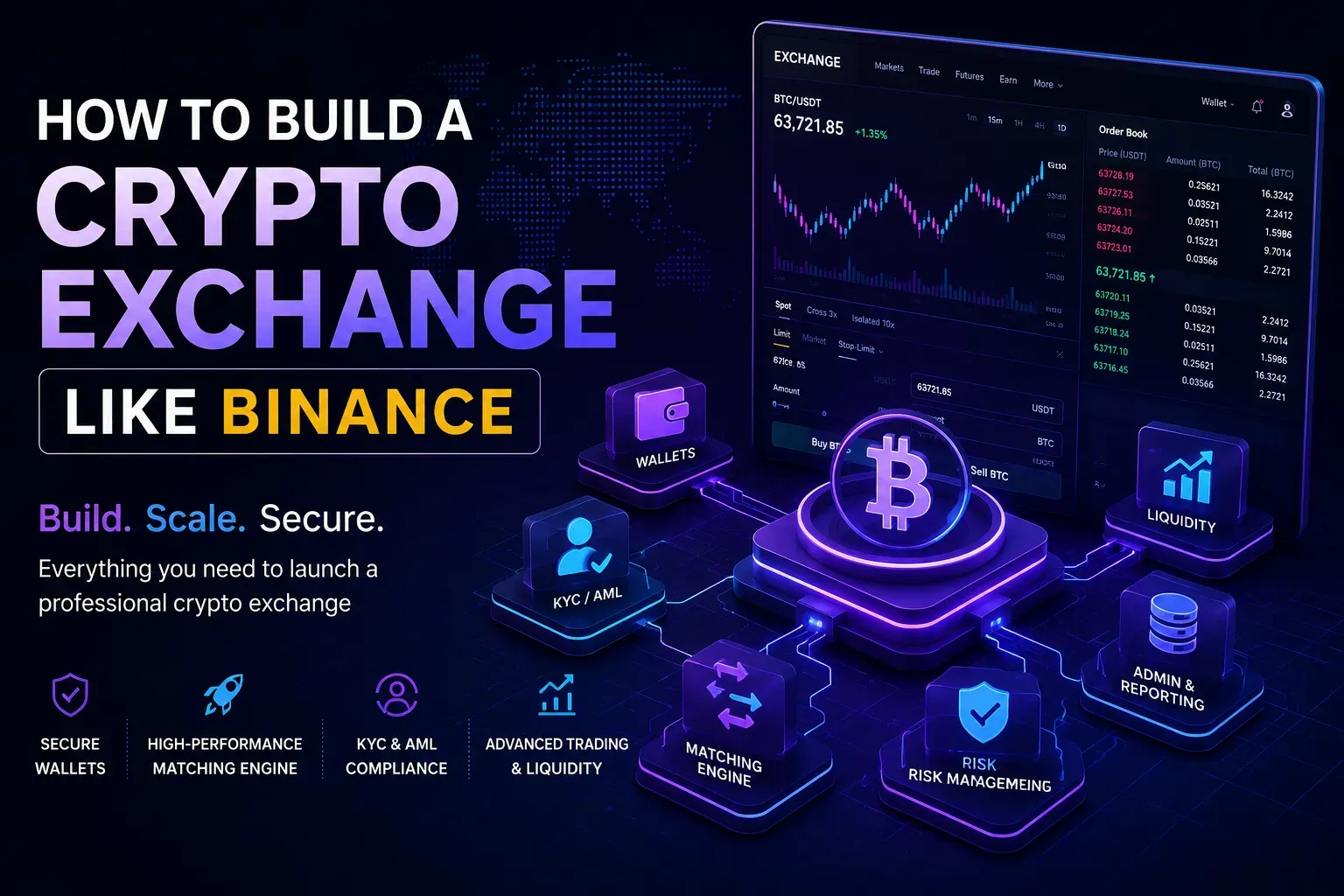
What Do You Need to Build a Binance-Like Exchange?
A professional centralized exchange usually requires:
1.User registration, authentication, KYC, KYB, and account security 2.An internal double-entry ledger and balance-management system 3.A high-performance matching engine and market-data service 4.Hot and cold crypto wallets with deposit and withdrawal processing 5.Liquidity-provider and market-making integrations 6.Spot trading, advanced orders, charts, and trading history 7.REST and WebSocket APIs for web, mobile, and algorithmic trading 8.Admin, reporting, compliance, finance, support, and risk-management tools 9.Fiat payment rails and regional payment integrations 10.Optional P2P, futures, options, staking, launchpad, and prop-trading modules
These components must work as one financial infrastructure. A visually impressive trading terminal is not useful if balances, order execution, wallet accounting, or withdrawals are unreliable.
1. Define the Business and Regulatory Model
Before development begins, define the markets the exchange will serve. The target countries affect licensing, supported fiat currencies, customer verification, payment providers, data storage, transaction monitoring, and restrictions on specific trading products. You should also decide whether the exchange will be custodial. A custodial centralized exchange controls users’ crypto deposits and withdrawals and therefore requires wallet security, treasury management, reconciliation, withdrawal approvals, and incident-response procedures. The business model should define customer segments, supported assets, trading fees, listing fees, withdrawal fees, market-making arrangements, and additional revenue products. Compliance cannot be added only after development. FATF guidance applies risk-based AML and counter-terrorist-financing expectations to virtual asset service providers. Its Travel Rule framework may also require covered businesses to obtain, retain, and securely transmit specified originator and beneficiary information. Legal requirements vary by jurisdiction, so local legal and compliance specialists should review the operating model before launch.
2. Design a Modular Exchange Architecture
A Binance-like exchange should not place authentication, trading, wallets, payments, notifications, and administration inside one tightly coupled application. A modular architecture separates major responsibilities into controlled services. The account system manages identity and access. The ledger records financial movements. The matching engine handles orders and executions. Wallet services monitor blockchain transactions. Market-data services distribute order books, trades, and price updates. This separation improves scalability and reduces the risk that a failure in one product affects the entire exchange. It also makes future expansion easier. P2P trading, derivatives, staking, token sales, and institutional services can be introduced as independent modules connected through defined APIs and events. Javizen follows this approach by providing a centralized exchange foundation with order matching, KYC, custodial wallets, fiat and crypto rails, and an admin panel, while allowing businesses to add P2P, futures, options, and prop-trading modules as their roadmap develops.
3. Build an Accurate Ledger
The internal ledger is one of the most important parts of the exchange. It determines how much each customer owns, what amount is available for trading, what is locked in open orders, what is pending withdrawal, and what has been charged as fees. Blockchain balances should not be treated as customer account balances. The exchange needs an independent accounting system that records every deposit, withdrawal, trade, fee, transfer, refund, liquidation, and administrative adjustment. A double-entry ledger creates matching debit and credit records for each financial event. This makes reconciliation and investigation easier and helps prevent balances from appearing or disappearing without an accounting trail. Financial operations should also be idempotent. If a network request is repeated because of a timeout, the same deposit, withdrawal, or trade should not be recorded twice.
4. Develop the Matching Engine
The matching engine receives orders and matches compatible buyers and sellers according to the exchange’s priority rules. It must process orders consistently during normal activity and sudden volume spikes. It should support essential order types such as market, limit, stop-limit, post-only, immediate-or-cancel, and fill-or-kill. The engine should communicate with the ledger before and after execution. Funds must be locked when an order is accepted, transferred when a trade occurs, and returned when the remaining order is cancelled. The matching system should also publish real-time updates for order books, recent trades, tickers, and user orders. Binance’s official developer documentation provides separate REST, WebSocket, and market-stream interfaces for spot trading. Its WebSocket streams distribute real-time trade and market information, illustrating the need to separate transactional APIs from continuous market-data delivery.
5. Implement Secure Crypto Wallets
A custodial exchange needs infrastructure for generating addresses, detecting deposits, calculating confirmations, processing withdrawals, and reconciling blockchain balances. Hot wallets provide the liquidity required for normal withdrawals, while most operational reserves can be kept in more restricted cold-storage environments. Withdrawal security should include address allowlisting, multi-factor confirmation, risk scoring, configurable limits, manual review, and multi-person approval for sensitive transactions. The wallet system must also handle network fees, blockchain reorganizations, unavailable networks, memo-based assets, failed transactions, and assets issued across several networks. Administrators need treasury dashboards that compare customer liabilities with wallet holdings and flag unexpected differences.
6. Connect Liquidity and Market-Making Services
New exchanges rarely have enough organic users to create deep order books from the first day. Liquidity can be provided through external exchanges, institutional liquidity providers, market makers, or a combination of sources. The integration may stream external market prices, place hedging orders, aggregate depth, and maintain controlled spreads on internal markets. However, customer orders and market-making activity should remain clearly separated and fully auditable. The operator needs controls for price precision, quantity precision, minimum order size, market limits, price bands, and emergency suspension. Liquidity is not only a technical integration. Commercial agreements, available capital, supported markets, latency, counterparty exposure, and settlement arrangements also affect execution quality.
7. Create the Trading Interface and APIs
The trading terminal should provide charts, an order book, recent trades, order-entry forms, balances, open orders, order history, and fee information. It must remain responsive during rapid market movement and clearly explain rejected orders. Users should understand whether an order failed because of an insufficient balance, invalid price, minimum quantity, risk limit, or unavailable market. A professional exchange should also provide secure APIs for institutional and algorithmic traders. API keys need configurable permissions, IP restrictions, request signing, rate limits, and the ability to disable withdrawals. WebSocket connections should deliver market and private account updates without requiring clients to repeatedly request the same information. Mobile applications should consume the same documented backend APIs rather than implementing independent trading logic.
8. Add KYC, Security, and Risk Controls
Customer security should include multi-factor authentication, device management, session monitoring, anti-phishing codes, login alerts, withdrawal confirmations, and temporary restrictions after sensitive account changes. Administrative access requires role-based permissions, least-privilege policies, approval workflows, and immutable audit logs. Compliance teams need configurable verification levels, sanctions screening, transaction monitoring, customer risk scores, account restrictions, and case-management tools. The exchange should also monitor credential stuffing, API abuse, unusual withdrawals, rapid account changes, price manipulation, wash trading, and suspicious links between accounts. Sensitive services should be protected through network segmentation, encryption, secret management, rate limiting, backups, disaster recovery, and continuous security monitoring.
9. Build the Admin and Operations Platform
A large exchange cannot be managed through direct database access. The admin platform should allow authorized teams to manage users, KYC reviews, wallets, deposits, withdrawals, markets, fees, orders, support requests, payment methods, liquidity settings, and platform configuration. Finance teams need ledger exports, fee reports, treasury reports, and reconciliation tools. Support teams need customer timelines without receiving permission to change balances. Compliance teams need investigation workflows, while senior employees may approve large withdrawals or emergency actions. Every sensitive action should record the employee, timestamp, previous value, new value, reason, and approval status.
10. Add Advanced Products in Phases
After the spot exchange is stable, the platform can expand into additional products.
A practical rollout may follow three phases:
- Foundation: accounts, KYC, ledger, wallets, spot matching, liquidity, deposits, withdrawals, admin tools, and security monitoring
- Growth: mobile apps, public APIs, referral programs, P2P trading, staking, OTC services, token listings, and launchpads
- Advanced trading: futures, margin, options, copy trading, portfolio margin, subaccounts, institutional APIs, and prop trading
Derivatives should not be added before the operator has strong risk-management capabilities. Futures require margin calculations, mark prices, funding, liquidation logic, insurance mechanisms, exposure limits, and emergency controls. Javizen’s futures infrastructure, for example, includes USDT-margined perpetual contracts, cross and isolated margin, one-way and hedge modes, funding, liquidation, an insurance fund, and market-level emergency guardrails.
White-Label Exchange or Custom Development?
A fully custom exchange offers maximum control but requires a large engineering team, extensive testing, security expertise, and a longer development cycle. A white-label platform provides an existing exchange foundation that can be branded and customized. This approach can reduce development risk and allow the operator to focus more resources on licensing, banking, liquidity, marketing, and customer acquisition. The right approach depends on the required differentiation. Businesses with highly unusual trading models may need custom development. Companies launching a standard centralized exchange can often begin with a modular white-label product and customize integrations, workflows, branding, assets, markets, and revenue features. Javizen provides both customizable ready-made exchange infrastructure and end-to-end custom development, including planning, setup, deployment, and go-live support.
Final Thoughts
Building a crypto exchange like Binance is not a single software-development project. It is the creation of a financial, trading, custody, security, compliance, and operational ecosystem. The correct starting point is not futures, staking, or hundreds of trading pairs. It is an accurate ledger, reliable matching engine, secure wallets, sufficient liquidity, effective KYC, strong administrative controls, and a scalable architecture. Once this foundation is stable, the exchange can expand into P2P, derivatives, token launches, institutional trading, and other products based on customer demand and regulatory capacity. Javizen provides production-ready and customizable crypto exchange infrastructure for businesses that want to launch a branded CEX and expand it through modular trading and blockchain products.
Frequently asked questions
Can I legally build an exchange like Binance?
You can build a platform with similar categories of functionality, but you should not copy Binance’s trademarks, protected interface assets, source code, or proprietary materials. You must also comply with the laws and licensing requirements of every jurisdiction you serve.
How long does it take to build a Binance-like exchange?
The development period depends on whether you use a white-label foundation or build from scratch. It is also affected by licensing, wallet integrations, liquidity, payment providers, supported networks, mobile applications, and advanced trading modules.
What is the most important component of a crypto exchange?
The ledger is the financial source of truth, while the matching engine handles order execution. Both must integrate correctly with wallet, fee, risk, and reporting systems.
Does a new exchange need liquidity?
Yes. Without sufficient liquidity, users may experience empty order books, wide spreads, delayed execution, and high slippage.
Can a white-label exchange scale like Binance?
A well-designed modular white-label platform can scale significantly, but infrastructure capacity is only one requirement. Liquidity, security operations, compliance, banking relationships, customer support, and business execution also determine growth.
Which product should be launched first?
Most businesses should begin with secure spot trading, deposits, withdrawals, KYC, liquidity, and administration. P2P, futures, options, staking, and other modules can be introduced after the core platform is stable.
Latest Post
 06 Sep, 2026
How to Build a Crypto Options Trading Platform
 05 Sep, 2026
How to Launch a Crypto Prop Trading Platform
 03 Sep, 2026
How to Scale a Crypto Exchange for High Trading Volume
 02 Sep, 2026
How to Design a Crypto Exchange Fee Structure
 01 Sep, 2026
Market Makers vs Liquidity Providers: What Is the Difference?
Build with Javizen.
Planning an exchange, token or blockchain product? Talk to our team and turn the ideas in this article into a launch-ready platform.