
Matching Engine in Crypto Exchanges Explained
Quick Answer: What Is a Crypto Exchange Matching Engine?
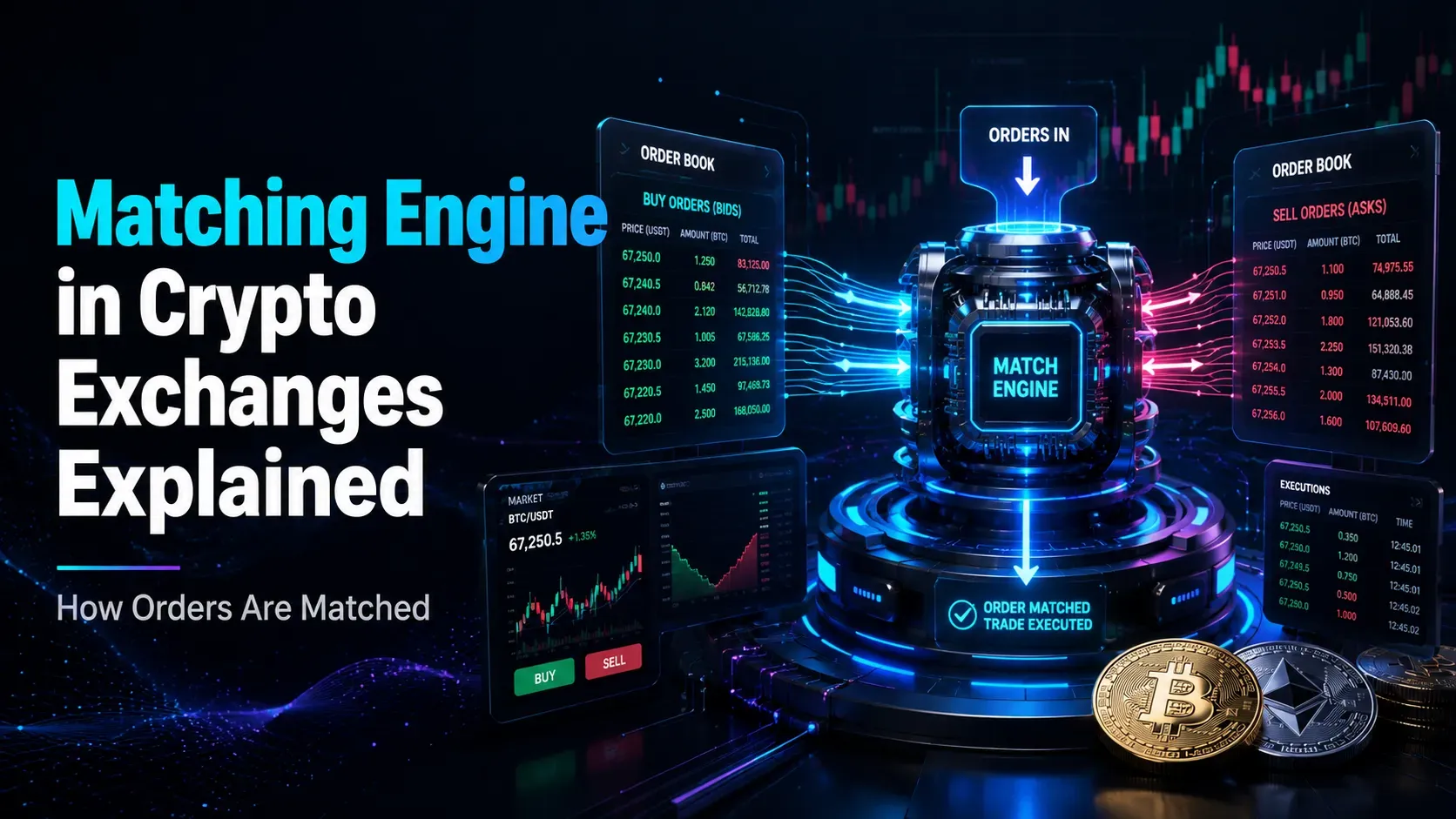
A crypto exchange matching engine is the software responsible for pairing compatible buy and sell orders. When a new order reaches the exchange, the engine compares it with existing orders on the opposite side of the order book. If the prices are compatible, a trade is executed. If no suitable match exists, the order may remain in the order book until another trader matches it, the user cancels it, or it expires. Most spot exchanges use price-time priority. This means the best-priced order is executed first, and when multiple orders have the same price, the oldest order receives priority.
Why Is the Matching Engine Important?
The matching engine is the operational core of a centralized cryptocurrency exchange. If it is slow or unreliable, traders may experience delayed executions, incorrect fills, duplicate trades, excessive slippage, inconsistent balances, or inaccurate market data. A professional matching engine must do more than process orders quickly. It should also produce predictable results, maintain fair order priority, prevent race conditions, support recovery after failure, and create a complete audit trail. During periods of high volatility, these requirements become even more important because thousands of traders may place, cancel, or modify orders at the same time
Main Components of an Exchange Trading System
The matching engine is part of a larger trading architecture. The order gateway receives requests from websites, mobile applications, trading bots, and APIs. Before sending an order to the matching engine, it usually checks the user’s permissions, available balance, price precision, quantity limits, market status, and API restrictions. The order book stores active buy and sell orders. Buy orders are called bids, while sell orders are called asks. The highest available buy price is the best bid, and the lowest available sell price is the best ask. The matching engine compares incoming orders with the order book and decides which orders should trade, at what price, and in what quantity. After a match occurs, the ledger system updates buyer and seller balances, locked funds, trading fees, order status, and trade history. At the same time, the market-data service publishes updated prices, recent trades, order-book depth, volume, and chart information.
How Does a Matching Engine Work?
Consider a simplified BTC/USDT order book with the following sell orders:
| Price | Price |
|---|---|
| $60,000 | 0.5 BTC |
| $60,050 | 1 BTC |
| $60,100 | 2 BTC |
A trader submits a market order to buy 1 BTC. The engine first purchases 0.5 BTC at the best available price of $60,000. It then purchases the remaining 0.5 BTC at $60,050. The order is completed through two separate trades, and the average execution price becomes $60,025. This example shows why large market orders can experience slippage. If there is not enough liquidity at the best price, the order continues into the next available price levels.
Price-Time Priority Explained
Price-time priority is one of the most common matching methods used by electronic exchanges. The engine first selects the order with the most competitive price. If several orders have the same price, the order submitted first is executed first.
Suppose three traders submit sell orders:
| Trader | Price | Quantity | Time |
|---|---|---|---|
| A | $60,100 | 1 BTC | 10:00:01 |
| B | $60,000 | 1 BTC | 10:00:03 |
| C | $60,000 | 2 BTC | 10:00:05 |
Trader B receives priority over Trader A because B offers a lower selling price. Trader B also receives priority over Trader C because B submitted the order earlier at the same price. This model is popular because it is simple, transparent, and generally considered fair.
Other Matching Algorithms
Although price-time priority is common in crypto spot exchanges, other algorithms may be used in certain markets. A pro-rata model divides an incoming order among several resting orders based on their relative sizes. For example, a trader representing 70% of the available quantity at one price may receive approximately 70% of the incoming order. An auction model collects orders during a defined period and executes them at a single clearing price. Auctions may be used during token listings, market openings, volatility interruptions, or special liquidity events. Some exchanges also use hybrid systems that combine time priority, price priority, proportional allocation, and market-maker rules. Whatever model is selected should be documented clearly and applied consistently.
How Different Order Types Are Matched
A market order is executed immediately against the best available prices. It prioritizes speed but does not guarantee the final execution price. A limit order defines the highest price a buyer is willing to pay or the lowest price a seller is willing to accept. If it cannot be filled immediately, it usually remains in the order book. A stop order becomes active after a predefined trigger price is reached. Once activated, it may be sent to the matching engine as a market or limit order. An immediate-or-cancel order executes as much as possible immediately and cancels the remaining quantity. A fill-or-kill order must be completely executed at once. Otherwise, the entire order is cancelled. A post-only order is designed to enter the order book as a maker order. If it would execute immediately, the exchange rejects or adjusts it according to its trading rules.
Maker and Taker Orders
A maker order adds liquidity to the order book. It usually waits for another order to match with it. A taker order removes liquidity by immediately matching against an existing order. For example, a limit buy order placed below the current market price may become a maker order. A market buy order that immediately consumes existing sell orders is a taker order. Many exchanges charge different maker and taker fees to encourage users and market makers to add liquidity.
Partial Fills
A large order may not be completed by one counterparty. For example, a 5 BTC buy order may match with several smaller sell orders at different prices. Each execution becomes a separate fill. The exchange must calculate every fill accurately, including price, quantity, fee, remaining order size, and final average execution price. The accounting system must also ensure that balances are updated only once for each confirmed trade.
Self-Trade Prevention
Self-trading occurs when two orders belonging to the same user or organization match against each other. This may happen accidentally when a trader uses several bots, or intentionally when someone tries to create artificial volume. A matching engine can prevent self-trading by cancelling the incoming order, cancelling the resting order, cancelling both orders, or reducing the matched quantity. This control helps protect market integrity and reduces the risk of wash trading.
Latency and Throughput
Matching-engine performance is commonly measured using latency and throughput. Latency is the time required to process an individual order. Throughput is the number of orders or messages the system can process during a specific period. Another important metric is tail latency, which measures the slowest processing times during periods of heavy traffic. A production engine should remain stable during sudden order bursts, mass cancellations, high API traffic, large order books, and rapid market movements. Low average latency is not enough if execution becomes unpredictable whenever the market becomes volatile.
Determinism and Recovery
A matching engine should be deterministic. This means that the same ordered sequence of commands should always produce the same result. Deterministic processing makes it easier to replicate the engine, recover from failure, audit past events, investigate incidents, and reconstruct the order book. Many matching engines process orders for each market sequentially to prevent conflicting updates and race conditions. The platform should also maintain an event journal or transaction log so that active orders and order-book state can be restored after a restart.
Matching Engine Security
Because the matching engine controls trade execution, it must be protected from both software errors and deliberate abuse. The engine should validate all incoming orders, verify balances before accepting trades, prevent duplicate requests, generate unique order identifiers, enforce rate limits, and maintain immutable audit logs. Administrative access should be tightly restricted. No operator should be able to secretly modify execution priority, alter completed trades, or manipulate the order book without creating a traceable record. The exchange should also monitor suspicious activity such as wash trading, spoofing, repeated order placement and cancellation, or unusual market-maker behavior.
Matching Engine vs. Liquidity
A matching engine does not create liquidity. It can organize and execute orders efficiently, but the market still needs active buyers and sellers. Liquidity may come from retail traders, professional market makers, institutional users, external liquidity providers, connected exchanges, or internal market-making systems. A powerful engine cannot compensate for an empty order book. Exchange operators need both reliable matching technology and a realistic liquidity strategy.
What Should Exchange Operators Evaluate?
Before choosing or developing a matching engine, operators should evaluate its supported order types, matching rules, latency, throughput, recovery process, market-data performance, precision handling, fee calculation, self-trade prevention, scalability, and ledger integration. They should also verify how the engine behaves during traffic spikes, server failures, liquidity-provider disconnections, and extreme price movements. Performance claims should be reviewed carefully. Statements such as “one million transactions per second” may refer to messages, orders, or internal events rather than completed trades. The test environment, hardware, number of markets, and order-book size should always be considered.
Matching Engine Infrastructure with Javizen
Javizen provides customizable crypto exchange infrastructure for companies that want to launch and operate their own trading platforms. The Javizen CEX platform includes a professional matching engine, order-book management, trading APIs, internal accounting, wallet integration, liquidity connectivity, and a complete administration system. Its modular architecture can also support P2P trading, futures, options, prop trading, and token-launch modules. The matching engine can be configured according to the operator’s supported markets, expected traffic, fee model, liquidity strategy, and business requirements.
Conclusion
The matching engine is the operational heart of a cryptocurrency exchange. It determines how orders are prioritized, how trades are executed, how partial fills are handled, and how accurately the order book reflects market activity. Exchange operators should not select an engine based only on speed. Fairness, reliability, deterministic processing, security, recovery, scalability, and integration with the ledger are equally important. A professional user interface may attract traders, but a reliable matching engine is what allows the market behind that interface to function correctly.
Frequently asked questions
What does a crypto exchange matching engine do?
It receives orders, compares them with the order book, applies priority rules, executes compatible orders, and generates trade records.
Is the matching engine the same as the order book?
No. The order book stores active buy and sell orders. The matching engine applies trading rules and determines when those orders should execute.
What is price-time priority?
It means the best-priced order receives priority. If several orders have the same price, the earliest order is executed first.
Can a matching engine create liquidity?
No. It only manages and executes available orders. Liquidity must come from traders, market makers, or external providers.
What happens when a market order is larger than available liquidity?
Lower and more stable latency improves execution speed, reduces uncertainty, and helps the exchange remain reliable during high market activity.
Latest Post
 06 Sep, 2026
How to Build a Crypto Options Trading Platform
 05 Sep, 2026
How to Launch a Crypto Prop Trading Platform
 03 Sep, 2026
How to Scale a Crypto Exchange for High Trading Volume
 02 Sep, 2026
How to Design a Crypto Exchange Fee Structure
 01 Sep, 2026
Market Makers vs Liquidity Providers: What Is the Difference?
Build with Javizen.
Planning an exchange, token or blockchain product? Talk to our team and turn the ideas in this article into a launch-ready platform.